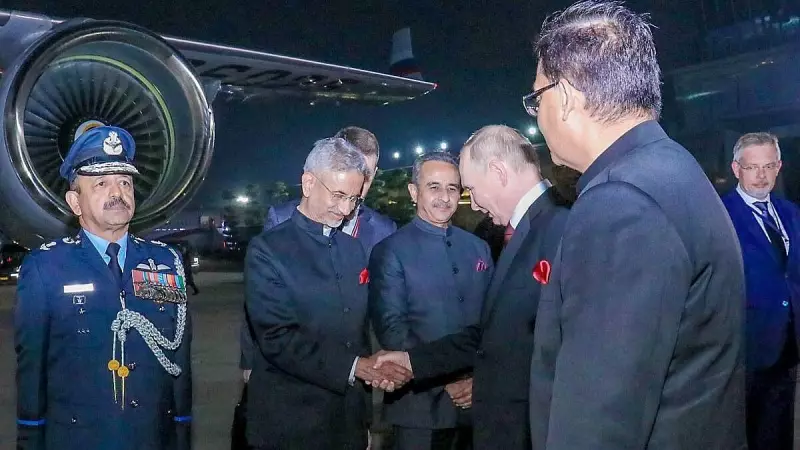
External Affairs Minister S Jaishankar has robustly defended the depth and stability of India's strategic partnership with Russia, describing it as one of the "steadiest" relationships in the world. His comments came during an interactive session, where he also addressed potential diplomatic complexities arising from Russian President Vladimir Putin's visit to India.
Jaishankar's Firm Stance on a Time-Tested Partnership
In a clear articulation of India's foreign policy stance, Jaishankar emphasized the enduring nature of the bond between New Delhi and Moscow. He highlighted that this relationship has weathered significant global geopolitical shifts over decades, maintaining a consistent trajectory of cooperation and mutual respect. The minister's statement, made on December 6, 2025, serves as a reaffirmation of India's commitment to a multi-aligned foreign policy that prioritizes national interest.
S Jaishankar pointed out that the fundamentals of the India-Russia partnership are solid and based on long-standing trust. This includes critical areas of collaboration such as defense, energy security, and space. His characterization of the ties as "steadiest" is a direct counter to narratives that question the partnership's relevance in the contemporary world order.

Dismissing Concerns Over US-India Trade Negotiations
A significant part of the interaction focused on addressing concerns that President Vladimir Putin's visit to India could create complications for New Delhi's ongoing negotiations with the United States on a bilateral trade agreement. Jaishankar firmly disagreed with such views, presenting a nuanced understanding of modern diplomacy.
He argued that mature nations like India are capable of managing multiple relationships independently. Engaging robustly with one global power does not come at the expense of another. Jaishankar's remarks underscore India's confidence in navigating complex international equations, where it engages with the US, Russia, and other nations based on specific shared interests.
Implications for India's Strategic Autonomy
The minister's comments have several key implications. Firstly, they reinforce the principle of strategic autonomy, a cornerstone of India's foreign policy. Secondly, they signal to both international partners and domestic audiences that India will not allow its engagements with one country to be dictated by its relations with another.
This balanced approach is crucial for India's energy imports, defense modernization, and its stance on global issues. By maintaining steady ties with Russia while pursuing deeper trade cooperation with the US, India aims to secure its economic and security needs from multiple sources, thereby reducing over-dependence on any single nation.
In conclusion, Jaishankar's assertive defense of the India-Russia relationship clarifies New Delhi's diplomatic priorities. It demonstrates a foreign policy that is both pragmatic and principled, seeking to maximize national advantage through diverse partnerships. The message is clear: India's foreign policy decisions are sovereign and made with a clear-eyed assessment of its long-term interests.