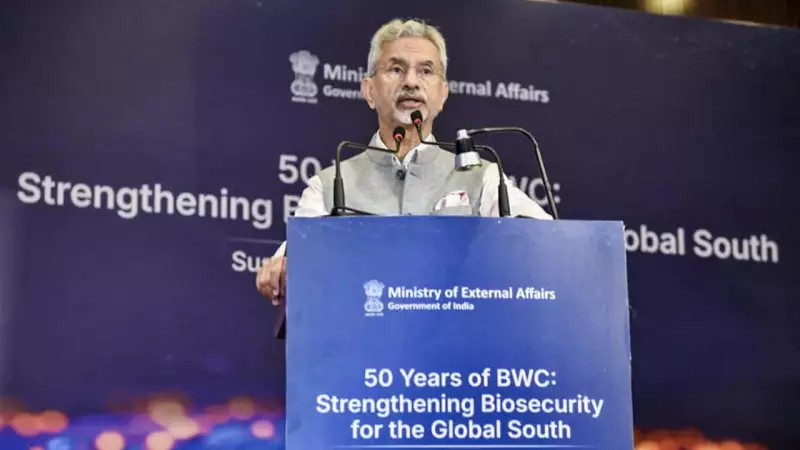
India's External Affairs Minister, Dr. S. Jaishankar, has issued a stark warning about the growing threat of biological weapons being misused by non-state actors, stating it is no longer a distant possibility. Speaking at a conference marking 50 years of the Biological Weapons Convention (BWC) in New Delhi, he called for urgent international cooperation to combat this emerging challenge.
Gaps in the Biological Weapons Convention
Jaishankar reaffirmed India's strong commitment to the full and effective implementation of the BWC and highlighted the country's well-established record on non-proliferation. However, he pointed out critical structural deficiencies in the decades-old convention that hinder global preparedness.
"Bioterrorism is a serious concern that the international community has to be adequately prepared for. Yet the BWC still lacks basic institutional structures," the Minister stated. He elaborated that the convention currently has no robust compliance system, no permanent technical body, and no formal mechanism to track rapid scientific and technological developments.

"These gaps must be bridged in order to strengthen confidence," Jaishankar emphasized, urging for a systematic review of scientific progress to ensure governance keeps pace with innovation.
India's Proposals for a Stronger Global Framework
Outlining India's proactive stance, Jaishankar detailed several key proposals. He stated that India has consistently advocated for stronger compliance measures within the BWC, including a modern verification mechanism suited for today's world.
The Minister highlighted India's proposal for a National Implementation Framework. This comprehensive plan covers crucial areas such as:
- Identification of high-risk biological agents.
- Oversight of dual-use research of concern.
- Domestic reporting and incident management protocols.
- Continuous training and capacity building.
Furthermore, Jaishankar underscored India's support for international cooperation that enables the exchange of materials and equipment for peaceful purposes. He also noted India's contribution to global non-proliferation architecture through initiatives like the annual Disarmament and International Security Affairs Fellowship and the Capacity Building Programme under ITEC focused on UNSC Resolution 1540 and Strategic Trade Controls.
The Path Forward: International Collaboration
Jaishankar's address served as a clarion call for the international community to reflect on the new challenges posed by advancements in science and technology. The rapid pace of innovation in fields like biotechnology necessitates a equally agile and strengthened international treaty.
The conference provided a platform to discuss how to modernize the BWC to effectively address contemporary threats. India's leadership role, backed by its consistent non-proliferation record and concrete proposals, positions it as a key voice in shaping the future of global biosecurity governance. The call for action is clear: to safeguard global health security, the world must unite to fortify the Biological Weapons Convention against the evolving threat of bioterrorism.