

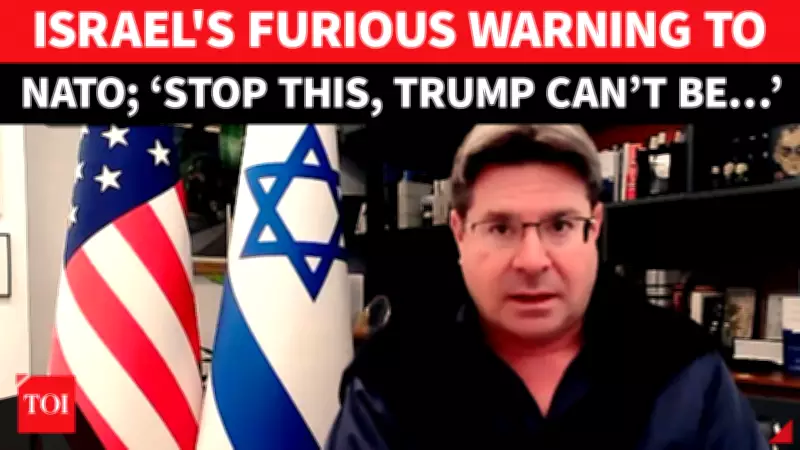
Israeli Diplomat Defends Trump's Iran Strikes, Criticizes NATO Allies
Israel's Consul General Ofir Akunis has delivered a robust defense of former U.S. President Donald Trump's decision to authorize military strikes against Iran, while launching a scathing critique of NATO allies for what he termed a policy of appeasement. In a recent and intense interview, Akunis emphatically rejected assertions that Israeli Prime Minister Benjamin Netanyahu pressured Washington into conflict, stating the move was a sovereign American choice.
Akunis Rejects Claims of Israeli Pressure on U.S.
Ofir Akunis clarified that the strikes were driven solely by U.S. concerns regarding Iran's advancing nuclear program and its ballistic missile capabilities. He stressed that the decision-making process was internal to the United States, aimed at countering what he described as a significant regional threat. This statement directly counters narratives suggesting external influence from Israel in prompting American military action.
Sharp Criticism of NATO's Stance on Iran
In his remarks, Akunis did not hold back in criticizing European NATO members for their perceived failure to support Israel and the United States in confronting Iran. He drew a stark historical parallel, comparing the current European position to the appeasement policies toward Adolf Hitler in the 1930s, warning that such neutrality only emboldens adversarial regimes. Citing former U.S. President George W. Bush, he argued that inaction enables Iran's aggressive pursuits, potentially escalating tensions further.

Potential for Lebanon in Abraham Accords Without Hezbollah
Beyond the immediate conflict, Akunis touched upon diplomatic possibilities, suggesting that Lebanon could potentially join the Abraham Accords—a series of normalization agreements between Israel and Arab nations—provided it distances itself from the militant group Hezbollah. This indicates a strategic vision for regional stability that extends beyond military engagements to include diplomatic normalization, contingent on the exclusion of Iran-backed factions.
The interview underscores ongoing geopolitical tensions in the Middle East, highlighting divisions between Western allies and the complex dynamics involving Iran, Israel, and the United States. Akunis's comments reflect Israel's firm stance on security threats and its advocacy for stronger international cooperation against what it views as Iranian aggression.






