INSV Kaundinya's Voyage: A Milestone in Indo-Oman Maritime Relations
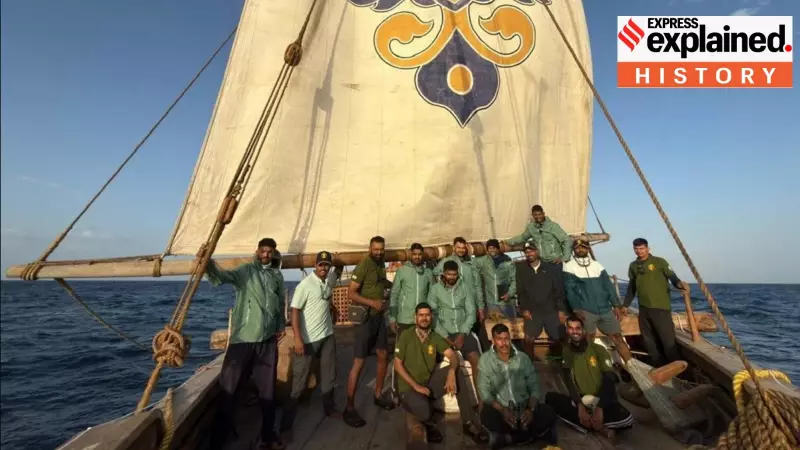
The commissioning and maiden voyage of the stitched sailing vessel INSV Kaundinya from Porbandar to Muscat, completed on January 14 after an 18-day journey, marks a significant moment in the deepening maritime and strategic partnership between India and Oman. As the two nations celebrate seventy years of diplomatic relations, this voyage symbolizes a partnership that extends far beyond modern statehood, rooted in millennia of shared history across the Indian Ocean.
Reviving Ancient Shipbuilding Traditions
At its core, the voyage of INSV Kaundinya revives India's ancient shipbuilding prowess and maritime imagination. The construction of this vessel is a tribute to indigenous knowledge systems that once dominated Indian Ocean trade. A dedicated team of naval architects, archaeologists, master craftsmen, and shipwrights spent nearly two years meticulously recreating the ancient technique of stitching planks together without nails or metal fastenings. Such vessels, known for their flexibility and sturdiness, were capable of withstanding the turbulent open seas.
India's shipbuilding expertise was so renowned that the Tamil word 'Kattumaran' entered the English lexicon as 'catamaran'. The naming of the ship after the legendary Indian sailor Kaundinya, believed to have founded the first kingdom in ancient Cambodia, further underscores the rich tapestry of India's maritime history and its enduring connections across the region.

Celebrating Deep-Rooted Maritime and Civilisational Ties
The voyage also celebrates the profound maritime, cultural, and civilisational ties between India and Oman, which stretch back over five millennia. As India and Oman mark seven decades of diplomatic relations, Kaundinya's arrival in Muscat serves as a powerful reminder of a partnership that predates the modern nation-state. The Indian Ocean has long served as a vital corridor for commerce, culture, and the exchange of ideas, fostering a unique bond between these two nations.
Shared Maritime Heritage and Strategic Cooperation
India-Oman relations are firmly anchored in a shared maritime heritage. During Prime Minister Narendra Modi's visit to Oman in December, the two sides signed a Memorandum of Understanding on Maritime Heritage and Museums, formally acknowledging that their relationship is not merely strategic or transactional but civilisational in character. Historically known as Magan, Oman has been a key node in Indian Ocean exchange networks since at least the third millennium BCE, specializing in shipbuilding, maritime commerce, and the trade of copper, frankincense, timber, and pearls.
From the time of the Indus Valley civilisation, the exchange networks established between India and Oman have not only been sustained but have adapted to changing international environments over the centuries. This adaptability has proven advantageous for both peoples. India has been a major supplier of cotton and luxury goods, while Omani seafarers were among the earliest to recognize India's potential. In turn, India benefited from maritime networks with the Magan region, a primary source of copper essential for its metallurgical industry.
Oman's strategic location at the junction of international shipping lanes played a crucial role in connecting India with distant regions, including the Roman world. Arab-Omani sailors acted as intermediaries during the peak of trade with the Roman world in the early first millennium. This seafaring tradition produced skilled navigators like Ahmad bin Majid, the fifteenth-century scholar known as the 'Lion of the Sea', whose treatise Al-Nuniah al-Kubra remains a classic in navigation and cartography.
People-to-People Connections and Cultural Exchange
Maritime commerce fostered dense people-to-people connections between India and Oman. Omani merchants were present in ancient Indian ports such as Arikamedu, Muziris, Sopara, and Nelcynda. By the early Islamic period, sizeable Omani communities had settled along the Malabar coast. Arab historian Al-Masudi recorded in the tenth century that nearly ten thousand Arab Muslims, including many from Oman, resided on India's western coast.

Conversely, merchant communities from India's western coast, such as the Gujarati Jains and Bohras, were welcomed in Oman. Their descendants today form a valued segment of Omani society, serving as living testimony to centuries of mobility across the Arabian Sea. In 1870, Gujarati merchant Ramdas Thakersay arrived in Muscat from Mandvi, leveraging trading linkages and strong people-to-people ties to build the Khimji Ramdas Group, one of Oman's most powerful business conglomerates. Kanaksi Khimji, who carried this legacy forward, was bestowed the honorary title of 'Sheikh' by Sultan Qaboos, making him the only Hindu 'Sheikh' in the world.
The cultural imprint of these linkages is abundant, with folklore like the tales of Sinbad in the Arabian Nights revealing a deep familiarity with India in the regional imagination. The flow of traded goods—such as horses, dates, spices, textiles, sandalwood, indigo, tea, and rice—has been accompanied by a rich exchange of culture. Pilgrimage for Hajj has also ensured constant movement of people and ideas, further strengthening these bonds.
Strategic Dimension and Maritime Security
The Indian Ocean has historically been a zone of interaction rather than conquest, until the arrival of European maritime empires. In the early sixteenth century, the Portuguese attempted to impose a violent monopoly over Indian Ocean trade by capturing ports and fortifying chokepoints like Hormuz, Goa, Diu, and Muscat. In resisting this dominance, Indian and Omani rulers forged one of the earliest examples of regional maritime cooperation.
Under the Ya'aruba dynasty, Oman emerged as a leading force challenging European supremacy. In 1650, Imam Sultan bin Saif expelled the Portuguese from Muscat, inaugurating Oman's rise as a naval power. Gujarati merchants, Arab sailors, and Indian shipbuilders played a crucial role in sustaining Omani fleets. Teak from western India and shipbuilding expertise from Surat underpinned Omani naval expansion, laying the foundations of a strategic partnership rooted in maritime security.
It is therefore unsurprising that Oman became one of the first Gulf Cooperation Council (GCC) countries with which India developed sustained defence cooperation. Geography has ensured that strategic interdependence remains an inbuilt feature of the relationship, with both nations recognizing the importance of maritime security in the region.
Partners in a Changing Maritime Order
Today, the Indian Ocean has re-emerged as a theatre of intense geopolitical competition. China's growing naval presence, expanding partnerships among extra-regional powers, and the vulnerability of energy and trade routes have heightened the strategic value of reliable regional partners. For India, whose trade and energy lifelines traverse these waters, Oman's location near the Strait of Hormuz makes it an indispensable ally.
Prime Minister Modi's visits to Oman in 2018 and 2025 reflect this convergence of interests. India's access to the Duqm port has expanded its operational reach, while recent agreements—including a Joint Vision Document on Maritime Cooperation and a Comprehensive Economic Partnership Agreement—signal a relationship geared towards both security and prosperity.
In this context, the voyage of INSV Kaundinya acquires a significance that goes beyond mere symbolism. It links past and present, heritage and strategy, reminding both countries that their partnership is anchored not only in contemporary geopolitics but in a shared maritime civilisation that has endured for millennia. This journey serves as a testament to the enduring bonds between India and Oman, highlighting a future built on a rich historical foundation.