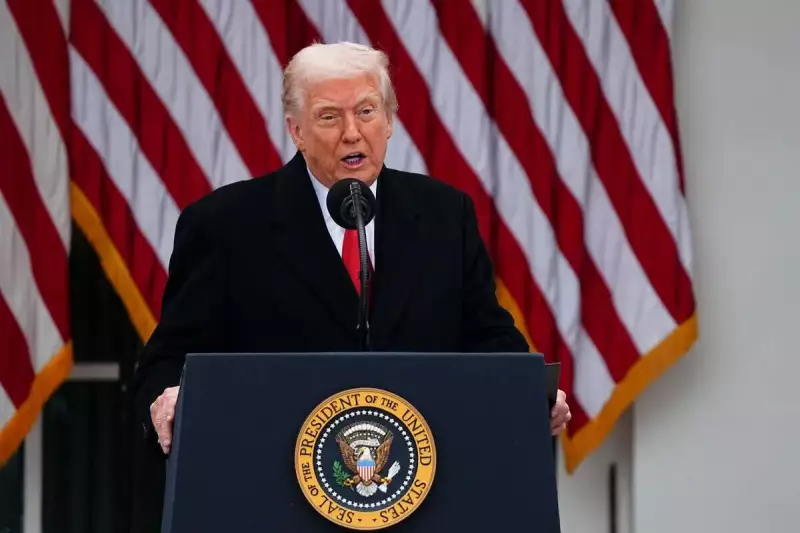
Former President Donald Trump's administration has unveiled its National Security Strategy for 2025, a comprehensive 29-page document that maps out America's foreign policy priorities. The strategy outlines a vision where the United States seeks to reshape global engagements, and India emerges as a significant partner in several critical areas.
India's Four Strategic Mentions in the Blueprint
The document references India on four distinct occasions, highlighting its growing importance in Washington's strategic calculus. The first mention credits Trump with negotiating peace between India and Pakistan, among other nations, though it does not provide specific details on these claimed negotiations.
The second and perhaps most substantial reference comes in the context of the Indo-Pacific. The strategy asserts that the US must "continue to improve commercial (and other) relations with India to encourage New Delhi to contribute to Indo-Pacific security." This contribution is explicitly tied to "continued quadrilateral cooperation with Australia, Japan, and the United States ('the Quad')." This underscores the administration's intent to solidify the Quad as a central pillar of its regional security architecture.

AI Alliances and Global Resource Security
A third mention of India appears in a section discussing technological diplomacy. The document cites President Trump’s state visits to Persian Gulf countries in May 2025 as a model, where he reportedly won support for American AI technology. It then proposes that America should "similarly enlist our European and Asian allies and partners, including India," to strengthen joint positions in the Western Hemisphere and, concerning critical minerals, in Africa. This points to a strategy of building tech and resource coalitions that include New Delhi as a key node.
The fourth reference involves the contentious South China Sea. The strategy calls for developing strong measures to keep sea lanes open and free from unilateral closure. It states this will require "strong cooperation with every nation that stands to suffer, from India to Japan and beyond." This explicitly links India's security interests to freedom of navigation in the distant South China Sea, framing it as a shared concern.
A Firm Stance on Borders and Migration
Beyond the specifics related to India, a major pillar of the 2025 strategy is a stark position on migration. The document declares that "the era of mass migration must end," labeling border security as the primary element of national security. It argues that mass migration strains resources, increases crime, and undermines social cohesion. The strategy commits to protecting the country from what it terms "invasion," encompassing not just migration but also cross-border threats like terrorism, drug trafficking, and espionage.
The release of this document provides a clear, albeit controversial, roadmap for a potential future Trump administration's foreign policy. For India, the repeated mentions signal a continued and possibly deepened strategic partnership, focused on security in the Indo-Pacific, technological collaboration, and addressing shared challenges in global commons like the South China Sea. The emphasis on the Quad suggests this forum will remain a priority for Washington in managing relations with Asia.