

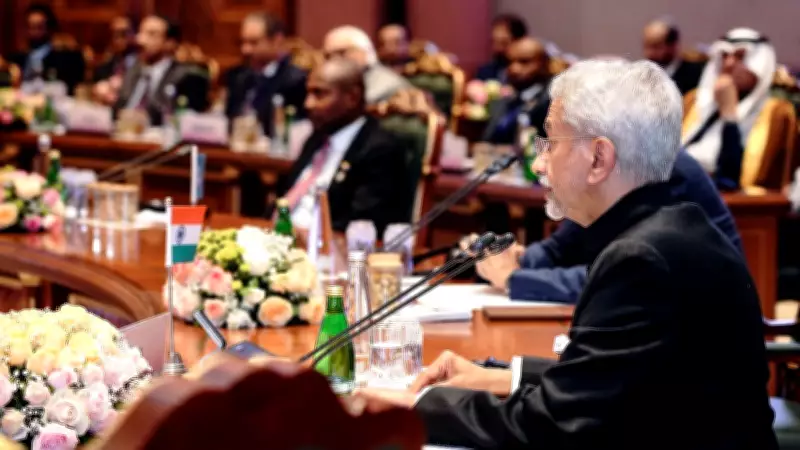
In a significant diplomatic move, India and the Arab League have jointly expressed their dedication to fostering a just, comprehensive, and lasting peace in the Middle East. This commitment was outlined in a rare joint statement that notably refrained from explicitly criticizing Israel, signaling a strategic approach by both parties.
Strategic Silence on Israel
The omission of Israel's name in the statement is viewed as an indication of strategic maturity from the Arab countries and India. This comes at a critical time when the second phase of a ceasefire deal is actively being negotiated. Arab nations have maintained a cautious stance in their public remarks about Israel as the conflict in Gaza continues to unfold.
Key Points from the Joint Statement
The statement, released after the India-Arab League Foreign Ministers' Meeting in New Delhi, co-chaired by External Affairs Minister S Jaishankar, emphasized several crucial aspects:

- Support for a sovereign, independent, and viable State of Palestine based on the 1967 borders, coexisting peacefully with Israel.
- Recognition of the inalienable rights of the Palestinian people.
- Commitment to achieving peace through international law, relevant UN resolutions, and the Arab Peace Initiative.
Condemnation of Terrorism
Without directly naming Pakistan, the Arab States' foreign ministers strongly condemned the heinous terrorist attack in Pahalgam that targeted innocent Indian tourists. They reaffirmed their unwavering support in combating terrorism in all its forms, which Delhi considers a major diplomatic achievement.
Counter-Terrorism Initiatives
The joint statement highlighted:
- Mutual support in fighting terrorism and transnational crime.
- Appreciation for counter-terrorism efforts by various Arab States.
- A principle of zero tolerance towards terrorism, described as a serious threat to international peace.
- Condemnation of cross-border terrorism and a call for states to refrain from using terrorism against others.
Support for Ceasefire and Humanitarian Efforts
The statement welcomed the outcomes of the 2025 Sharm El-Sheikh Peace Summit, which led to a ceasefire agreement in Gaza. It commended the roles played by Arab States, particularly Egypt and Qatar, as well as the United States and Algeria at the UN Security Council.
Humanitarian Access in Gaza
Both sides underscored the necessity of ensuring adequate, sustained, and unimpeded access for humanitarian assistance throughout the Gaza Strip. They emphasized the importance of supporting relief agencies and international organizations, including UNRWA, to facilitate recovery and reconstruction efforts.
This joint initiative reflects a nuanced diplomatic strategy aimed at promoting stability in the Middle East while addressing complex geopolitical dynamics.






