Swiss Military Study Details IAF's Decisive Air Dominance in 2025 Operation
A comprehensive report from Switzerland's Centre for Military History and Perspective Studies has revealed that the Indian Air Force achieved tactical superiority over a substantial portion of Pakistan's airspace by May 10, 2025. This strategic advantage enabled Indian forces to continue targeting enemy infrastructure at will, ultimately coercing Islamabad into requesting a ceasefire during Operation Sindoor.
How Air Superiority Shaped the Conflict's Outcome
The Swiss analysis indicates that by the morning of May 10, 2025, the IAF had established clear air superiority over large segments of Pakistani airspace, providing India with a decisive operational edge. According to the report, "The Indian Air Force managed to significantly degrade the enemy's air defence system, then concluded the conflict by carrying out a series of spectacular strikes against Pakistan's principal Air Force stations."
This aerial dominance proved central to shaping the conflict's trajectory, allowing India to dictate both the tempo and depth of its military operations. The advantage facilitated sustained long-range precision strikes against enemy infrastructure, contingent upon the availability of advanced munitions including BrahMos and SCALP-EG missiles.

Operation Sindoor: Background and Ceasefire
Operation Sindoor was launched by India on May 7, 2025, in response to the Pahalgam terror attack. During this military campaign, Indian forces targeted nine terrorist camps belonging to groups such as Jaish-e-Mohammed and Lashkar-e-Taiba across Pakistan and Pakistan-occupied Kashmir, resulting in over 100 terrorist casualties.
The ceasefire was formally announced on May 10 at Pakistan's request, with India accepting the proposal after declaring that its operational objectives had been successfully achieved.
The Decisive May 10 Counterstrikes
The Swiss report provides detailed insights into how May 10 became a critical turning point in the conflict. The IAF moved swiftly in the early hours after detecting preparations for a Pakistani attack planned for the previous evening.
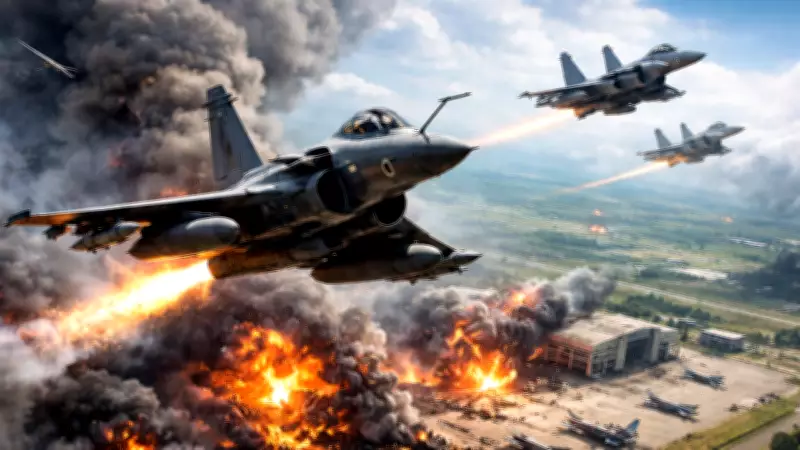
Once Pakistani operations concluded between 2 am and 5 am, the IAF launched a rapid counterstrike from within Indian airspace, employing BrahMos, SCALP-EG, and Rampage missiles launched from Su-30MKIs, Jaguars, and Rafale aircraft. These strikes impacted seven targets up to 200 kilometers inside Pakistani territory, including:
- Multiple air bases
- A surface-to-air missile battery
- Drone-related infrastructure facilities
The initial wave focused primarily on drones, sensors, and command nodes, with significant damage reported at several key installations:
- Nur Khan Air Base near Islamabad: Destruction of a Pakistan Air Force command-and-control centre
- Murid Air Base: Strikes on hangars and control facilities at this hub for Medium Altitude Long Endurance (MALE) drones
- Rahim Yar Khan Air Base: Runway damage sustained
- Rafiqi Air Base: Targeted in operations
- Sukkur Air Base: Damage to a drone hangar and radar installation in southern Pakistan
Second Wave and Ceasefire Request
After detecting preparations for a Pakistani counterstrike, the IAF launched a second offensive wave around 10 am, expanding targets to include manned aircraft and major operational bases:
- Sargodha Air Base was rendered inoperative
- Jacobabad sustained damage to an F-16 maintenance hangar and critical support systems
- Bholari Air Base saw a hangar housing an Erieye aircraft struck
The IAF assessment concluded that multiple aircraft, drones, radars, and command centres were destroyed on the ground during these operations. This extensive damage reportedly prompted Pakistan to seek a ceasefire by noon on May 10, which India accepted after confirming its military objectives had been accomplished.
The Swiss military study underscores how control of the airspace proved instrumental in determining the conflict's outcome, with India's tactical superiority enabling precise strikes that ultimately compelled Pakistan to request cessation of hostilities.