

Former Pakistan Diplomat Issues Stark Nuclear Threat Against Indian Cities
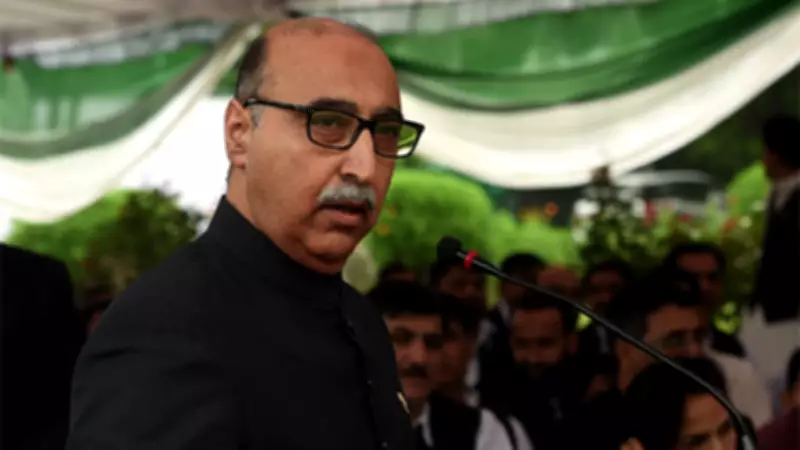
In a highly provocative declaration that has escalated regional tensions, Abdul Basit, the former high commissioner of Pakistan to India, has asserted that striking major Indian cities such as New Delhi and Mumbai should be Islamabad's "default move" if Pakistan comes under attack from the United States. This controversial statement was made during an interview with the Pakistani channel ABN News, where Basit, now a defense strategist, outlined a grim hypothetical scenario.
Basit's Rationale: Nuclear Range Limitations and India as a Target
Basit argued that Pakistan's nuclear arsenal cannot reach the United States, making retaliation against America impractical in the event of an attack. "America won't attack Pakistan's nuclear arsenal. Even if we believe that in a hypothetical situation, America attacks Pakistan, we won't be able to hit back as America does not fall within our nuclear range," he stated. When asked about alternatives, he pointed directly to India, saying, "What do you think will be our option then? India."
He elaborated with a chilling threat: "If somebody casts an evil eye on us, we will attack Mumbai and New Delhi in India without even thinking twice. We will see whatever happens later." Basit emphasized that while neither the US nor Israel is within Pakistan's nuclear range, the world should understand that any attack on Pakistan would trigger a response against India, wherever Islamabad chooses.

Context: Reaction to US Intelligence Assessment
Basit's remarks came in response to recent statements by US National Intelligence director Tulsi Gabbard before the Senate intelligence committee. Gabbard highlighted that Pakistan's long-range ballistic missile program could potentially threaten the US homeland. In the 2026 Annual Threat Assessment presented to the House intelligence committee, she noted Pakistan is among countries developing missile systems with nuclear and conventional payloads that put the US within range.
Basit dismissed Gabbard's concerns as biased, calling her worldview "anti-Pakistan" and pointing out that she focused on Pakistani missiles while ignoring India's intercontinental missiles like Agni-5 and Agni-6. "Pakistan's deterrence is India-specific," he asserted, underscoring the regional focus of Islamabad's defense strategy.
Pakistan's Missile Capabilities: A Detailed Overview
According to the Center for Arms Control and Non-Proliferation, Pakistan maintains a significant nuclear-capable ballistic missile arsenal. Key details include:
- Operational Missiles: Pakistan has six types of nuclear-capable ballistic missiles, primarily short to medium-range.
- Arsenal Composition: The ground-based arsenal consists of 106 land-based missiles with yields ranging from 5 to 40 kilotons.
- Current Inventory: Road-mobile ballistic missiles include the short-range Abdali, Ghaznavi, Shaheen-1, and NASR, as well as the medium-range Shaheen-2 and Ghauri.
- Development Projects: The Shaheen-3 and Ababeel medium-range ballistic missiles (MRBMs) are under development, with Shaheen-3 capable of hitting targets up to 2,750 km.
However, it's crucial to note that Shaheen-3 is not an intercontinental ballistic missile (ICBM), which requires a minimum range of over 5,500 km. The distance between the US and Pakistan exceeds 11,200 km, highlighting the limitations Basit referenced.
Indian and Pakistani Reactions: Sharp Condemnation and Denial
In India, BJP national spokesperson Tuhin Sinha reacted sharply to Basit's statement, linking it to past military actions. "Abdul Basit's threat that Delhi and Mumbai will be blown up with bombs from Pakistan shows that even today, Pakistan is rattled by strikes during Operation Sindoor. It has lost its mental balance," he said on Sunday.

Meanwhile, Pakistan's Ministry of Foreign Affairs spokesperson Tahir Andrabi responded to Gabbard's assessment by stating, "Pakistan categorically rejects the recent assertion by a US official alleging a potential threat from Pakistan's missile capabilities." He emphasized that Pakistan's strategic capabilities are "exclusively defensive" and aimed at safeguarding national sovereignty and regional stability in South Asia.
Broader Implications: Regional Security and Global Tensions
This incident occurs against the backdrop of ongoing global conflicts, including the US-Israel-Iran tensions, where Iran has vowed tit-for-tat strikes after ultimatums. Basit's threats inject a new layer of volatility into South Asian geopolitics, raising concerns about miscalculations and escalation. The statement underscores the persistent India-Pakistan rivalry and the complex interplay of nuclear deterrence, with implications for international diplomacy and security frameworks.





