EU's Kaja Kallas Unveils Global Security Partnerships, Including India, at Munich Conference
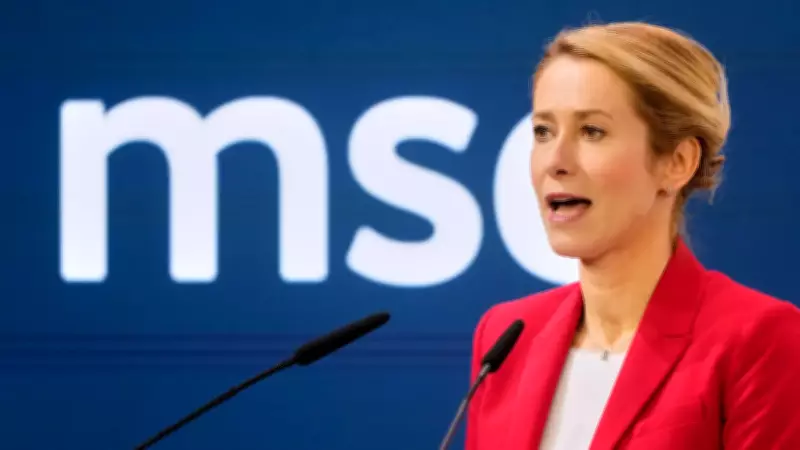
In a significant address at the Munich Security Conference (MSC) 2026, Kaja Kallas, the Vice President and High Representative for Foreign Affairs and Security Policy of the European Commission, highlighted the European Union's expanding global footprint. She emphasized that the bloc is actively forging deep-seated security and defence partnerships with key global players, notably including India.
Europe's Strategic Shift from Trade to Security
Prior to addressing a panel titled "Europeans Assemble! Reclaiming Agency in a Rougher World" on the final day of the conference, Kallas articulated Europe's evolution beyond its traditional identity as a trade power. "Take trade, for example. The European Union has built the largest free trade network in the world. Close to 80 countries are now covered by EU trade agreements," she stated, underscoring the foundation upon which new security initiatives are being built.
Expanding on the EU's strategic priorities, Kallas revealed, "And on top of trade, we are creating partnerships on security and defence, 10 so far, including India and Australia this year alone." This move signals a proactive approach to diversifying alliances in response to global challenges.

Addressing a "Rougher World" Through Collaboration
Kallas noted that countries worldwide are increasingly seeking to diversify their partnerships to manage risks in what she described as a "rougher world," citing challenges ranging from tariffs to digital security and semiconductors. "The vast majority of the countries also want the same thing: stability, growth, and prosperity for their people. The best way to get there is to go together," she asserted, promoting collective action.
Drawing inspiration from the Marvel comic universe, Kallas invoked the panel discussion title as a call to action: "Heroes are made by the path they choose, not the powers they are graced with." Europe's path is clear: defend Europe, secure our neighbourhood, and build partnerships across the globe."
Deepening India-EU Strategic Cooperation
Her remarks come against the backdrop of India and the EU significantly ramping up their strategic cooperation. This includes enhanced collaboration through the India-EU Trade and Technology Council (TTC) and increasing maritime security partnerships in the Indo-Pacific region, reflecting a mutual commitment to stability and growth.
New European Security Strategy and Global Context
Kallas also disclosed that she is working closely with European Commission President Ursula von der Leyen on a "new European security strategy." This comprehensive strategy aims to address all dimensions of security, from hard defence to economic security, based on the principle that "security is indivisible."
During the panel, which included Latvian President Edgars Rinkevics and French Minister Delegate for European Affairs Benjamin Haddad, discussions centered on the urgent need for Europe to reclaim its "agency" on the global stage.
Response to Criticism and Focus on Russia
Addressing questions on "Europe bashing" by America, Kallas countered, "Contrary to what some may say, woke, decadent Europe is not facing civilizational erasure." She emphasized that European defence "starts in Ukraine" and depends on the outcome of Russia's war, as the United States pushes efforts to halt the conflict.
Kallas provided a stark assessment of Russia, stating, "Let's be clear-eyed about Russia. Russia is no superpower," and insisting the country was "broken." She detailed the consequences: "After more than a decade of conflict, including four years of full-scale war in Ukraine, Russia has barely advanced beyond the 2014 lines. And the cost? 1.2 million casualties. Today, Russia is broken. Its economy is in shreds, it is disconnected from the European energy markets, and its own citizens are fleeing."

She warned, "In fact, the greatest threat Russia presents right now is that it gains more at the negotiation table than it has achieved on the battlefield." Kallas advocated for a robust response: "Russia's maximalist demands cannot be met with a minimalist response. Think about it. If Ukraine's military is to be limited in size, Russia should be too. Where Russia has caused damage in Ukraine, Russia should pay."
Ukraine's EU Membership Prospects
On Ukraine's application to join the EU, submitted days after the conflict with Russia began in February 2022, Kallas noted that EU member states "are not ready to give a concrete date" for membership, despite President Volodymyr Zelenskiy's demands. However, she affirmed, "There's lots to be done, but I think the priority, the urgent need to move and to show that Ukraine is part of Europe is there."
Conference Dynamics and Broader Discussions
The Munich Security Conference also featured other notable moments. In a previous panel titled "Breaking Point: The International Order Between Reform and Destruction," US Ambassador Michael Waltz claimed that the Trump leadership was responsible for ending the India-Pakistan war and resolving other global conflicts, eliciting a bewildered reaction from Kallas. That discussion included Prince Faisal bin Farhan Al Saud, the Saudi foreign minister, and Colombian defence minister Pedro Arnulfo Sanchez Suarez, moderated by Zanny Minton Beddoes, Editor-in-Chief of The Economist.
Overall, Kallas's address at MSC 2026 underscored the EU's strategic pivot towards becoming a more decisive security actor, with India emerging as a key partner in this global realignment.