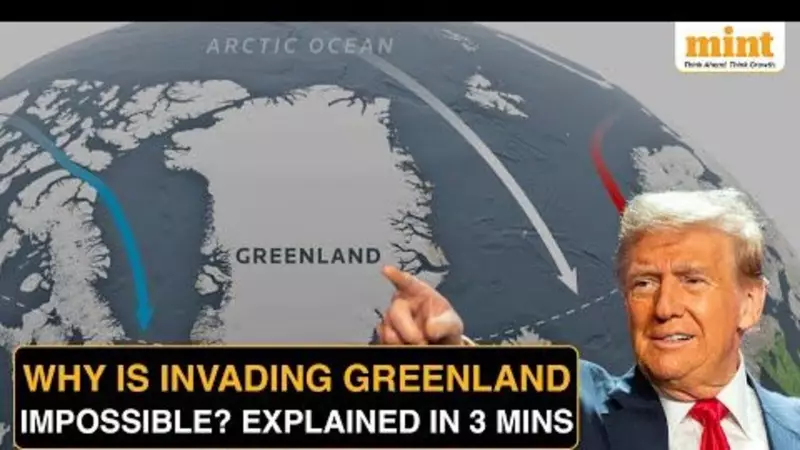
Diplomats from Denmark and Greenland have launched a concerted campaign in Washington, urging key Trump administration officials and American lawmakers to distance themselves from President Donald Trump's renewed interest in acquiring the strategic Arctic island of Greenland.
High-Stakes Diplomatic Push in Washington
According to Danish government officials speaking anonymously, Denmark's Ambassador to the US, Jesper Møller Sørensen, and Greenland's chief representative in Washington, Jacob Isbosethsen, held a crucial meeting on Thursday with officials from the White House National Security Council. The agenda was Trump's persistent push to acquire Greenland, a move he has suggested could involve military force. The White House did not comment on this meeting.
The envoys have also conducted a series of meetings with US lawmakers this week, seeking their assistance in persuading the President to withdraw his threat. This diplomatic offensive precedes an expected meeting next week between US Secretary of State Marco Rubio and Danish officials.

Trump's Ownership Stance vs. Existing Treaty
In an interview with The New York Times published Thursday, Trump argued that outright ownership of Greenland was preferable to the existing 1951 defense treaty, which already grants the United States broad rights to establish military bases on the island with consent from Denmark and Greenland's government.
"I think that ownership gives you a thing that you can't do with, you're talking about a lease or a treaty. Ownership gives you things and elements that you can't get from just signing a document," Trump stated.
Vice President JD Vance framed the issue as a matter of urgent defense, telling reporters that European leaders must "take the president of the United States seriously." He claimed Denmark had "obviously" failed to properly secure Greenland and that Trump was prepared to defend American Arctic interests aggressively. Vance reiterated to Fox News that Greenland is crucial for US and global missile defense infrastructure.
Greenland's Right to Self-Determination
The remarks from US leadership have sparked offense in Greenland, a vast island with a population of about 56,000, mostly Inuit people. Aaja Chemnitz, one of Greenland's two representatives in the Danish parliament, told The Associated Press that many Greenlanders find the comments disrespectful and feel discussions are happening "over their heads."
She emphasized the local saying, "Nothing about Greenland, without Greenland," and clarified that while many desire more self-determination, they seek cooperation based on mutual respect. Chemnitz also denied Trump's claim that Greenland is "covered with Russian and Chinese ships," calling it inaccurate.
The sentiment was echoed internationally. European Council President Antonio Costa affirmed, "Greenland belongs to its people." French President Emmanuel Macron, in a speech, criticized an increasingly dysfunctional world order where great powers divide the world, making people "wonder if Greenland will be invaded."
Existing Defense Framework and Regional Buildup
Following Vance's visit to Greenland last year, Danish Foreign Minister Lars Løkke Rasmussen highlighted the existing 1951 defense agreement, which he said "offers ample opportunity for the United States to have a much stronger military presence in Greenland" if desired.
The US military footprint has shrunk from thousands of personnel across 17 bases post-1945 to the remote Pituffik Space Base in northwest Greenland, which houses about 200 personnel and supports US and NATO missile warning and space surveillance.
Denmark is not sitting idle. Last year, it approved a bill to allow US bases on Danish soil and announced a 14.6 billion-kroner ($2.3 billion) agreement with Greenland and the Faroe Islands to bolster surveillance and sovereignty in the North Atlantic. This plan includes new Arctic naval vessels, surveillance drones, and satellite capacity, managed by the Joint Arctic Command headquartered in Nuuk.
The diplomatic and military maneuvers underscore the high stakes in the Arctic, where climate change is opening new strategic waterways and resource opportunities, making Greenland's future a focal point of global power dynamics.