The Viral Resurgence of 'China's Nostradamus' and His Chilling 2024 Forecasts
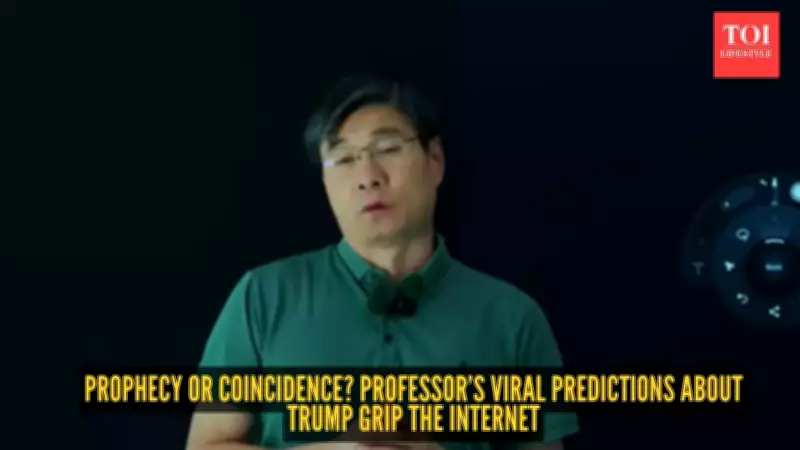
Have you ever encountered an old video that predicts the future with such uncanny accuracy it sends genuine shivers down your spine? The digital world is currently gripped by this exact phenomenon, as netizens collectively dub a seemingly obscure academic figure 'China's Nostradamus.' Amidst escalating global geopolitical tensions, a lecture from May 2024 by professor Jiang Xueqin has explosively resurfaced, captivating millions online. The core reason for this viral storm is startlingly simple: out of three major global predictions he confidently outlined, two have already materialized in our present reality.
Who Is the Man Behind the Prophecies?
Before imagining a mystic with a crystal ball, it is crucial to clarify the profile of the individual at the center of this storm. The figure in the viral video is Jiang Xueqin, a Chinese-Canadian professor of philosophy and history based in Beijing, educated at Yale University. Far from being an internet conspiracy theorist, his credibility stems from his academic background. However, his current fame extends far beyond the classroom walls. He is the creator behind the YouTube channel 'Predictive History,' which has quietly garnered over 1.5 million subscribers who specifically follow his remarkably precise global forecasts.
His methodology rejects astrology or supernatural means. Instead, Jiang's forecasting is deeply inspired by Isaac Asimov's renowned science fiction concept of 'psychohistory.' In practice, this involves analyzing recurring historical patterns, applying principles of game theory, and scrutinizing geopolitical incentives to map probable future trajectories for world events.

The Three-Part Prophecy That Ignited a Digital Frenzy
Social media platforms are experiencing a collective meltdown over one specific lecture Jiang uploaded in May 2024. During this presentation, he laid out three exceptionally bold claims about the near future.
- He predicted that Donald Trump would successfully stage a political comeback and return to the presidency.
- He warned that a second Trump term would inevitably trigger a major military conflict with Iran.
Fast forward to the present day, and both of these highly specific scenarios have unfolded, aligning perfectly with his forecasts. This validation has propelled intense scrutiny toward his third and final, more ominous prediction: Jiang asserts that the United States will ultimately lose this ongoing escalation with Iran.
Historical Parallels: The Modern 'Sicilian Expedition'
One might wonder why a modern superpower could face defeat in such a conflict. Jiang supports his controversial claim with potent historical analogies. He compares a potential US invasion or prolonged war with Iran to the ancient 'Sicilian Expedition'—a massive, ambitious military campaign launched by Athens that concluded in total disaster. According to the professor, a protracted occupation in Iran would represent a strategic quagmire. He highlights Iran's challenging, mountainous terrain, its substantial population, and the likelihood of fierce domestic resistance as factors that render the nation practically unconquerable in a drawn-out war.
In a recent appearance on the US news program Breaking Points, Jiang delivered another stark assessment. He noted that Iran has not been passive; the nation has been actively preparing for this exact confrontation for two solid decades, refining its strategies and defenses.
A World Poised for Permanent Transformation
Jiang Xueqin firmly believes the impending conflict will evolve into a brutal war of attrition. He argues that Iran and its extensive proxy networks—including groups like the Houthis, Hezbollah, and Hamas—have had ample time and numerous 'practice runs' to meticulously analyze American and Israeli military tactics. Their overarching strategy, according to Jiang, is not centered on achieving a swift victory. Instead, it aims to gradually exhaust, systematically weaken, and ultimately contribute to the decline of American global influence.

Whether his final, alarming prediction will materialize remains a question only time can answer. However, Jiang expresses absolute certainty on one point: this conflict is destined to persist for an extended period, and whenever the dust finally settles, the world as we currently know it will be irrevocably and profoundly changed.