

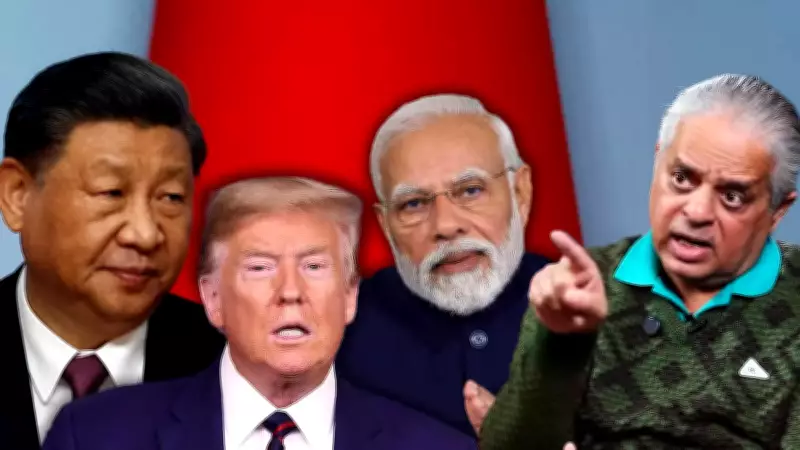
China Will Not Be Allowed To Be A Hegemon: Expert On US' Asia Strategy And India's Defence Posture
In a comprehensive analysis of contemporary geopolitics, defence expert Lt. Gen. Raj Shukla (Retd.) has articulated a critical perspective on the shifting global landscape. He emphasizes that geopolitics and national security are now deeply interconnected, with the world's focus moving decisively from purely economic concerns to urgent military priorities.
Global Defence Dynamics And US Strategy Under Trump
Shukla highlights a significant trend of rising defence budgets across nations, reflecting this strategic pivot. He describes how the United States, under the leadership of former President Donald Trump, has been employing a dual approach of tariffs and military power as primary instruments of statecraft. This strategy is not merely economic but is fundamentally geopolitical in nature.
The expert points to specific US military and fiscal actions designed to counter perceived international threats. These include measures aimed at nations like Venezuela and, more prominently, a concerted effort to prevent the People's Republic of China from establishing itself as a regional hegemon in Asia. The clear message, according to Shukla, is that China will not be allowed to dominate the Asian strategic space.

Imperatives For India's Strategic Defence Posture
Against this backdrop of great power competition, Shukla stresses the paramount importance for India to strengthen its own defence posture. He argues that India must take proactive and decisive steps to secure its national interests in an increasingly volatile environment.
The retired general identifies two key areas for immediate action:
- Increased Defence Spending: A substantial boost in the defence budget is essential to modernize the armed forces and develop indigenous capabilities.
- Strategic Military Transformation: Beyond mere spending, a holistic transformation of military structures and doctrines is required to meet future challenges.
Welcoming Reforms, Calling For Deeper Change
Shukla welcomes ongoing initiatives within the Indian military, such as the development of Integrated Battle Groups (IBGs) and other operational reforms. He acknowledges these as positive steps toward greater integration and efficiency.
However, he cautions that these measures, while important, are insufficient on their own. To truly address the evolving geopolitical and security challenges, Shukla calls for deeper, more structural changes. He outlines several critical components of this necessary transformation:
- Adequate and Sustained Budgetary Allocation: Ensuring long-term financial commitment to defence modernization.
- Establishment of Functional Theatre Commands: Moving towards a unified command structure for seamless joint operations across domains.
- Integration of Advanced Unmanned Systems: Embracing cutting-edge technologies like drones and autonomous platforms to enhance surveillance and combat effectiveness.
In conclusion, Lt. Gen. Raj Shukla's analysis presents a clear-eyed view of a world where military strategy is back at the forefront. For India, the path forward involves not just reacting to the strategies of others, like the US's efforts to contain China, but proactively building a robust, modern, and strategically autonomous defence apparatus capable of safeguarding its sovereignty and interests in the 21st century.






