

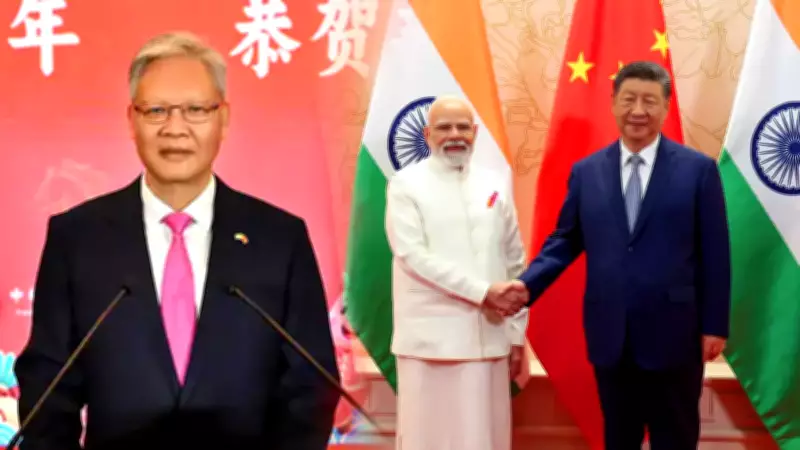
China Endorses India's BRICS Presidency Amid Record Trade Growth
In a significant diplomatic development, China has publicly backed India's presidency of the BRICS grouping, while simultaneously announcing that bilateral trade between the two Asian giants has reached an unprecedented milestone. According to Chinese Ambassador Xu Feihong, India-China economic engagement soared to a record USD 155.6 billion in 2025, marking a new phase in their complex relationship.
Diplomatic Thaw and Economic Milestones
The remarkable trade growth comes against the backdrop of a diplomatic reset initiated after the meeting between Prime Minister Narendra Modi and Chinese President Xi Jinping in Tianjin. Ambassador Xu described this surge as concrete evidence that relations between India and China are not only stabilizing but evolving into a new era of engagement.
The envoy emphasized that both nations share common developmental objectives, pointing to the convergence between India's Atmanirbhar Bharat initiative and China's self-reliance push. He further highlighted philosophical alignment between China's vision of harmony and India's ancient principle of Vasudhaiva Kutumbakam, suggesting deeper cultural connections beyond mere economic ties.

Multilateral Cooperation and Strategic Implications
Beijing's endorsement of India's BRICS leadership represents a strategic acknowledgment of New Delhi's growing influence in multilateral forums. This support is particularly significant as both nations aim to strengthen the collective voice of the Global South in international affairs.
The trade surge follows years of military disengagement along the contested border regions, indicating that despite lingering strategic rivalry, both countries are prioritizing economic stability and pragmatic cooperation. This delicate balance reflects the broader power dynamics in Asia, where cooperation and competition continue to coexist.
Regional Geopolitics and Global Supply Chains
The evolving India-China relationship has profound implications for regional geopolitics and global supply chains. As two of the world's largest economies and most populous nations, their interactions shape not only Asian stability but also worldwide economic patterns.
The record trade figures suggest that economic interdependence has become a stabilizing factor, even as strategic differences persist. This complex dynamic illustrates how major powers can compartmentalize their disagreements while pursuing mutual economic benefits.
The diplomatic reset and trade milestone represent a calculated effort by both nations to navigate their multifaceted relationship, balancing competition with cooperation in an increasingly multipolar world order.






