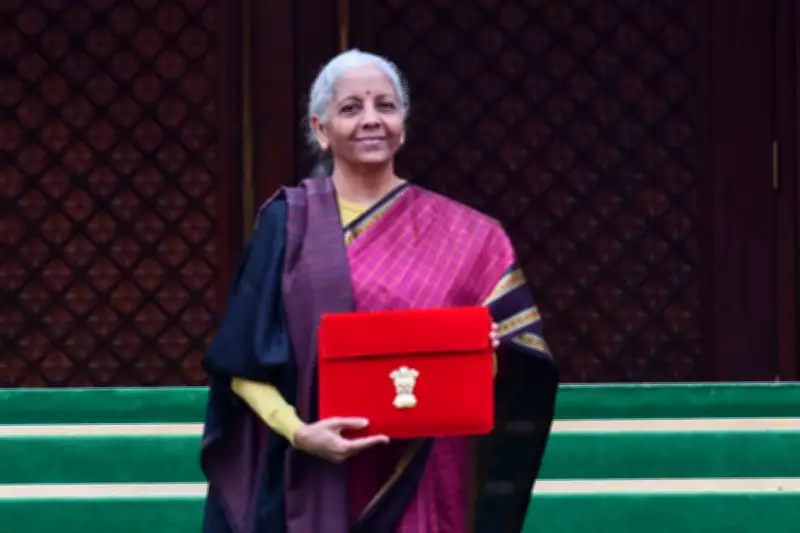
Finance Minister Nirmala Sitharaman presented the Union Budget for the fiscal year 2026-27 in Parliament today, marking a significant shift in how education is positioned within the government's economic framework. Rather than treating education as an isolated social sector, the budget strategically integrates it into the broader employment conversation, framing it as a crucial feeder system for key industries including services, healthcare, tourism, and technology.
Substantial Increase in Education Allocation
The Ministry of Education has been allocated a substantial ₹1,39,285.95 crore for the upcoming financial year, representing an impressive increase of 8.27% compared to the previous year's allocation. This substantial boost underscores the government's commitment to strengthening the educational foundation of the nation.
School Education Receives Major Funding Boost
Within the overall education budget, school education emerges as a clear priority with an allocation of ₹83,561.41 crore. This marks a significant increase from the revised estimate of ₹70,567.14 crore in 2025-26, demonstrating both restoration of previous funding levels and expansion into new areas.

The budgetary progression for school education over recent years reveals a clear upward trajectory:
- Budget 2025-26: ₹78,571.30 crore
- Revised 2025-26: ₹70,567.14 crore
- Budget 2026-27: ₹83,561.41 crore
The substantial jump between the revised estimate and the new budget allocation indicates not just recovery from previous adjustments but genuine expansion of educational initiatives.
Centrally Sponsored Schemes: The Primary Channel
Centrally sponsored schemes continue to serve as the primary mechanism through which the Union government implements its school education interventions. For 2026-27, allocations under this category have risen to ₹63,010.02 crore, up from ₹57,370.02 crore at the revised estimate stage last year.
The consistent growth pattern of centrally sponsored scheme allocations demonstrates sustained government focus:
- Actual 2024-25: ₹50,669.36 crore
- Budget 2025-26: ₹62,660.00 crore
- Revised 2025-26: ₹57,370.02 crore
- Budget 2026-27: ₹63,010.02 crore
Samagra Shiksha: The Anchor Programme
Samagra Shiksha, the government's comprehensive school education programme covering pre-primary to senior secondary levels, continues to receive substantial funding. With an allocation of ₹42,100 crore for 2026-27, the programme moves past last year's revised estimate and slightly exceeds the previous budget projection.
This integrated scheme, which subsumes earlier elementary and secondary education initiatives, focuses on multiple critical areas:
- Improving access to education across all levels
- Enhancing student retention rates
- Providing comprehensive teacher support
- Developing essential school infrastructure
Samagra Shiksha's consistent funding positions it as the stabilising force within the public education system, supporting the fundamental mechanics of schooling rather than pursuing targeted interventions.
PM POSHAN: Nutrition as Retention Tool
The Pradhan Mantri Poshan Shakti Nirman scheme, formerly known as the Mid-Day Meal Scheme, receives increased funding of ₹12,750 crore for 2026-27. This allocation rises above both last year's revised estimate and the earlier budget figure, reflecting the government's continued emphasis on nutrition as a crucial tool for student retention.
The scheme's primary objectives remain focused on:
- Addressing classroom hunger among students
- Improving school participation rates
- Supporting nutritional needs at the primary level
This consistent funding pattern demonstrates that nutrition continues to be treated as an integral component of the educational ecosystem rather than a peripheral addition.
PM SHRI: Model School Development
The PM Schools for Rising India initiative, aimed at developing over 14,500 government schools as model institutions aligned with the National Education Policy, receives an allocation of ₹750 crore for 2026-27. This represents a return to the originally budgeted level after a lower revised estimate last year.

These model schools are designed to demonstrate excellence in multiple areas:
- Quality infrastructure development
- Innovative pedagogical approaches
- Effective governance structures
The scheme continues to function primarily as a signalling instrument, showcasing best practices rather than pursuing mass coverage across the educational landscape.
STARS: Focused Learning Interventions
The Strengthening Teaching Learning and Results for States programme, which supports targeted interventions to improve learning outcomes, receives an allocation of ₹500 crore for 2026-27. This amount remains unchanged from the revised estimate stage, suggesting a period of consolidation rather than expansion for this outcome-focused initiative.
The programme concentrates on several key areas:
- Enhancing teacher capacity and development
- Improving assessment systems
- Strengthening overall learning outcomes
Strategic Implications of Budgetary Allocations
The 2026-27 school education budget effectively restores momentum after the compression observed at the revised estimate stage last year. The increased funding flows predominantly into large, system-wide schemes rather than newer or more narrowly focused interventions.
Several key patterns emerge from the allocation strategy:
Samagra Shiksha absorbs the majority of the funding increase, reinforcing its position as the backbone of India's public schooling system. This reflects a commitment to maintaining and strengthening existing educational infrastructure.
PM POSHAN receives a clear and substantial boost, indicating the government's continued reliance on nutrition as a powerful lever for improving student participation and retention.
PM SHRI maintains its role as a model-building exercise rather than a comprehensive scaling solution, focusing on creating exemplar institutions that can demonstrate educational excellence.
Outcome-focused and capacity-building schemes, while important, remain modest in their budgetary allocations, suggesting a measured approach to educational transformation.
Broader Policy Implications
The allocation pattern revealed in Budget 2026-27 suggests a budgetary approach that prioritises stability and broad coverage over structural redesign. The government appears focused on strengthening existing educational pipelines without fundamentally altering how students progress through the system.
For families navigating school transitions and educational choices, these budgetary numbers serve as important signals beyond mere headlines. They indicate where the government is choosing to reinforce the educational system and where it might be adopting a more patient approach to development.
The integration of education into the employment conversation represents a significant policy shift, recognising education not just as a social good but as a critical economic investment that feeds directly into key growth sectors of the Indian economy.