Bangladesh's Political Landscape Transforms as Tarique Rahman Becomes Prime Minister
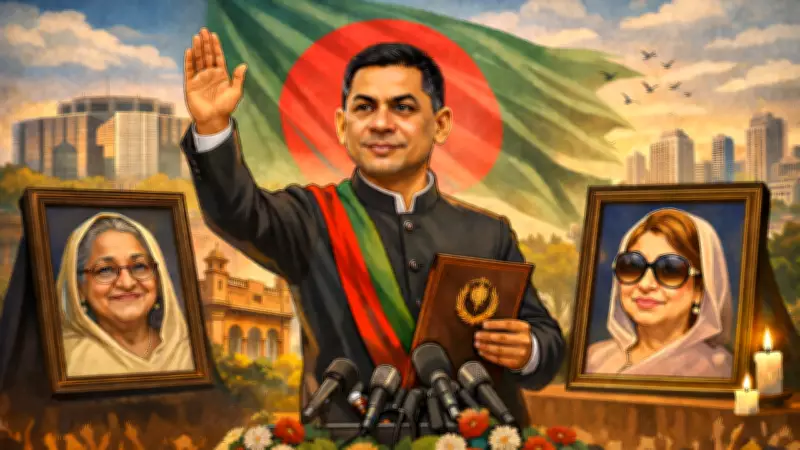
Bangladesh has witnessed a historic political transformation with the election of Tarique Rahman as Prime Minister, marking the definitive end of the country's decades-long "battle of begums" era. This dramatic shift represents a fundamental change in the nation's power dynamics that would have seemed improbable just two years ago.
The End of an Era: Battle of Begums Concludes
For over three decades, Bangladesh's political landscape was dominated by two powerful women leaders: Sheikh Hasina and Khaleda Zia. Their intense rivalry, often described as the "battle of begums," shaped every aspect of the country's political life, from elections and governance to foreign policy decisions. Both leaders came from families deeply intertwined with Bangladesh's founding and political evolution.
Sheikh Hasina, daughter of Bangladesh's founding father Sheikh Mujibur Rahman, dominated the political scene for much of the past two decades. Her tenure saw significant economic transformation and strengthened global standing for Bangladesh, though her later years drew criticism for increasingly autocratic tendencies, suppression of opposition, and concentration of power.

Her rival, Khaleda Zia, widow of former president Ziaur Rahman and leader of the Bangladesh Nationalist Party (BNP), represented the principal alternative political force. As Bangladesh's first female prime minister in 1991, she led governments in 1991, 1996, and 2001, ensuring the country remained defined by a bipolar political system.
Dramatic Political Upheaval and Leadership Vacuum
The "battle of begums" era ended abruptly in August 2024 when a massive youth-led uprising swept across Bangladesh. Driven by frustration over unemployment, economic inequality, and political repression, tens of thousands of young Bangladeshis poured into the streets demanding systemic change and accountability. The protests intensified rapidly, spreading from university campuses to cities, highways, and government institutions.
The unrest grew so powerful that protesters surrounded and stormed Hasina's official residence in Dhaka, leaving her with no option but to flee the country to avoid the fate her father and family faced in 1975. She took refuge in India, ending her uninterrupted 15-year rule in dramatic fashion.
Khaleda Zia, once Hasina's fiercest rival, was unable to step into the resulting political vacuum. Years of illness had weakened her physically, and within days of her son Tarique Rahman's return to Bangladesh, she died, marking the definitive end of an era defined by her rivalry with Hasina.
Tarique Rahman's Remarkable Political Comeback
Into this historic vacuum stepped Tarique Rahman, son of Khaleda Zia and heir to one of Bangladesh's most influential political dynasties. His return from exile after 17 years, followed by a sweeping electoral victory, has reshaped Bangladesh's political order completely.
Rahman's political comeback seemed improbable until recently. Once a controversial and polarizing figure, he went into exile in London in 2008 amid corruption charges and political pressure. For nearly two decades, he remained physically absent from Bangladesh's political stage.
His return to Bangladesh was met with massive celebrations. Crowds in Dhaka erupted to welcome him as he arrived in a bulletproof bus painted in the red and green colors of the Bangladesh national flag. In his first public address, he invoked American political veteran Martin Luther King, declaring, "I have a plan."
Rahman struck a reassuring and secular tone in a country shaken by communal tensions, outlining BNP's inclusive vision ahead of the elections. He emphasized values of unity and safety for all citizens, stating: "It is time for us all to build the country together. In this country, there are people from the hills, plains, Muslims, Hindus, Buddhists, Christians. We want to build a safe Bangladesh."
Landslide Victory and Constitutional Changes
The BNP secured a landslide victory in the elections, winning nearly two-thirds of parliamentary seats and restoring the party to power. The recently held polls were different in several significant ways:

- Voters cast ballots twice—once to choose their next Prime Minister and again to give consent to the "July Charter"
- The referendum was conducted across all 64 districts under tight security and international observation
- Results showed a commanding "Yes" vote for the Charter from both urban and rural regions
The July National Charter Implementation Order 2025 is a 28-page political agreement signed by Muhammad Yunus and 25 political parties. Its goal is to transform Bangladesh into what many call the "Second Republic"—a state designed to prevent any future return to authoritarianism. Under the Charter's regulations, the powers of Prime Minister Tarique Rahman will face closer checks to prevent authoritarian tendencies.
Challenges of Leadership and Political Inheritance
Rahman's political rise was marked by personal tragedy, with his mother Khaleda Zia dying after prolonged illness in December. Her death marked not only the loss of a mother but the passing of one of Bangladesh's most influential political figures and first female prime minister.
Rahman inherited not only leadership of the BNP but also a powerful political legacy shaped by struggle, violence, and sacrifice. His father, President Ziaur Rahman, who founded the BNP in 1978, had been assassinated in a military coup in 1981 when Tarique was a teenager.
Rahman took charge at a time when Bangladesh was facing one of its most unstable internal security situations in years. December proved particularly turbulent, with Dhaka and several other cities witnessing explosions, widespread unrest, and internet shutdowns.
Much of the violence was triggered by an assassination attempt on influential student leader Osman Hadi, who later died from his injuries in Singapore. News of his death sparked anger across the country, leading to violent attacks targeting minorities, especially Hindu laborers, businessmen, and community members.
Reinventing Leadership Style and Political Alliances
Since his return, Rahman has tried to present himself as a calmer and more mature leader, ready to move beyond past political conflicts. The image of an aggressive political operator from the BNP's 2001–2006 era has largely faded.
During Sheikh Hasina's rule, Rahman faced multiple corruption cases and was convicted in absentia. In 2018, he was also sentenced to life imprisonment over a 2004 grenade attack on a rally Hasina was addressing. Rahman denied all allegations, calling them politically motivated. Following Hasina's ouster, he has since been acquitted in these cases.
The elections also marked significant gains for Jamaat-e-Islami, which won nearly one-third of parliamentary seats—its strongest performance in decades. Notably, the party did not field a single woman candidate, reflecting its ideological position on women's role in politics.
Two months earlier, Jamaat had surprised observers by forming an alliance with the National Citizen Party (NCP), created in 2025 by leaders of the student uprising. This alliance reflects the complex and evolving nature of Bangladesh's political landscape.
International Implications and Regional Relations
Rahman's rise carries important implications for India-Bangladesh relations. After Sheikh Hasina fled and took refuge in India, ties between the two countries became strained. The interim government under Nobel laureate Muhammad Yunus did little to improve relations.
Rahman, however, moved quickly to reach out diplomatically. Prime Minister Narendra Modi spoke with Rahman and congratulated him on his electoral victory. India sent Lok Sabha Speaker Om Birla and Foreign Secretary Vikram Misri to attend the oath-taking ceremony, signaling its willingness to rebuild relations.
Under Sheikh Hasina, India was Bangladesh's closest regional partner. Rahman's outreach suggests an effort to restore stability and cooperation between the two neighbors.
Bangladesh at a Historic Crossroads
Tarique Rahman's rise marks a major turning point in Bangladesh's political history. For decades, politics was dominated by Sheikh Hasina and Khaleda Zia. Their rivalry shaped the country's leadership, elections, and direction. That era has now ended definitively.
Rahman's leadership represents both continuity and change—continuity through political legacy, and change through generational transition. He faces major challenges including:
- Restoring trust in democratic institutions
- Maintaining communal harmony in a diverse society
- Managing rising political forces with differing ideologies
- Rebuilding foreign relations with key partners like India
Bangladesh now stands at an important moment, entering a new political phase under a leader whose journey—from exile to elected power—reflects the country's own years of conflict, change, and political transformation. The nation's political center in Dhaka, founded on democratic and secular principles in 1971 following independence from Pakistan, faces both challenges and opportunities in this new era.