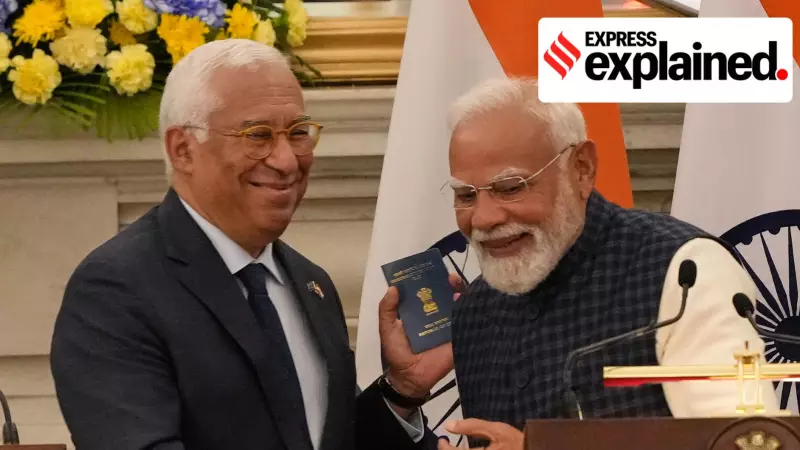
European Council President Antonio Costa, often referred to as the 'Gandhi of Lisbon' for his exceptional dialogue-driven approach and negotiating prowess, recently highlighted his profound connection to India during a significant diplomatic event. As India and the European Union finalized a landmark free trade agreement on January 27, 2026, in New Delhi, Costa emphasized both the strategic importance and personal resonance of the deal.
Antonio Costa's Personal Connection to India
During a press statement following the agreement, Costa proudly displayed his Overseas Citizen of India (OCI) card to Indian Prime Minister Narendra Modi. He stated, "I am the President of the European Council, but I am also an overseas Indian citizen. Then, as you can imagine, for me, it has a special meaning. I am very proud of my roots in Goa, where my father's family came from." This moment underscored his dual identity and deep familial ties to the Indian state of Goa.
Costa, a former Prime Minister of Portugal, earned the nickname 'Gandhi of Lisbon' during his tenure as mayor of Lisbon, thanks to his commitment to peaceful dialogue and effective negotiation. His Indian supporters affectionately call him "Babush," a Konkani term meaning a young, loved one. The OCI card was presented to him by Prime Minister Narendra Modi in 2017 during the first-ever bilateral visit by an Indian Prime Minister to Portugal, symbolizing a bridge between his Portuguese leadership and Indian heritage.

What is the Overseas Citizen of India (OCI) Scheme?
The Overseas Citizen of India Scheme was introduced in August 2005 to address the persistent demands for dual citizenship from the global Indian diaspora. According to the Ministry of External Affairs, the scheme allows Persons of Indian Origin (PIOs) who were citizens of India on or after January 26, 1950, or were eligible to become citizens at that time, to register as OCIs. However, individuals who are or have been citizens of Pakistan, Bangladesh, or as specified by the Central Government are excluded from eligibility.
OCI cardholders enjoy several benefits, including eligibility for multiple entries into India and a lifelong free visa. Importantly, they do not hold dual citizenship and are not considered Indian citizens, which means they cannot vote, hold constitutional posts, or typically work in government positions.
Goa's Unique Historical Context and OCI Eligibility
Goa, a Portuguese colony since 1510, gained independence in 1961 after 450 years of colonial rule. Under Portuguese law, anyone born before December 19, 1961, in the former Portuguese territories in India could register their birth in Portugal, making their children and grandchildren up to the third generation eligible for Portuguese citizenship. This created a complex situation for many Goans who sought to maintain ties with India while acquiring foreign passports.
India follows a strict single citizenship policy, meaning any Indian who acquires a foreign passport automatically loses their Indian citizenship. Consequently, numerous Goans who obtained Portuguese citizenship applied for OCI cards to live and work in India, albeit with restrictions such as no voting rights or ability to purchase agricultural land.
In the past, Indians who took foreign passports were required to surrender their Indian passports, and those who registered births in Portugal without informing authorities faced passport revocation and OCI ineligibility. This left many Goans stranded without citizenship. However, in 2024, the Ministry of External Affairs issued a memorandum allowing Indians from former Portuguese territories whose passports had been revoked to apply for OCI cards, providing a resolution for affected individuals.
Restrictions and Ineligibility for OCI Cards
Not everyone is eligible for an OCI card. Applicants are ineligible if their parents or grandparents have ever been citizens of Pakistan or Bangladesh. However, foreign-origin spouses of Indian citizens or OCIs, with a registered marriage that has subsisted for at least two years, can apply. Additionally, foreign military personnel, whether active or retired, are not entitled to OCI cards.

OCI cardholders face several restrictions in India. They cannot vote, serve as members of legislative assemblies or councils, hold parliamentary seats, or occupy constitutional posts such as President, Vice President, or Judge of the Supreme Court or High Court. They are also generally barred from government employment, highlighting the distinction between OCI status and full Indian citizenship.
This framework ensures that while OCIs like Antonio Costa can maintain strong cultural and economic ties to India, the integrity of Indian citizenship and governance is preserved. Costa's story exemplifies how the OCI scheme facilitates global connections while honoring historical roots.