

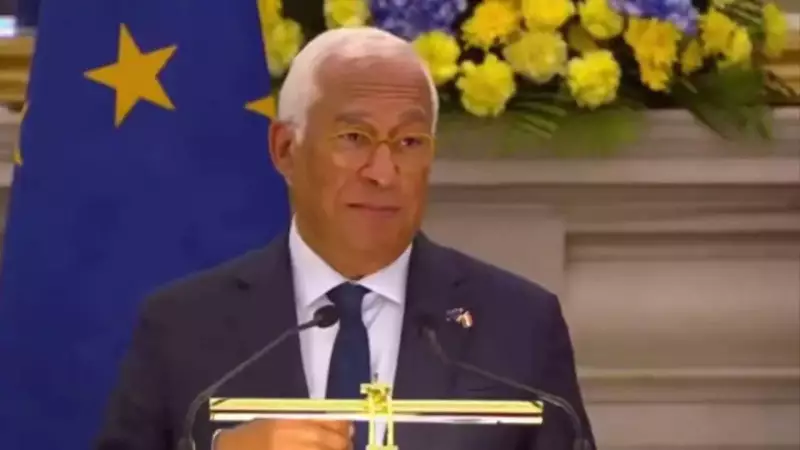
EU Council President António Costa's Personal OCI Card Moment at India-EU FTA Signing
In a deeply symbolic gesture that blended personal heritage with high-stakes diplomacy, European Council President António Costa held up his Overseas Citizen of India (OCI) card during the signing ceremony of the landmark India-EU Free Trade Agreement (FTA) in New Delhi. This poignant moment served as a powerful reminder that international relations are shaped not just by economic strategies and market considerations, but also by personal memory, migration histories, and ancestral lineage.
A Historic Agreement with Personal Significance
The emotional display occurred as India and the European Union formally sealed their long-anticipated Free Trade Agreement, which Brussels has hailed as the "most ambitious" trade pact in the bloc's entire history. Addressing distinguished guests at Hyderabad House, Costa directly connected this historic economic partnership to his own family story, creating a unique bridge between institutional diplomacy and personal identity.
"I am from Goa," Costa declared, recalling his ancestral connections to the Indian coastal state. Holding his OCI card visibly, he added with evident pride: "I'm the President of the European Council, but I'm also an overseas Indian citizen. Then, as you can imagine, for me it has a special meaning. I'm very proud of my roots in Goa, where my father's family came from and the connection between Europe and India is something personal to me."

Beyond Trade: Elevating Strategic Partnership
Costa's heartfelt statement about his Indian heritage comes at a pivotal moment when India and the European Union are working to elevate their relationship beyond conventional trade parameters. The comprehensive FTA aims to eliminate or reduce tariffs on more than 90 percent of traded goods while simultaneously deepening services and investment linkages between the two economic powerhouses.
This agreement strategically positions both India and the EU as reliable, forward-looking partners in an increasingly multipolar global landscape, where economic resilience and strategic autonomy have become paramount concerns for nations worldwide.
António Costa: A Seasoned Leader with Deep Indian Connections
António Luís Santos da Costa stands among Europe's most experienced political figures, having assumed the presidency of the European Council on December 1, 2024. Born in Lisbon on July 17, 1961, Costa brings a remarkable breadth of governmental experience to his current role, which places him at the center of coordination among the European Union's 27 member states during a period of significant geopolitical volatility and economic realignment.
His distinguished career includes serving as Prime Minister of Portugal from 2015 to 2024, an eight-year tenure as mayor of Lisbon, and holding multiple cabinet portfolios ranging from justice to internal affairs. Costa has also served as a member of both the Portuguese Parliament and the European Parliament, earning widespread recognition as a consensus-driven leader capable of navigating complex political landscapes.
The Goa Connection: Family Heritage and Cultural Legacy
Costa's profound connection to India flows directly through his father, Orlando António Fernandes da Costa, a celebrated Portuguese writer and intellectual of Goan origin. The Costa family traces its roots to Margao in South Goa, which remained part of Portuguese India until 1961.
Costa's grandfather was born in Goa and spent his formative years there as part of the Catholic Goan community that developed through centuries of Indo-Portuguese cultural exchange. These rich experiences found vivid expression in Orlando da Costa's literary works, which frequently explored Goan life, cultural hybridity, and the complex realities of migration.
Although António Costa grew up in Portugal, Goa remained vibrantly present within his family's consciousness through cherished stories, Konkani phrases, traditional Goan cuisine like sorpotel, and intergenerational memories carefully preserved across decades and distances.

A Living Bond That Transcends Generations
This connection extends far beyond historical references or sentimental nostalgia. The Costa family maintains an ancestral home on Abade Faria Road in Margao, where extended relatives continue to reside today. During a personal visit to Goa in 2017, Costa spent meaningful time with family members in his father's hometown, reinforcing these living bonds.
Within Goa and among segments of the global Indian diaspora, Costa is often affectionately referred to as "Babush," a Konkani term of endearment that reflects local pride in his remarkable ascent to one of Europe's most influential leadership positions. This personal narrative adds a unique human dimension to the strategic partnership between India and the European Union, demonstrating how individual histories can meaningfully intersect with and enrich international diplomacy.





