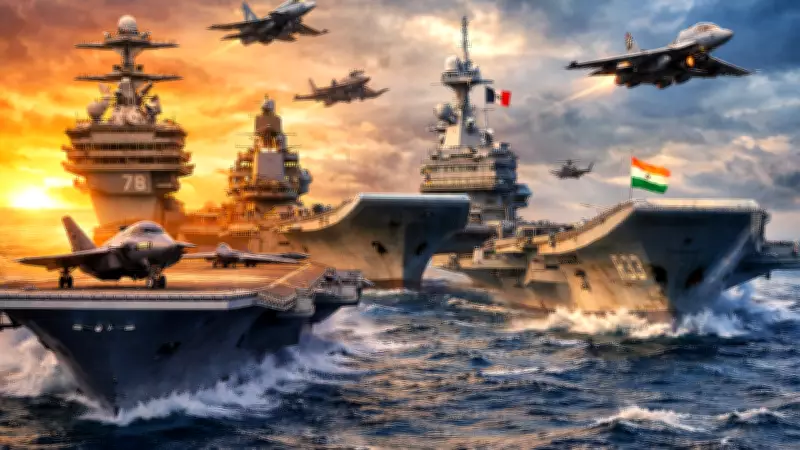
Global Aircraft Carriers: Power Projection and Naval Strategy Explored
Aircraft carriers stand as some of the most formidable naval assets worldwide, serving as mobile airbases that enable nations to deploy fighter jets and helicopters far from their own coastlines. These massive warships, equipped with flight decks, control towers, and hangars, project military power, support combat and reconnaissance missions, and are instrumental in humanitarian and disaster-relief operations, making them essential tools in contemporary naval strategy.
Gerald R Ford Class: US Navy's Technological Marvel
The USS Gerald R Ford, the lead ship of a new class of US Navy aircraft carriers, represents the most technologically advanced carrier ever deployed by the United States and the first new design in over four decades. It features significant upgrades compared to the older Nimitz-class vessels, including the Electromagnetic Aircraft Launch System (EMALS), which replaces steam catapults to allow faster, more efficient aircraft launches and a higher sortie rate during operations.
Measuring approximately 1,106 feet in length and displacing around 100,000 long tons when fully loaded, this nuclear-powered carrier is driven by two A1B reactors, providing near-unlimited range and speeds exceeding 30 knots. Its air wing can carry more than 75 aircraft, including F-35C Lightning II stealth fighters and F/A-18E/F Super Hornets, solidifying its role as a cornerstone of US naval power projection.

Nimitz-class Aircraft Carriers: Backbone of US Naval Dominance
The Nimitz-class aircraft carriers form the backbone of the United States Navy's carrier strike groups, designed to project military power and maintain maritime dominance globally. Named after World War II Fleet Admiral Chester W Nimitz, these nuclear-powered carriers can operate for decades without refueling and support large air wings for combat, surveillance, and humanitarian missions. Ten Nimitz-class carriers are currently in active service.
To defend against threats, these carriers are equipped with layered defensive systems, including:
- Close-In Weapon Systems (CIWS) for missile and aircraft defense.
- Rolling Airframe Missiles (RAM) and Evolved Sea Sparrow Missiles (ESSM) for short- and medium-range threats.
- Machine guns for surface threats such as small boats.
Advanced electronic warfare systems further enhance their survivability in hostile environments.
Queen Elizabeth Class: UK's Naval Powerhouses
The Queen Elizabeth-class aircraft carriers, HMS Queen Elizabeth and HMS Prince of Wales, are the largest and most powerful ships ever constructed for the UK's Royal Navy, designed to project British air power at sea. Each 65,000-tonne carrier can deploy up to 72 aircraft, including F-35B fighter jets and helicopters, and operate dozens of sorties daily while carrying over 1,600 personnel.
Equipped with ski-jump ramps for jet launches and advanced defensive systems like Phalanx close-in weapon systems, these carriers are central to the UK's naval strategy and global operations. They displace about 65,000 tonnes, making them larger than France's Charles de Gaulle-class carriers but smaller than the US Navy's Nimitz-class, and roughly three times the size of the UK's former Invincible-class ships. Each carrier can reach speeds up to 25 knots, has a range of approximately 10,000 nautical miles, and can operate for around seven days between replenishments, with a crew of about 700 that can expand to 1,600 with a full air wing.
Construction began in 2009, with HMS Queen Elizabeth christened in 2014 and commissioned into service in December 2017.
Admiral Kuznetsov and Liaoning: Soviet-Era Legacy Carriers
The Kuznetsov-class aircraft carriers are Soviet-designed ships now operated by the Russian and Chinese navies, marking a significant advancement in Soviet-era naval aviation. Using a ski-jump launch system for conventional fighter aircraft, this design improved on earlier Soviet carriers that could only operate vertical take-off jets.

Following the collapse of the Soviet Union, the class had a fragmented development history: Russia commissioned the lead ship, Admiral Kuznetsov, while an unfinished sister ship was later sold to China and completed as Liaoning in 2012. China subsequently built a modified third vessel, Shandong, which entered service in 2019, expanding Beijing's aircraft carrier capabilities.
A key setback in the carrier's development was the Soviet Union's failure to master steam catapult technology, preventing the adoption of a CATOBAR launch system used by Western carriers. As a result, designers shifted to a STOBAR configuration, adding a ski-jump ramp at the bow to assist aircraft takeoff. While functional, this change limited the carrier's aircraft launch capabilities and has been viewed as a long-term constraint on its air operations.
INS Vikramaditya: India's Refurbished Naval Asset
INS Vikramaditya is India's refurbished former Soviet aircraft carrier, originally commissioned into the Russian Navy in 1987 as Baku and later renamed Admiral Gorshkov. After the Soviet Union's collapse, India acquired and modernized the ship for service as a short take-off but arrested recovery (STOBAR) carrier for the Indian Navy.
The refurbished carrier underwent extensive modernization to meet Indian Navy requirements, with 234 new hull sections added using about 2,500 tonnes of steel. It is 284 metres long, about 60 metres wide, displaces roughly 44,500 tonnes, and rises around 60 metres from keel to mast. The warship has 22 decks and approximately 2,500 compartments, many of which were rebuilt, and can accommodate over 1,600 personnel.
Upgrades included:
- A ski-jump ramp and arrester gear systems.
- Improved lighting, air-conditioning, and refrigeration systems.
- Desalination plants capable of producing around 400 tonnes of freshwater daily.
- New electrical cabling, structural improvements to the bow, upgraded aircraft and ammunition lifts, and expanded flight deck features.
These enhancements transformed Vikramaditya into a modern carrier capable of sustained naval air operations.
Charles De Gaulle: France's Nuclear-Powered Flagship
France's aircraft carrier Charles de Gaulle is the country's flagship naval vessel and its primary power-projection platform, in service since 2001. Displacing about 42,500 tonnes and measuring 261 metres in length, it is one of the few nuclear-powered aircraft carriers globally and the only one outside the United States to use nuclear propulsion.
Powered by two nuclear reactors, the carrier can operate for years without refueling, providing energy for propulsion, aircraft catapults, and onboard systems for its roughly 2,000 crew. It uses a CATOBAR system to launch and recover aircraft, allowing heavier jets to take off rapidly compared to ski-jump carriers. Highly maneuverable and designed for global deployments, Charles de Gaulle is central to France's naval strategy and its ability to project military power far beyond its shores.
São Paulo: Brazil's Former Flagship Carrier
The São Paulo (A12) is a former French Navy aircraft carrier that served as Brazil's flagship carrier after being acquired in 2000. Originally commissioned as Foch in 1963, the ship was built in France as part of the Clemenceau-class, which comprised two carriers that operated with the French Navy from the 1960s until 2000.
Measuring about 266 metres in length and displacing roughly 33,700 tonnes at full load, São Paulo could reach speeds up to 30 knots and carry nearly 2,000 personnel, including its crew and air wing, making it a key platform for Brazil's naval aviation operations.
Cavour: Italy's Versatile Multi-Role Carrier
Italy's aircraft carrier Cavour was launched in 2004, delivered to the Italian Navy in 2008, and entered service in 2009, later participating in Haiti earthquake relief operations in 2010. Displacing about 27,100 tonnes at full load and measuring 244 metres in length, the carrier can reach speeds around 27 knots and accommodate over 1,200 personnel, including crew, aircrew, and embarked troops.
Designed for flexibility, Cavour can operate as an aircraft carrier or amphibious assault ship, carrying vehicles, landing craft, and troops for military and humanitarian missions. Its flight deck features a ski-jump for short take-off aircraft and is suited for helicopters and VTOL fighters such as the F-35B, while its hangars and garages can house aircraft, helicopters, vehicles, and tanks, making it a versatile multi-role naval platform.
INS Vikrant: India's Indigenous Naval Milestone
INS Vikrant, India's first indigenously built aircraft carrier, was commissioned on September 2, 2022, marking a major milestone in the country's naval and defense manufacturing capabilities. Designed by the Indian Navy's Warship Design Bureau and built by Cochin Shipyard Limited, it is the largest warship ever constructed in India and features about 76% indigenous content, involving hundreds of domestic firms and generating thousands of jobs.
The carrier is about 262.5 metres long, displaces roughly 45,000 tonnes, and can reach speeds up to 28 knots, powered by four gas turbines. Operating on a STOBAR system, it can carry around 30 aircraft, including MiG-29K fighters and multiple helicopters, and accommodates approximately 1,600 personnel.
Beyond combat roles, Vikrant has demonstrated operational versatility, such as a 2025 medical evacuation mission at sea, and generates enough electricity to power thousands of households, underscoring its scale and technological sophistication.