Ahmedabad's Public Bicycle Sharing System Faces Commuter Hurdles Ahead of 2030 Commonwealth Games
As Ahmedabad prepares to host the Commonwealth Games in 2030, the city confronts a critical urban mobility challenge: efficiently transporting large crowds through its congested and hot streets. Public cycling has been identified as a potential solution, but the current Public Bicycle Sharing System (PBSS) is predominantly used for leisure rather than daily commuting, according to a recent academic study.
Study Reveals High Rate of "Zero Displacement" Rides
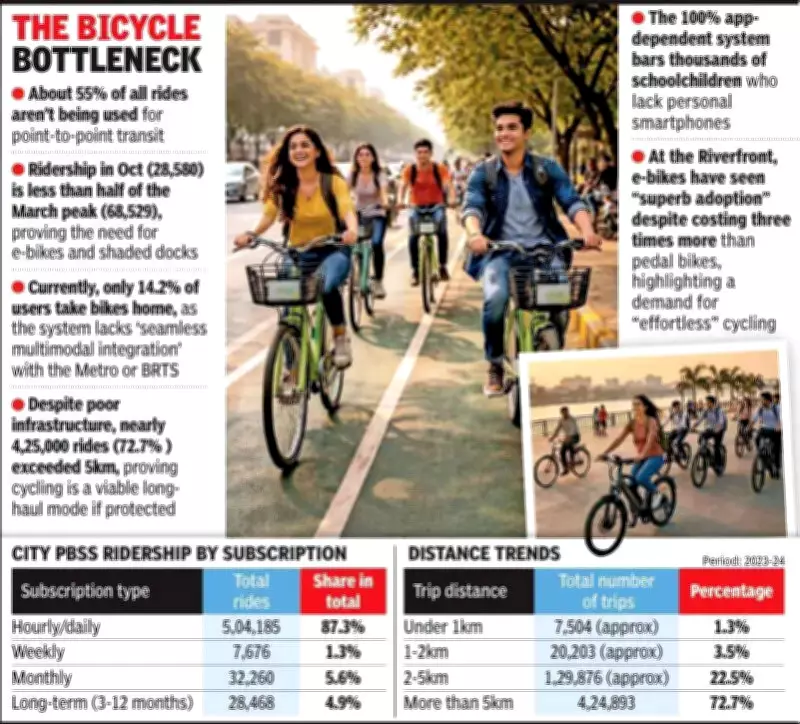
The 2025-26 research, titled 'Ridership Analysis of the Public Bicycle Sharing System in Ahmedabad', was conducted by Tothad Sattarsad Shagufta, Dimpu Byalal Chindappa, and Seelam Srikanth from the School of Civil Engineering at REVA University in Bengaluru. Over one year, the system recorded 5.77 lakh trips across 253 docking stations. However, more than half of these rides—3.17 lakh, or 55%—involved no movement between stations, classified as "zero displacement" where bicycles were borrowed and returned to the same dock.
Short-term hourly and daily passes accounted for 87.3% of all trips, while longer subscriptions of three to 12 months made up only 4.93%, indicating a strong preference for occasional use over regular commuting.

Operational Challenges and Infrastructure Gaps
Arjit Soni, founder of MYBYK, the sole PBSS operator in Ahmedabad managing over 10,000 bicycles, explained that leisure trips dominate because roads are less crowded during off-peak hours. The system performs worst during the morning rush from 6am to 9am, which still accounts for 30% of daily ridership, as traffic and safety concerns deter commuters.
To address these gaps, MYBYK has initiated placing electric bicycle docks inside offices and residential societies to improve first-mile connectivity. However, cost remains a significant barrier. A standard pedal bicycle costs Rs 50 per trip, while an electric cycle costs Rs 150 for just 15 minutes. A transport expert attributed the high pricing to the absence of government subsidies, noting that operators must install digital hardware on each cycle for tracking and access.
Without financial support from the city, the system remains inaccessible to many potential users. Additionally, PBSS access is smartphone-dependent, excluding groups like school students who lack app access. Soni has urged the Ahmedabad Municipal Corporation to integrate PBSS with the National Common Mobility Card and absorb part of the revenue risk. One proposal suggests bundling a Rs 20 BRTS ticket with a Rs 10 add-on for 12 hours of bicycle use.
Weather Impact and Untapped Potential
Weather patterns significantly influence ridership, with usage peaking at 68,529 rides in March but dropping to 32,154 in August during the monsoon season. Despite these challenges, the study highlights untapped potential: nearly 73% of trips—over 4.24 lakh rides—exceed 5km, suggesting strong commuter demand for longer distances.
For Soni, infrastructure remains a decisive factor in transforming the PBSS into a viable commuting option. As Ahmedabad gears up for the 2030 Commonwealth Games, addressing these issues will be crucial for enhancing urban mobility and reducing congestion.