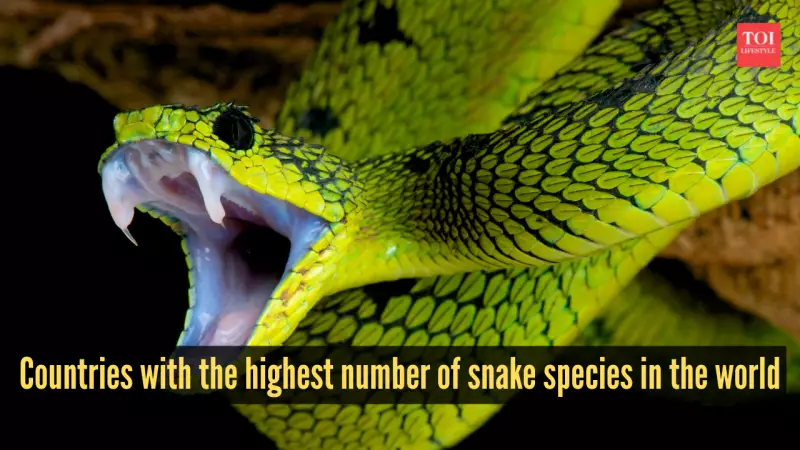
Snakes remain among the planet's most enigmatic and misunderstood creatures. Often elusive and cloaked in fear, these reptiles are vital ecological players. While estimating their total global population is nearly impossible due to their secretive nature, scientists can document the number of distinct species within national borders. Worldwide, there are over 3,500 known snake species. Contrary to popular belief, only about 600 are venomous, and a mere 200 pose a significant threat to humans. Based on species-count data from biodiversity researchers, here are the ten countries hosting the richest diversity of these fascinating reptiles.
Global Leaders in Snake Biodiversity
The ranking is based on the count of documented snake species within a country's territory, not on total snake population or danger level. These numbers reflect the incredible adaptability of snakes to diverse habitats, from dense rainforests to arid deserts. Ecologically, snakes are indispensable for controlling rodent populations and maintaining balanced food chains, even as many face threats from human misunderstanding and habitat loss.
The Top 10 Nations: A Detailed Look
1. Mexico: Topping the global list is Mexico with an impressive 438 known snake species. Its varied landscapes—including deserts, grasslands, tropical forests, and extensive coastlines—create perfect niches for a wide array of serpents, including rattlesnakes, vipers, and coral snakes.

2. Brazil: A close second, Brazil is home to 420 snake species. The vast Amazon Rainforest acts as a fertile breeding ground for iconic snakes like the anaconda and boa constrictor, alongside venomous species such as the fer-de-lance.
3. Indonesia: The Indonesian archipelago, with its thousands of islands, hosts 376 snake species. Tropical rainforests, mangrove swamps, and volcanic terrain across islands like Sumatra and Java support a rich mix of terrestrial and marine snakes.
4. India: India boasts remarkable reptilian diversity, with 305 recorded snake species. Its ecosystems range from the Himalayan foothills to the Western Ghats rainforests, Thar Desert, and sprawling wetlands. While many are non-venomous, India is also home to the saw-scaled viper, a species linked to a significant number of snakebite fatalities globally.
5. Colombia: Recognized as one of the world's most biodiverse nations, Colombia shelters 301 snake species. Its strategic position bridging Central and South America, coupled with Amazonian rainforests and Andean highlands, fosters this incredible variety.
6. China: Due to its vast size and climatic range, China provides habitat for 246 snake species. These snakes inhabit the country's forests, grasslands, wetlands, and subtropical regions.
7. Ecuador: Despite its relatively small area, Ecuador punches above its weight with 241 snake species. This high density is driven by three distinct regions: the Amazon basin, Andean slopes, and the Pacific coast.
8. Vietnam: The dense forests, wetlands, and tropical climate of Vietnam support 226 snake species, making it a key habitat for reptiles in Southeast Asia.
9. Malaysia: Malaysia, with its lush rainforests on Peninsular Malaysia and Borneo, is home to 216 known snake species.
10. Australia: Rounding out the list is Australia with 215 snake species. The continent's long geographic isolation has led to unique evolutionary lineages. Notably, not all Australian snakes are highly venomous, and many pose little threat to humans.

Conservation and Understanding
This list underscores the critical need for snake conservation. Many species are declining due to habitat destruction and persecution. It is crucial to remember that snakes are not inherently aggressive and play an essential role in healthy ecosystems. The data, sourced from reviews like the World Population Review, is dynamic; species counts may change with new discoveries and taxonomic updates. Moving beyond fear to appreciation is key to ensuring these remarkable creatures continue to thrive in the wild.