On a sunny and humid July morning, just outside Luang Prabang, the cultural capital of Laos, ancient rice terraces stretch out like a green blanket to the horizon. It is not yet 9 am, but a handful of us, with conical bamboo hats perched on our heads, are almost knee-deep in greyish slushy mud, profusely sweating. We are attempting to plant saplings as part of an immersive rice experience at Living Land Farm, a local collective, though our efforts can be described as clumsy at best. A Laotian youngster from the collective, serving as our guide, finds our struggle amusing. Taking pity, he calls off the exercise and ushers us into a covered area, leading us through the rest of the rice cultivation process. The collective sigh of relief is audible as we escape the muddy fields.
The Staple of Laotian Cuisine: Sticky Rice
Rice is a permanent fixture on the Laotian table, with sticky rice, or khao niew, being a staple. After guiding us through the harvesting, threshing, and pounding processes, our guide demonstrates how it is cooked. Unlike regular rice, which is steamed or boiled, sticky rice is first soaked in water and then steamed in a conical bamboo basket called thip khao, placed over a large pot of water. When almost done, it is continuously flipped, perhaps to agitate the gluten, until it forms a solid mass the size of a football. Fistfuls are then plucked and shaped into smaller balls, served in small bamboo pockets. The rice is soft, slightly sweet, and chewy, often enjoyed with an assortment of rice crisps. Typically off-white in color, sticky rice can also be red, maroon, or even black, with some estimates suggesting Laos grows over 500 varieties.
Exploring Laotian Cuisine: Bold Flavors and Fresh Ingredients
Laotian cuisine is known for its simplicity and freshness, featuring bold spices, herbs, and condiments such as chilli, lime, and fish sauce. While influenced by neighboring countries like Thailand, Vietnam, Cambodia, China, and Myanmar, it has managed to retain a distinct identity. In a country where over 70 percent of the land is mountainous, the food often relies on foraging in woods and jungles, incorporating ingredients like catfish, river crabs, insects, birds, frogs, herbs, lemongrass, and wild mushrooms. These elements are vividly displayed in Luang Prabang’s early morning market, where old ladies showcase their wares on rice gunny bags.

National Dish: Larb or Laab
Considered the national dish of Laos, larb or laab is a minced meat salad made with pork, chicken, beef, or fish. It can also include mushrooms, tofu, banana flowers, and sprouts. This mixture is combined with lime juice, fresh herbs, and roasted rice powder for added crunch. Typically eaten with sticky rice, it is often accompanied by cabbage and lettuce leaves to temper the chilli kick. I sampled this dish at 3 Nagas, a restaurant on Sakkaline Road, savoring its vibrant flavors.
Papaya Salad: Tam Mak Hoong
Larb faces competition from tam mak hoong, or papaya salad. Unlike the Thai som tam, the version at Tamarind Restaurant and Cooking School on Kingkitsarath Road boasts a distinct fermented flavor from fish sauce. Slivers of papaya are mixed with tomatoes, lime, chilli, garlic, and fish sauce, resulting in a dish that offers a bold blend of spicy, sour, sweet, and salty notes.
Traditional Stew: Or Lam
The best accompaniment to sticky rice is or lam, a traditional Laotian slow-cooked stew regarded as a true classic. During a day-long Mekong river cruise, which included stops at Buddhist temples, rice wine breweries, and spice gardens, I enjoyed or lam alongside sticky rice. This stew is a melange of vegetables with herbs like chilli and lemongrass, made unique by the addition of Lao chilli wood, a vine with a peppery flavor that can numb the tongue. Paired with sticky rice, it provides an earthy and warming experience. After the fieriness, it is only fitting to follow it with chunks of mango and sweet sticky rice for a refreshing contrast.

Night Market Delights and Final Farewell
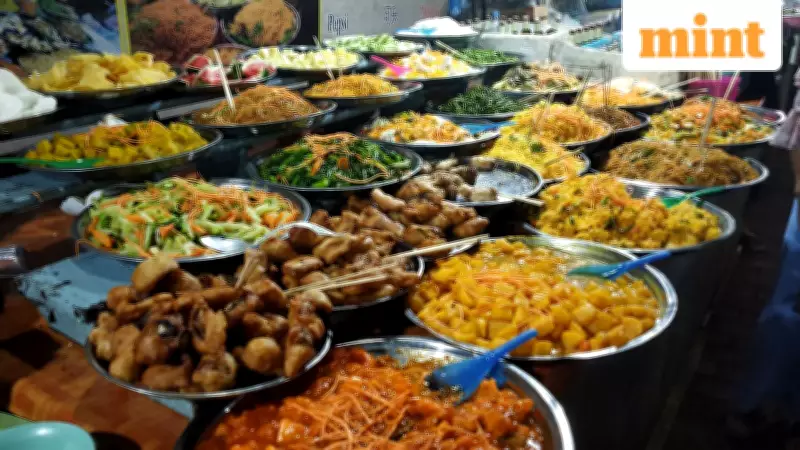
Later that evening, wandering through Luang Prabang’s night market on Sisavangvong Road, a cluster of little alleys packed with food stalls caught my attention. I succumbed to the sai oua stall, which sells various Laotian sausages. Made with minced pork and enriched with herbs and spices, these sausages are incredibly savory. Later, I enjoyed a different version, cut into bite-sized pieces and served with sticky rice and dipping sauces at Manda de Laos restaurant.
On my last night, I returned to the night market to try khao poun, a noodle soup made with rice vermicelli in a savory broth of coconut milk. I opted for chicken, though it can also contain pork or fish. The complex flavors are drawn from lime leaves, garlic, galangal, chillies, and fish sauce. Accompanied by fresh herbs, lime wedges, crispy noodles, and fried onions for added texture, this dish is a meal in itself and entirely satisfying, in many ways epitomizing the essence of Laos.