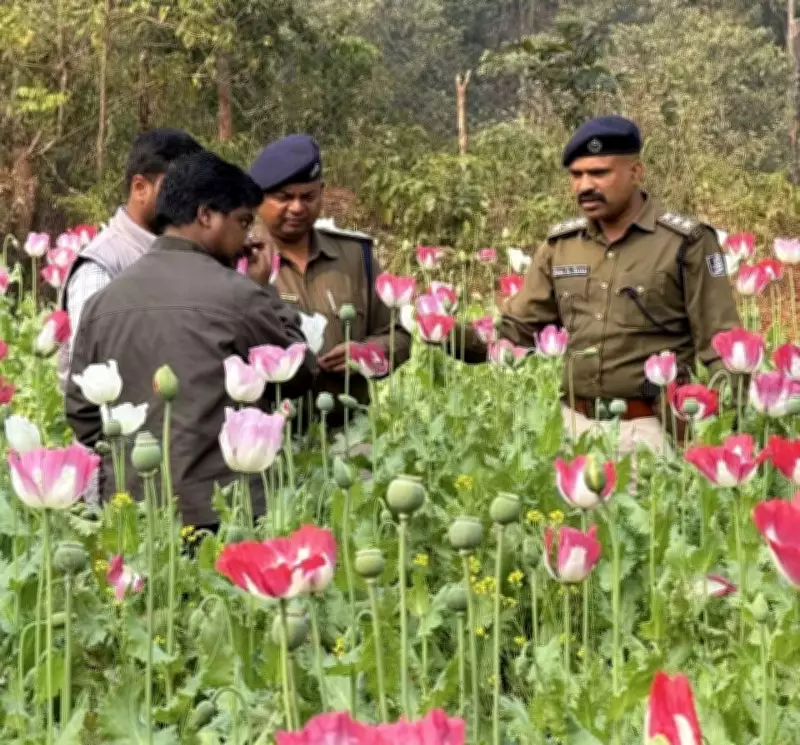
Odisha Confronts Escalating Illegal Opium Poppy Cultivation Across Forest Districts
Following the significant hashish oil seizure in Koraput's forests, drug law enforcement agencies in Odisha are now grappling with another serious challenge: widespread illegal opium poppy cultivation. Police investigations have revealed extensive unauthorized farming operations spanning several acres across multiple districts in recent months.
Discovery of Vast Illegal Farming Operations
Authorities have uncovered substantial illegal poppy cultivation in Mayurbhanj, Angul, Sundargarh, and Keonjhar districts. This discovery marks a concerning development for drug enforcement in the state, particularly as opium cultivation in India is strictly regulated and legally permitted only in notified tracts of Madhya Pradesh, Rajasthan, and Uttar Pradesh for medicinal purposes under licensed supervision.
Unlike more commonly abused substances like ganja and brown sugar, opium consumption remains relatively limited in Odisha. However, seizure data from recent years indicates a troubling upward trend. In 2022, authorities confiscated 11.86 kilograms of opium along with 1,024 kilograms of poppy husk and straw. The following year saw 10.35 kilograms of opium seized, while 2024 has already witnessed the confiscation of 13 kilograms of opium and 140 kilograms of husk.
Alarming Discovery in Protected Tiger Reserve
Police officials report that the pattern of illegal cultivation appears to have begun during the 2023-24 period. The recent discovery of extensive poppy plantations within the core area of Similipal Tiger Reserve has particularly alarmed enforcement agencies, including police, excise, forest officials, and the Narcotics Control Bureau.
Enforcement authorities suspect that cultivation activities in Similipal may have been ongoing for at least two years, with possible involvement of traffickers from neighboring Jharkhand. Poppy cultivation typically follows a seasonal pattern, with sowing occurring in November and harvesting taking place between March and April.
Police Focus on Identifying Criminal Networks
Police authorities emphasize that their immediate priority involves identifying the kingpins and promoters who entice villagers into cultivating the crop on forest lands. A senior police officer provided specific details about recent enforcement actions:
- "We are fully aware of the illegal cultivation occurring in Mayurbhanj, Rourkela, Keonjhar, and Angul districts."
- "This month alone, we destroyed poppy plants valued at approximately Rs 5 crore in Angul district."
- "Last month, we eradicated crops worth Rs 7 crore cultivated across two acres in Keonjhar district."
- "Field officials have received instructions to reactivate their intelligence networks to combat this growing problem."
Legal Framework and Illicit Market Dynamics
Opium, derived as a dry latex from poppy plant seed capsules, is legally cultivated under the strict supervision of the Central Bureau of Narcotics according to provisions outlined in the Narcotic Drugs and Psychotropic Substances Act of 1985. The government purchases opium from licensed farmers at approximately Rs 2,000 per kilogram, while traffickers sell the same substance on the black market for nearly Rs 1 lakh per kilogram, representing a substantial profit margin that drives illegal cultivation.
Opium serves legitimate medical purposes as the source material for morphine, a powerful analgesic medication. However, it also functions as the base product for manufacturing heroin and brown sugar through chemical processing involving substances like acetic anhydride and calcium hydroxide.
The discovery of illegal opium poppy cultivation in Odisha's forest areas represents a significant challenge for law enforcement agencies, requiring coordinated efforts across multiple departments to dismantle trafficking networks and prevent further expansion of this illicit activity.