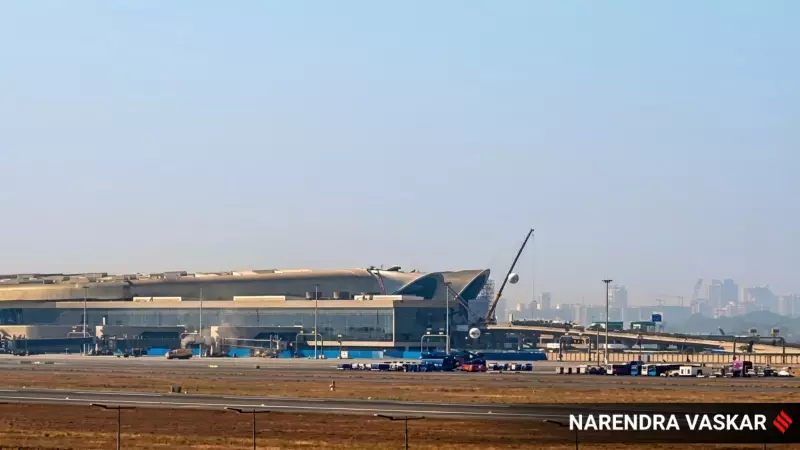
With the much-anticipated Navi Mumbai International Airport (NMIA) set to commence commercial operations from December 25, 2025, the focus has shifted to a critical question for passengers: how to get there? Located in Ulwe, Panvel taluka, the new aviation hub begins its journey without direct metro or express rail links. Until several major infrastructure projects are completed, travellers will need to navigate a combination of suburban trains, buses, and road transport to reach their flights.
Navigating by Suburban Rail: Affordable but Requires Patience
For budget-conscious travellers, suburban rail remains the most economical choice to approach the new airport, though it is not the most direct. There is no train service that goes directly to the airport terminal. All rail passengers must change trains at least once and then rely on road transport for the final leg of their journey.
Passengers starting from South Mumbai or parts of Central Mumbai will need to board Harbour Line services from the Chhatrapati Shivaji Maharaj Terminus (CSMT) heading towards nodes like Vashi, Nerul, or Belapur CBD. The crucial interchange happens at Belapur CBD, where one must switch to the Belapur–Uran line to alight at the recently operational Targhar station. For those commuting from Thane and the central suburbs, the Trans-Harbour Line to Nerul is the first step, followed by the same change to the Uran line.

From Targhar station, the airport terminals are still approximately 1.8 to 5 kilometres away, a distance that must be covered by auto-rickshaw, taxi, or shuttle. The total rail journey from CSMT to Targhar can take 75 to 90 minutes in non-peak hours but often exceeds two hours during peak periods due to crowding and interchange delays. While fares are low—second class under Rs 40 and first class between Rs 95 and Rs 175—the practicality for airport travel is hampered by luggage handling on crowded trains and the physical effort of interchanging at stations like Kurla, Dadar, and Belapur.
Public Bus Services: Low Cost but Unpredictable
Public buses operated by BEST and MSRTC will provide the cheapest surface connectivity to the airport region. However, this mode is likely the least predictable for passengers on a tight schedule, as no dedicated bus service to the airport terminal has been announced yet.
Most bus routes will drop passengers at points like Panvel, Belapur, Nerul, or Ulwe, from where a taxi or auto-rickshaw is necessary to complete the trip. Travel times are highly variable, heavily dependent on the notorious traffic congestion on the Sion–Panvel Highway and around Panvel junctions. Fares are modest, typically ranging from Rs 50 to Rs 200, but the need for multiple transfers, limited luggage space, and frequent stops make buses a challenging option for catching a flight.
Road Travel: The Most Convenient Initial Option
In the airport's initial phase, road travel is expected to be the most common and convenient mode, especially for those with luggage. Key access corridors include the Mumbai Trans Harbour Link (Atal Setu) from Sewri, the Sion–Panvel Highway, Vashi Bridge, Palm Beach Road, and the Eastern Freeway.
The Atal Setu has been a game-changer, cutting the harbour crossing to about 20 minutes and significantly improving access from South Mumbai. However, the overall journey time is often dictated by congestion on Navi Mumbai's internal feeder roads. Under moderate traffic, the drive from South Mumbai takes 60–80 minutes, while from the western suburbs it can stretch to 90–120 minutes. Residents of Navi Mumbai nodes have the advantage, with travel times as low as 20–30 minutes off-peak. Taxi fares are substantial, ranging from Rs 1,000 to Rs 1,500 from South Mumbai and Rs 1,500 to Rs 2,500 from the western suburbs, plus tolls on Atal Setu.

Connectivity Projects Still in the Pipeline
The airport's launch precedes the completion of several key infrastructure projects designed to streamline access. Metro Line 8 (the Gold Line), which will connect the existing Chhatrapati Shivaji Maharaj International Airport to NMIA, is under construction and is only expected to be operational around 2029.
Similarly, the Ulwe Coastal Road, intended to provide seamless direct access from the Atal Setu to the airport, is being built and is slated to open in early 2026. Announcements regarding dedicated airport express train or metro services are also still awaited. For now, passengers must plan their journey carefully, balancing cost, convenience, and time as Navi Mumbai's new gateway takes flight.