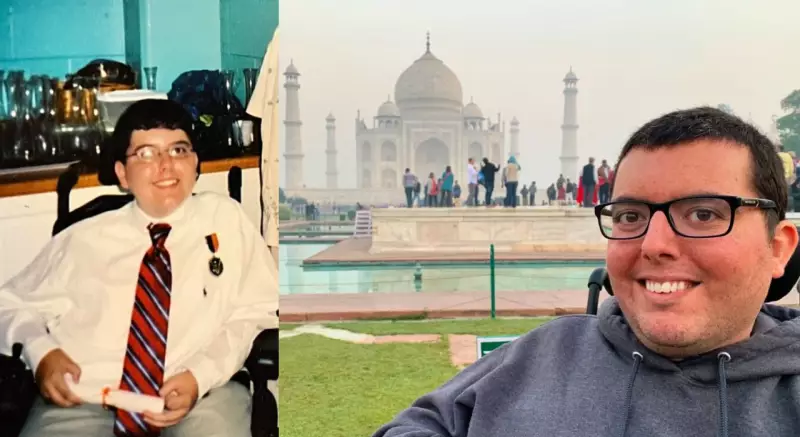
From a childhood diagnosis that confined him to a powered wheelchair to exploring the farthest corners of the globe, Cory Lee's life is a testament to a powerful piece of advice from his mother: "If you can't stand up, stand out." This mantra has propelled him to become a leading voice in accessible travel, visiting 55 countries across all seven continents by the age of 35, despite using a wheelchair full-time since he was four.
The Spark That Ignited a Global Passion
Cory Lee's first taste of international travel came at the age of 15 with a short cruise to the Bahamas. Though the trip offered only about 12 hours on land in Nassau, it was a revelation. "It completely blew me away," Lee has said. Experiencing a different culture, tasting new foods, and meeting people with vastly different lives planted a seed. He wondered if the Bahamas was this amazing, what the rest of the world must be like. That four-day journey was the birth of what he calls the "travel bug."
However, his path wasn't without significant barriers. A pivotal moment came during a job interview in his early adulthood. A potential employer bluntly told him he could not be hired because the role involved travel, which they assumed his disability made impossible. This rejection, instead of deterring him, hardened his resolve to prove them wrong.

Building a Guide for the Community: Curb Free With Cory Lee
In 2013, while planning his first major international trip to Australia, Lee noticed a critical gap: a severe lack of practical, firsthand information online for wheelchair users wanting to travel independently. Fueled by his recent job rejection and a desire to fill this void, he launched his blog, "Curb Free With Cory Lee."
The blog started as a personal diary, documenting which global destinations were accessible and, just as crucially, which were not. It quickly evolved into an essential resource for a community hungry for reliable information. His honest reviews and detailed guides have earned him a massive social media following and recognition from Condé Nast Traveller, which named him one of the most influential figures in accessible travel.
"Since then, I've fallen in love with the world and hopefully shown other wheelchair users what's possible," Lee states. His adventures are far from ordinary, including swimming in Iceland's Blue Lagoon, floating in a hot air balloon over Israel's Negev Desert, riding a camel in the Moroccan Sahara, and even paragliding in Switzerland. He has meticulously travelled across India, Egypt, Italy, and Thailand, and reached the remote ice of Antarctica.
The Realities and Challenges of Accessible Travel
Lee is quick to clarify that his travels are never spontaneous. Each journey requires exhaustive planning, often taking six months to a year of research focused on transport, accommodation, and physical access.
The most persistent challenge remains air travel. "I would love to be able to stay in my wheelchair on the plane," he says, noting that his ultimate dream is for airlines to create a dedicated wheelchair spot. The current practice of stowing his wheelchair in the cargo hold is a constant source of anxiety. "It is very frequently damaged during flight," he explains, "and then I can't get around independently, so it's a catastrophe."
Living with and Looking Beyond Spinal Muscular Atrophy
Cory Lee was diagnosed with Spinal Muscular Atrophy (SMA) at the age of two after his mother noticed he would take a few steps and fall. By four, he could no longer walk. The progressive neuromuscular condition has led to increased muscle weakness over time; today, he cannot straighten his legs or lift his elbows off his wheelchair's armrests.
When diagnosed in the 1990s, treatment options were virtually non-existent. "Back in the 90s, we had no treatment," he recalls, relying mainly on physical therapy and swimming. He views recent medical advances, like gene therapies now available for newly diagnosed children, with cautious optimism. "It's definitely exciting... I feel super hopeful for the next generation," he says, believing they will be able to maintain muscle function longer.

For Cory Lee, travel is more than a hobby; it is an escape and a powerful statement. He explores the world not in spite of his disability, but openly with it, rolling through places he was once told were forever out of reach, inspiring countless others to do the same.