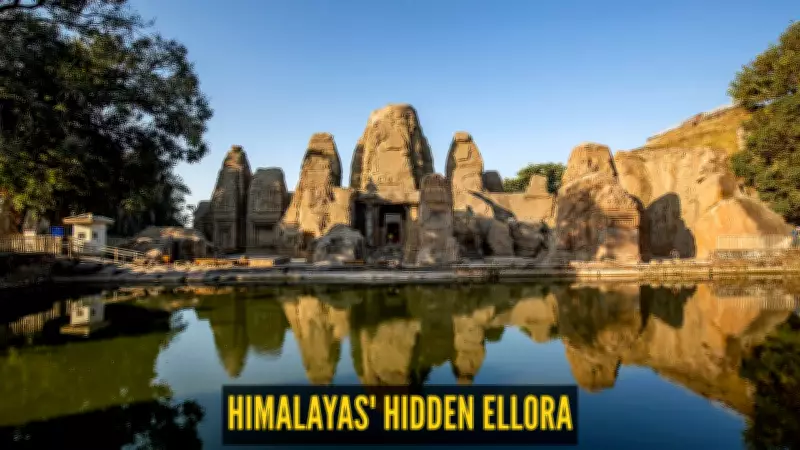
Tucked away in the hills of Himachal Pradesh’s Kangra Valley lies an extraordinary piece of Indian heritage that is mostly ignored. Often called the “Ellora of the Himalayas”, the Masroor Rock-Cut Temples form a stunning complex carved entirely out of a single face of sandstone. The spot backed by Dhauladhar mountain range delivers an incredible mix of spirituality, history, and natural beauty.
While massive crowds flock to nearby Dharamshala and McLeod Ganj every year, Masroor has managed to dodge the heavy footprints of mass tourism. If you're a traveller keen to unearth a genuine hidden gem in Himachal, you really shouldn't miss this ancient wonder.
Where exactly are the Masroor Rock-Cut Temples?
You'll find them situated in the Kangra district of Himachal Pradesh. They sit about 40 kilometres from Dharamshala and roughly 36 kilometres outside of Kangra town itself. Hovering at an altitude of roughly 2,535 feet above sea level, the temple complex looks out over the vibrant Beas Valley whilst offering cracking views of the snow-capped Dhauladhar peaks.

The site is right next to the little village of Masroor, wrapped up in a quiet, rural atmosphere that makes the whole place feel incredibly peaceful. To get there the drive through forests, bending roads, and farming fields make it the absolute lovely experience.
What makes Masroor stand out?
The uniqueness lies in the making of this temple. The who complex is carved out straight out of a massive sandstone ridge. It took an unimaginable amount of effort from ancient artisans to chip away at the rock until an interconnected group of 15 temples emerged from one solid block.
Scholars reckon the site dates back to somewhere between the 8th and 9th centuries CE. Today, it stands as one of the only surviving monolithic rock-cut monuments in the northern half of India.
Local legends say the Pandavas from the Mahabharata carved the whole thing during their long exile. One popular version of the tale even suggests they were attempting to build a stone stairway straight to heaven but had to abandon the project abruptly. This supposedly explains why certain sections look a bit unfinished. Today, the main sanctum actually houses idols of Lord Ram, Lakshman, and Sita, locals actively come and worship here.
Surviving the 1905 Earthquake
Perhaps the most impressive thing about Masroor is simply that it's still standing. Back in 1905, a horrific earthquake tore through the Kangra region, flattening villages, wrecking monuments, and even taking down massive chunks of the mighty Kangra Fort.
Masroor took a heavy hit. Several shrines collapsed, and the damage is still highly visible today. However, the core structure survived the disaster surprisingly well. Structural experts point out that because the temple is just one giant piece of rock, it managed to absorb and distribute the seismic shocks much better than a standard building made of stacked stones ever could.
Looking at the surviving spires today gives you a profound respect for the engineering skills of the people who carved it.
How to get to Masroor
Getting there takes a bit of forethought, but it is absolutely worth the effort.
- By Air: The closest flight hub is Gaggal Airport (often called Kangra Airport), sitting about 20 kilometres from the temples. You can easily catch regular flights here from Delhi and a few other major hubs.
- By Rail: If you're coming by train, Pathankot is your nearest major railway station, roughly 85 kilometres away.
- By Road: Masroor links up nicely with Kangra, Dharamshala, and the rest of Himachal via local roads. Honestly, the easiest way to do it, especially for a day trip is just to hire a local taxi from Dharamshala.
When is the best time to go?
Try to aim for spring (March to April) or autumn (September to October). The weather during these windows is spot-on, the skies stay relatively clear, and the surrounding countryside looks stunning.
Summer is also perfectly fine since the altitude keeps things much cooler than down in the plains. The monsoon season, however, is a bit dicey as the trails and roads get terribly slippery. Winter is great if you prefer having the place entirely to yourself; just make sure you wrap up warm because it gets properly cold.

The complex is generally open to visitors every day from dawn until dusk. With a tiny entry fee, it makes for a brilliant, budget-friendly day out.
Other Spots to Explore Nearby
You can easily bundle a trip to Masroor with a few other highlights around the Kangra Valley:
- Kangra Fort: One of the oldest and most massive forts in the Himalayas. It’s a brilliant stop if you’re into military history or royal heritage.
- Bathu Ki Ladi: A highly unusual cluster of old temples that literally spends half the year submerged in the Pong Dam reservoir, only emerging during the dry season.
- Pilgrimage Sites: The region is famous for its revered temples, so you might want to stop by Jwala Ji, Chamunda Devi, or Brajeshwari Devi whilst you're in the area.
The Masroor Rock-Cut Temples are far more than just an old monument. They stand as a brilliant fusion of engineering, deep-rooted faith, myth, and artistic flair. Chiselled out of a single hillside well over a millennium ago, the site continues to baffle and inspire anyone who makes the trek out there.