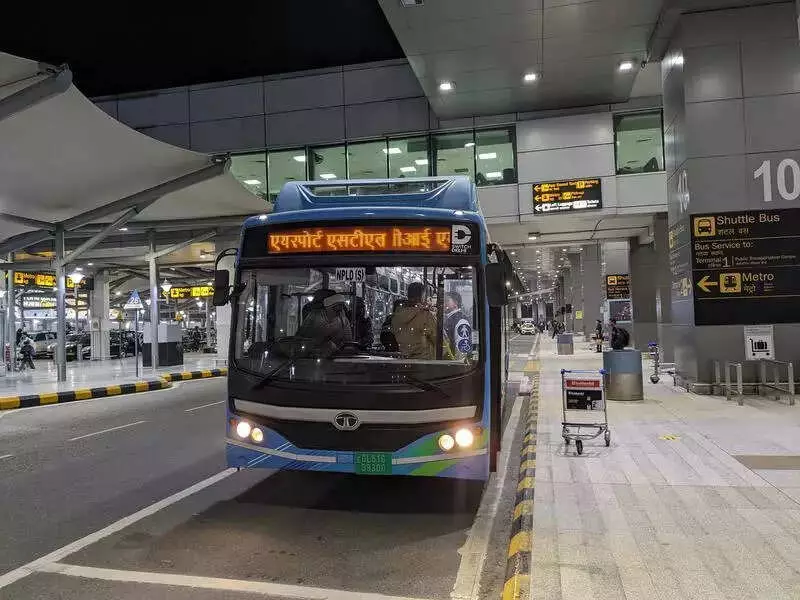
Passengers transiting through New Delhi's Indira Gandhi International Airport (IGIA) can expect a significantly smoother experience from next year. The airport operator is actively working on a plan to introduce dedicated airside corridors, eliminating the current cumbersome road-based transfers between terminals.
The Plan for Seamless Connectivity
Delhi International Airport Ltd (DIAL), which manages the airport, is developing a technical solution to connect terminals via secure, airside pathways. The initial phase will focus on facilitating transfers for passengers moving from domestic to international flights. According to sources, the aim is to launch this service before March 2026, pending necessary clearances from multiple government agencies.
The first corridor is expected to link Terminal 2 and Terminal 3. Following this, the facility for international-to-domestic transfers from T3 to T2 will be introduced. An even bigger relief is anticipated by June 2025, when a similar airside connection for domestic-to-international transfers between T1 and T3 is likely to be operational. The reverse route for international-to-domestic flyers from T3 to T1 will follow suit.

Why Start with Domestic-to-International?
The strategy to begin with domestic-to-international transfers is rooted in baggage handling logistics. Officials explain that passengers on an incoming domestic flight can directly carry their checked-in luggage to an outgoing international flight. Conversely, for international passengers entering India and catching a domestic connection, baggage must first clear Customs, which requires a different logistical setup. A seamless route for this latter group is also reportedly being designed.
Addressing a Long-Standing Pain Point
The commute between terminals, especially T1 and the T2/T3 complex, which are nearly 9 kilometers apart, has been a major inconvenience for transit passengers. Despite IGIA being one of the world's busiest airports, a proposed automated people mover or air train—common at global hubs like Singapore's Changi, London's Heathrow, and Dubai International—has remained on paper for almost a decade.
DIAL recognizes that in the continued absence of an air train, an interim solution is crucial. An internal DIAL team along with external consultants is working on the dedicated corridor project. The proposed system will use buses on the airside, operating with a speed limit of 20 kmph. Even at this pace, the transfer will be far more convenient and faster than the current roadside shuttle service.
Regulatory Hurdles and Future Vision
The airport operator plans to present the detailed blueprint to relevant government bodies, including the Ministry of Civil Aviation, the Directorate General of Civil Aviation (DGCA), the Bureau of Civil Aviation Security (BCAS), Customs, and the Central Industrial Security Force (CISF) for their inputs and final approvals.
This passenger-friendly initiative is timed to coincide with DIAL marking two decades of managing IGIA in 2026. The company, backed by the GMR Group, took over the airport under a public-private partnership (PPP) model in May 2006. With its first 30-year concession period ending in 2036, the window for a large-scale project like an air train to become operational and be financially viable is considered too narrow. Therefore, the dedicated airside corridor emerges as a practical and highly beneficial alternative for the foreseeable future.
For now, the plan does not include airside transfers for domestic-to-domestic passengers between the three terminals. However, the new corridors promise to be a game-changer for the vast number of domestic-international transit flyers, finally addressing a critical gap in India's premier aviation hub's infrastructure.