India's 7 Most Colorful Forest Birds: A Visual Guide to Nature's Palette
Among the most biodiverse regions on Earth, India's forests present an unparalleled spectacle for nature enthusiasts. Spanning from the alpine heights of the Himalayas to the rain-drenched evergreen forests of the Western Ghats and the dense jungles of Northeast India, these habitats are not only biodiversity hotspots but also visual feasts for birdwatchers. Thick canopies, ancient trees, forest clearings, and riverine corridors create the perfect stage for birds whose colors, calls, and courtship displays appear almost surreal.
Some birds captivate with their iridescence, others with their impressive size or extravagant tails. Many play vital roles in forest health and regeneration, making India arguably the most rewarding country in the world for birdwatching. Here are seven of the most colorful avian residents of Indian forests.
Himalayan Monal: The High-Altitude Marvel
Often hailed as the world's most colorful pheasant, the Himalayan Monal is a breathtaking sight in high-altitude forests. Inhabiting the oak, conifer, and rhododendron forests of Uttarakhand, Himachal Pradesh, and parts of the Northeast, the male monal showcases an extraordinary blend of metallic green, copper, violet, and blue that shifts with every movement. Its crest feathers enhance its regal appearance, particularly when observed foraging on open forest slopes. Females, while less flamboyant, possess an attractive earth-toned camouflage that helps them blend seamlessly with the forest floor.

Indian Peafowl: The Forest's Iridescent Gem
Although commonly associated with open areas and temple complexes, peafowl thrive equally in forest environments, especially dry deciduous and mixed forests. In these settings, the peacock's iridescent blue throat and magnificent train create a dramatic contrast against the subdued browns and greens of the forest. During the monsoon season, in forest clearings, the peacock engages in a captivating courtship display, vibrating its feathers and producing a soft rustling sound that adds to its allure.
Great Hornbill: The Prehistoric Giant
Few birds embody the spirit of tropical India as profoundly as the great hornbill. These colossal birds boast a wingspan stretching up to five feet, making them truly impressive. Their oversized yellow beak, adorned with a distinctive casque on top, lends them a prehistoric appearance. Beyond their striking looks, great hornbills are crucial for seed dispersal, consuming fruits whole and spreading seeds across the forest. Their slow, deliberate wingbeats produce a distinctive whooshing sound as they glide through the canopy.
Malabar Trogon: The Western Ghats' Hidden Jewel
Endemic to the Western Ghats, the Malabar trogon is one of India's most sought-after forest birds. Unlike louder or more conspicuous species, this quiet and somewhat elusive bird prefers the sheltered, moist evergreen forests near streams. Its arresting crimson belly, contrasted with a black head and finely patterned wings, makes it unforgettable once spotted. The Malabar trogon often sits motionless for extended periods, blending perfectly into the forest's stillness.
Indian Roller: The Sky's Electric Flash
The Indian roller is renowned for its spectacular flashes of blue during flight. While perched, it displays relatively subdued shades of brown and turquoise. However, the moment it takes to the air, its wings reveal brilliant electric-blue and aquamarine bands that seem to glow in sunlight. This dramatic color contrast has earned the bird a reputation as one of India's most eye-catching species. It is commonly found in open woodlands, forest edges, and agricultural landscapes.
Oriental Dwarf Kingfisher: The Living Jewel
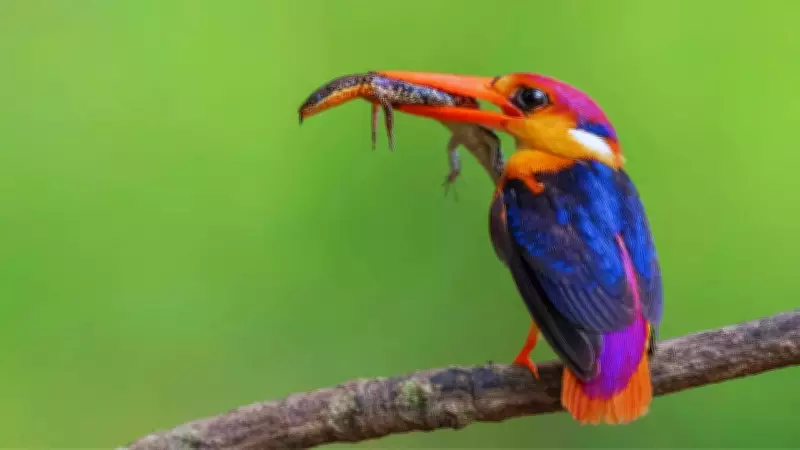
Often described as a living jewel, the Oriental Dwarf Kingfisher appears almost unreal even by kingfisher standards. Tiny in size but explosive in color, it showcases a dazzling mix of deep purple, electric blue, bright orange, yellow, and crimson, all packed into a body barely larger than a sparrow. Unlike most kingfishers, it is not typically seen near open water; instead, it prefers dense forest undergrowth near shaded streams, particularly in the Western Ghats and parts of eastern and northeastern India.

Indian Pitta: The Nine-Colored Forest Floor Dweller
Commonly called the Navrang or nine-colored bird, the Indian Pitta is one of the most visually striking inhabitants of the forest floor. Compact and round-bodied, it wears an extraordinary mix of colors: emerald green wings, a buffy underside, a bold black eye-stripe, and flashes of electric blue on its wing coverts that are usually visible only in flight. This sudden burst of color makes first sightings particularly thrilling for birdwatchers.
These seven colorful birds highlight the incredible avian diversity of India's forests, each contributing uniquely to the ecosystem's vibrancy and health. Their presence underscores the importance of conserving these precious habitats for future generations to admire and study.