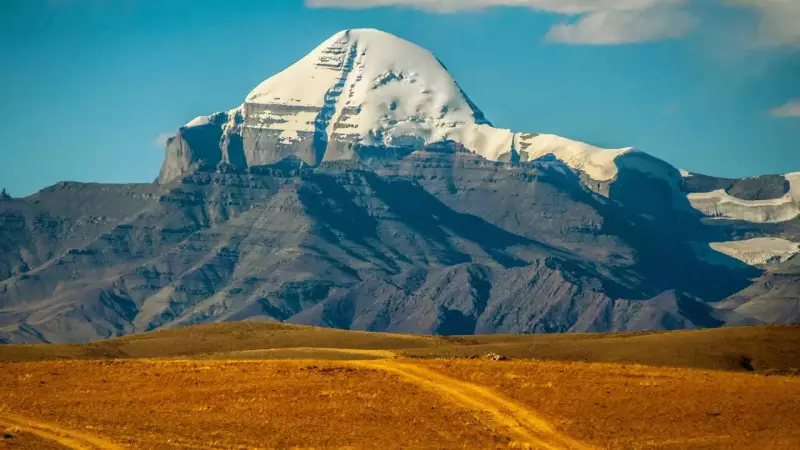
Since the dawn of human civilization, mountains have captivated humanity not merely as the highest geographical formations on Earth but as profound spiritual symbols. These majestic peaks are often perceived as divine abodes, sites of revelation, and pathways to enlightenment across diverse cultures and religions. People have undertaken arduous pilgrimages to these sacred summits seeking blessings, forgiveness, or spiritual awakening, while ancient myths and holy scriptures have woven them into the sacred tapestry of faith. Beyond their breathtaking beauty, these mountains carry narratives that shape belief systems and cultural identities. Here, we explore five of the world's most revered mountains and the timeless stories that sanctify them.
Mount Kailash, Tibet Autonomous Region, China
Often hailed as the spiritual epicenter of the world, Mount Kailash holds a unique position in global religious geography. This snow-capped peak is venerated by Hindus, Buddhists, Jains, and followers of the ancient Bon religion. In Hindu mythology, it is believed to be the eternal abode of Lord Shiva and Goddess Parvati, where Shiva resides in deep meditation, governing the universe. Devotees hold that performing a single parikrama (circumambulation) around the mountain can cleanse the sins of a lifetime, while completing 108 parikramas may lead to liberation from the cycle of rebirth. For Buddhists, Kailash symbolizes Mount Meru, the axis of the cosmos, and represents the tantric deity Chakrasamvara. Jains revere it as the site where their first Tirthankara, Rishabhadeva, attained enlightenment, and Bon followers consider it the seat of powerful sky deities.
Adam’s Peak or Sri Pada, Sri Lanka
Rising gracefully from the central highlands of Sri Lanka, Adam’s Peak, or Sri Pada, stands as one of the world's most remarkable multi-faith pilgrimage destinations. What distinguishes this mountain is not only its scenic allure but its ability to unite four major religions in the veneration of a single symbol. The summit features a natural rock formation resembling a human footprint, which holds profound spiritual significance. Buddhists identify it as the footprint of Lord Buddha, left during his legendary visit to the island. Hindus regard it as the imprint of Lord Shiva. Meanwhile, Muslims and Christians believe it marks the first step taken by Adam after his descent to Earth following expulsion from paradise, making it a powerful symbol of shared heritage.

Mount Fuji, Japan
Few mountains blend national identity with spiritual meaning as seamlessly as Mount Fuji. As Japan's tallest peak and most iconic natural landmark, this symmetrical volcano has long been revered as a sacred entity in Shinto and Buddhist traditions. In Shinto mythology, Mount Fuji is the dwelling of the goddess Konohanasakuya-hime, who embodies life, rebirth, and protection against volcanic fire. During the Edo period, organized pilgrimages known as the Fujiko movement encouraged ordinary citizens to undertake ritual ascents as acts of spiritual devotion. Today, shrines adorn the lower slopes and summit, and many climbers still approach the journey as a pilgrimage rather than a mere physical challenge, reflecting its enduring sacred status.
Mount Sinai, Egypt
Nestled within the arid deserts of the Sinai Peninsula, Mount Sinai is an integral part of the religious history of Abrahamic faiths. Locally known as Jebel Musa, or the Mountain of Moses, it is believed to be the site where Moses received the Ten Commandments from God, forming the moral foundation of Judaism, Christianity, and Islam. For centuries, devotees have ascended the mountain in solemn silence, often beginning their journey before dawn to reach the summit by sunrise. At its base lies St. Catherine’s Monastery, one of the oldest Christian monasteries globally and a UNESCO World Heritage Site. Within its ancient walls, priceless manuscripts, icons, and the Chapel of the Burning Bush are preserved, believed to mark the spot where Moses encountered God in the form of fire.

Mount Olympus, Greece
Long before its designation as a national park and mountaineering destination, Mount Olympus was revered as the symbolic throne of the gods in Greek mythology. It was considered the dwelling place of the Twelve Olympian gods, led by Zeus, the king of the gods. Ancient Greeks believed Olympus concealed gleaming palaces where deities feasted on ambrosia and deliberated the fates of mortals. For them, Olympus represented the boundary between the mortal realm and the world of immortals, a place too sacred and powerful for humans to tread, embodying the divine separation between earthly and celestial spheres.