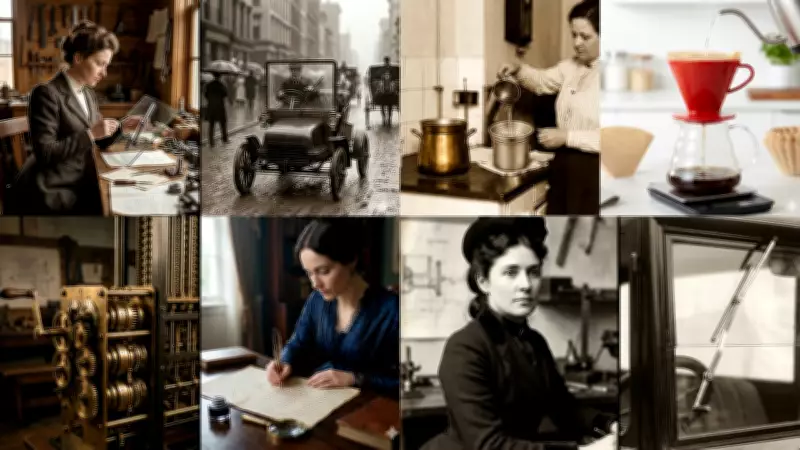
8 Essential Inventions Created by Women That Shaped Modern Life
In kitchens, workshops, and everyday spaces, women have consistently transformed frustration into brilliant ingenuity. While these inventions might not always be celebrated as groundbreaking technological marvels, they have quietly revolutionized daily tasks like washing dishes, driving safely, or enjoying a perfect cup of coffee. Many of these creations are so intuitive that their origins are often overlooked. This exploration delves into eight such essential inventions rooted in women's perseverance and innovative spirit, highlighting documented stories from museum records and engineering history that showcase how ordinary women became pioneers of practical solutions.
The Modern Coffee Filter: Melitta Bentz
In 1908, German housewife Melitta Bentz grew tired of the bitter, muddy coffee produced by traditional methods and the unreliable paper filters that frequently fell apart. Her ingenious solution involved punching holes in a brass pot, lining it with blotting paper from her son's school supplies, and adding coffee grounds. The result was a cleaner, smoother beverage. Bentz patented this idea and founded the company that still bears her name today. Design history case studies often cite her contribution as a classic example of user-centric design, transforming a household nuisance into a mass-market product. Her simple paper-and-funnel design is now archived in design museums as a revolutionary improvement in everyday taste.
The Disposable Sanitary Napkin: Multiple Women Inventors
During the late 19th and early 20th centuries, numerous women innovators contributed to the development of absorbent materials and pads for menstrual protection. Historical health research highlights figures like Mary Beatrice Davidson Kenner and other early pioneers who designed improved pads with better closures, materials, and shapes, enhancing hygiene and comfort. Feminist medical history monographs emphasize that these inventions were groundbreaking, granting women greater freedom and safety in their daily lives, even though their names were often omitted from popular advertising. Today, these patents are recognized as integral to the broader history of women's health and mobility.

Improvements to the Telephone Receiver: Ruth Graves Wakefield and Others
Early telephones suffered from poor sound quality, prompting various engineers to work on enhancing earpieces and receivers. Patent catalogues reveal that women filed for inventions that produced better sound and were more comfortable to use. Museum exhibits on communication technology history demonstrate how these innovations improved the user experience, helping make the telephone a staple household appliance. Engineering history papers note that such "small but vital" components are frequently overlooked in mainstream narratives.
The Computer Loop and Software Loop: Ada Lovelace
In the 1840s, Ada Lovelace collaborated on translating and annotating Charles Babbage's writings about his Analytical Engine. Through this work, she developed what computer historians now recognize as the first algorithm intended for machine execution. Lovelace was the first to conceptualize loops, or repeating operations, which are fundamental to computer programming. A National Institute of Standards and Technology report on early computing explicitly acknowledges her contribution to laying the groundwork for loops and conditional operations. In modern engineering and computer science education, her notebooks are used to illustrate the critical role of women in developing computer logic.
The Windscreen Wiper: Mary Anderson
During a visit to New York in 1903, Mary Anderson observed streetcar drivers struggling with rain-obstructed windscreens, forcing them to open windows to clear the view. Inspired, she sketched a "window cleaning device" featuring a rubber blade and an interior lever. Anderson patented this device in 1903, and automotive history studies credit her as the inventor of the first windscreen wiper. Journals on transportation history highlight how her idea evolved into the electric wipers used on cars, trains, and airplanes today.

The Circular Saw: Tabitha Babbitt
In the early 19th century, Tabitha Babbitt, a Shaker crafts worker, watched men laboriously sawing logs with pit saws and noted the inefficient, wasteful motion. She conceived the idea of a circular blade for a rotating saw, significantly speeding up the process. The Harvard Historical Society acknowledges her for the basic concept of a rotating saw, though patent history studies indicate she did not secure adequate legal protection for her work. Her case is now included in museum-based curricula on women inventors.
The Modern Turn Signal: Florence Lawrence and Others
While auto-signal arms were common, the development of turn indicators involved multiple women's innovations. Surveys of patent law and transportation history document how women in the early 20th century created levers, lights, and arrows to enhance driving safety. According to the National Women's History Museum, vehicle safety systems often credited to male engineers actually emerged from the combined ingenuity of both female and male innovators.
The Dishwasher: Josephine Cochrane
American social host Josephine Cochrane grew frustrated with her fine china getting chipped and broken during hand-washing in the late 19th century. In 1886, she designed and patented a mechanical "dish-washing machine" featuring a rack and water jets. Cochrane later supplied her invention to hotels and restaurants. The National Inventors Hall of Fame lists her in significant histories of engineering and women inventors, crediting her as a pioneering figure who turned a household problem into a new home appliance. Recent industrial history discussions note how her company's designs eventually evolved into the automatic dishwashers found in countless homes today.
These stories underscore the profound impact of women's ingenuity on everyday life, reminding us that innovation often springs from addressing practical challenges with creativity and determination.