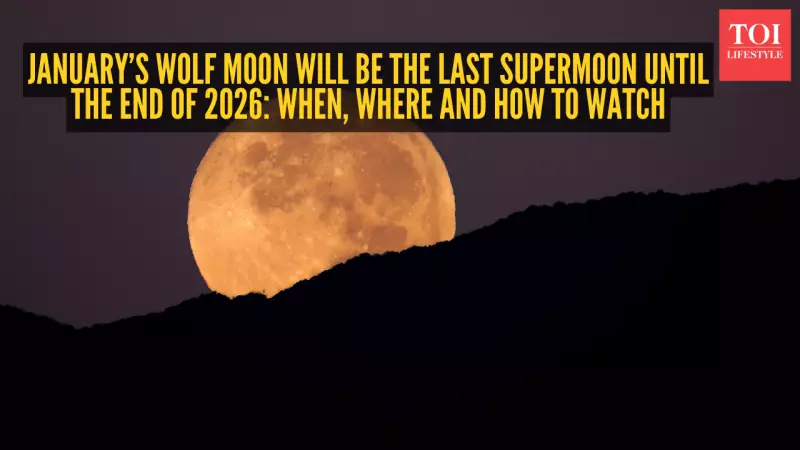
Skywatchers across India have a rare and final celestial treat before a long wait. The first full moon of 2026, known as the "Wolf Moon," will be a dazzling supermoon on Saturday, January 3. This event marks the last opportunity to witness a supermoon until November 2026, making it an unmissable spectacle.
What Makes This January Moon So Special?
A supermoon occurs when a full moon coincides with its closest orbital point to Earth, called perigee. According to NASA, this alignment makes the lunar disc appear up to 14 percent larger and roughly 30 percent brighter compared to a micromoon, which is when the moon is at its farthest point. The January 3 supermoon will reach peak illumination around 3:30 PM IST. However, the best viewing times in India will be around moonrise and moonset.
Best Time to Watch and the 'Moon Illusion' Effect
For observers in India, the supermoon will be visible throughout the night from January 2 into January 3. The most dramatic views typically occur just after sunset during moonrise and just before sunrise during moonset. NASA notes that the moon often looks exceptionally large near the horizon due to a visual trick known as the moon illusion. Additionally, its colour shifts from a bright white overhead to a deep, warm orange near the horizon because moonlight passes through more of Earth's atmosphere, scattering blue light and allowing red wavelengths to dominate.

This supermoon won't be alone in the sky. Jupiter will appear prominently close to the moon throughout the night, with the iconic winter constellation Orion nearby. Saturn will also be visible, glowing in the southwest sky around the time the moon rises.
How to Enjoy the Show and Photograph the Moment
The good news for city dwellers is that a supermoon is bright enough to overcome light pollution. You don't need special equipment; finding a clear view of the horizon is key. In January, the moon rises in the northeast on the evenings of January 2 and 3.
An added bonus is that this event overlaps with the peak of the Quadrantid meteor shower from January 2 to 3. While the supermoon's brightness may obscure fainter meteors, NASA states that the shower's characteristic bright fireballs should still be visible, especially between midnight and dawn.
For photography enthusiasts, using a tripod and a telephoto lens during moonrise can capture the rich colours. Smartphone users should rely on optical zoom (around 5x) and steady their device. Including foreground elements like trees or buildings can add drama and scale to your photos.
So, mark your calendars for this weekend. After the Wolf Moon sets, the next supermoon won't grace our skies for nearly three years, making this a truly special astronomical event for all of India.