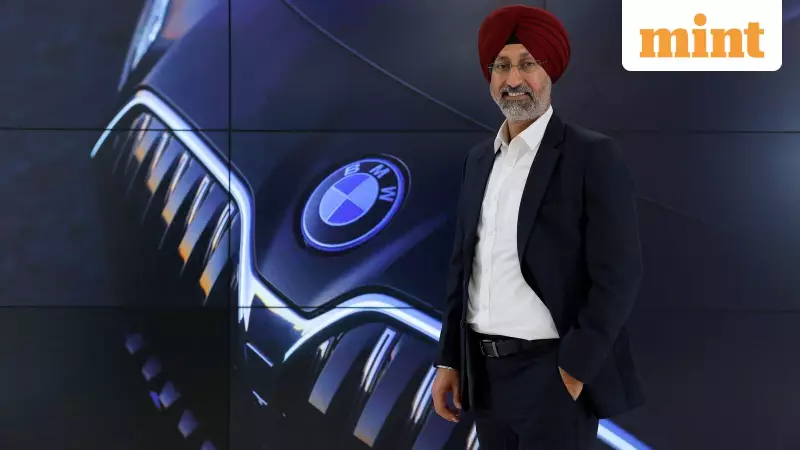
German automotive giant BMW is gearing up for its most ambitious product onslaught in India, with plans to introduce a staggering 25 new car models in 2026. This strategic move is squarely aimed at capturing the growing segment of first-time premium buyers in the country, as the luxury car market expands beyond its traditional base.
Record Sales Fuel Aggressive Expansion
This massive launch plan follows a landmark year for BMW in India. The company achieved its highest-ever annual sales in 2025, selling 18,001 units since its market entry in 2007. This marked a significant 14% year-on-year growth. A key driver of this success has been the brand's increasing appeal to customers upgrading from near-premium and non-premium segments.
According to data shared by the company, the share of such upgraders in BMW's total annual sales rose from 43% in 2024 to 49% in 2025. This indicates that nearly half of all new BMW purchases are now made by individuals entering the luxury car market for the first time.

The Electric Surge and Product Pipeline
Electric vehicles (EVs) have played a pivotal role in BMW's recent growth. The automaker witnessed a fourfold jump in EV sales in 2025, selling 3,753 units. Notably, one in every five BMWs sold in India is now electric. Popular models driving this charge include the top-end BMW i7 sedan and the entry-level luxury SUV, the BMW iX1.
Detailing the 2026 roadmap, Hardeep Singh Brar, Chief Executive of BMW India, stated that the launch blitz will include 15 new models under the core BMW brand and 10 under the MINI brand. The portfolio will comprise new nameplates, facelifts, and comprehensive model upgrades. Additionally, BMW's motorcycle division will introduce two new models, bringing the total number of launches to 27 vehicles.
Strategic Focus: Expanding the Luxury Pie
Brar emphasized that BMW's strategy is to broaden the base of the luxury car market itself. "We are actually playing the role of expanding the pie of the luxury market, because somebody has to play the role," he said. The company is targeting consumers who purchased SUVs in the ₹15-25 lakh range five to six years ago and are now seeking an upgrade to a luxury SUV.
This focus on the entry-luxury segment, where cars typically cost between ₹50-60 lakh, is seen as critical for an industry that sells only about 50,000-52,000 units annually in India—a minuscule fraction of the overall passenger vehicle market that crossed 4.3 million units in 2025.
The bullish outlook is supported by a rapid increase in wealth creation. The Mercedes-Benz Hurun India Wealth Report highlights that the number of millionaires in India nearly doubled from 458,000 in 2021 to 871,700 in 2025.
Contrasting Approaches with Rival Mercedes-Benz
BMW's volume-driven strategy stands in contrast to its chief rival, Mercedes-Benz, which continues to bet heavily on the top end of the luxury market. Despite the aggressive launch plan, BMW has no immediate plans to expand production capacity and will continue to manufacture vehicles from its sole plant in Chennai, which has an annual capacity of 50,000 units.
Industry analysts view the two German rivals' approaches as complementary. "Both approaches are right for today’s demand curve, one expands the base, the other deepens the value pool together lifting consumer choice, dealer confidence, and the category’s long-term health," said Harshvardhan Sharma of Nomura Research Institute Consulting and Solutions India.
With its 2026 product offensive, BMW is clearly doubling down on its bet to democratize luxury mobility in India, aiming to convert the country's burgeoning affluent class into lifelong customers of the brand.