

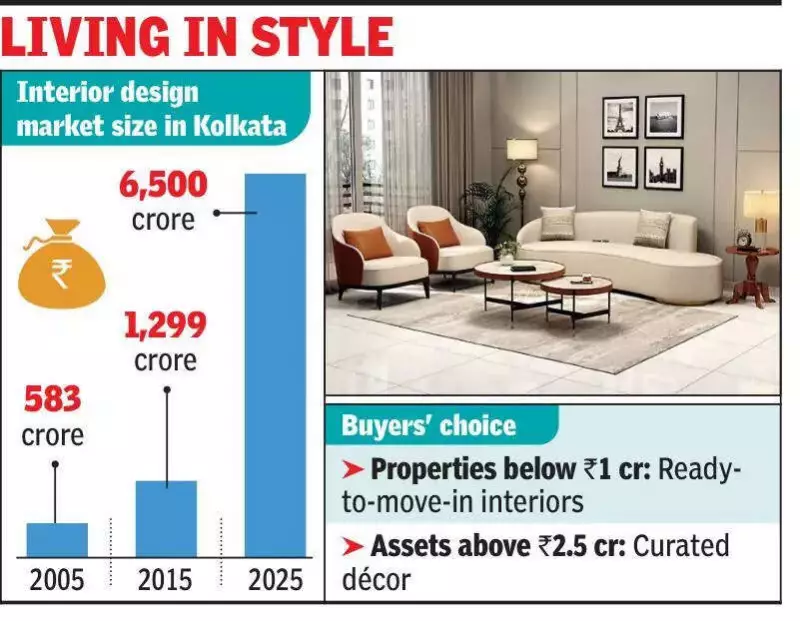
The interior design landscape in Kolkata is undergoing a remarkable transformation, evolving from a niche service to a multi-crore, specification-driven industry. The market in the city has witnessed explosive growth, expanding from Rs 583 crore in 2005 to Rs 1,299 crore by 2015. Current estimates peg the sector's revenues for 2025 at a staggering nearly Rs 6,500 crore. If the current compounded growth momentum holds, projections indicate the market could reach roughly Rs 12,000 crore by the year 2030.
Two-Tier Buyer Behaviour Reshaping the Market
Buyer preferences in Kolkata are now clearly split into two distinct patterns, largely dictated by budget and lifestyle. In the sub-Rs 1 crore apartment segment, buyers predominantly opt for ready-to-move-in interiors. They seek completed flooring, standardised kitchen fittings, wall tiles, and bathroom fixtures, driven by a desire for convenience, faster handover, and predictable, upfront costs.
Conversely, in the premium segment, especially for homes above Rs 2.5 crore, a significant shift is evident. Buyers increasingly prefer "bare shell" handovers, actively avoiding builder-installed finishes. This trend is empowering interior architects, as clients treat the interior design process as a highly personalised journey. "This shift is strengthening the role of interior architects in Kolkata, with higher-end clients treating interiors as a personalised design process," noted Raja Sinha, President of the Association of Building Interior Designers (ABID).

Key Trends: From Space Optimisation to Smart Tech
Contemporary interior architecture in Kolkata is moving towards cleaner planning, high-performance materials, and integrated detailing. Space optimisation has become central, with a strong emphasis on innovative storage solutions, flexible rooms, and multi-functional furniture. Premium homes are embracing larger, calmer volumes with concealed services, minimal visual clutter, and refined transitions between materials.
Kitchens are transforming into engineered, modular systems featuring better hardware, taller units, and improved workflow planning. Lighting design now strategically combines ambient, task, and accent lighting using concealed profiles to control glare. Furthermore, acoustic comfort is gaining focused attention in bedrooms, home offices, and media rooms.
"There is a visible move towards durable, low-maintenance finishes, better moisture management, and more precise execution standards," explained Samiran Banik, Principal Architect and ABID exhibition coordinator.
Technology as a Game-Changer
Technology is rapidly integrating into the design process and the final product. VR walkthroughs and immersive 3D visualisation are now commonly used to help clients experience layouts and material combinations before execution. AR tools allow buyers to preview furniture and finishes in their actual spaces.
Smart home integration, including voice-controlled lighting, automated blinds, and IoT-enabled appliances, is becoming a standard expectation in premium projects and is steadily trickling into mid-market homes. The adoption of modular and prefabricated elements for wardrobes and kitchens is also on the rise.
Looking ahead, AI-assisted design tools are set to generate layout options based on user constraints. Sustainable material selection will be aided by digital reporting of embodied carbon. 3D printing could make customised fixtures more accessible. "IoT-driven space optimisation will push interiors towards responsive, comfort-led environments, positioning Kolkata's market as more technologically enabled and design-mature," added Banik.
This confluence of rising demand, evolving consumer behaviour, and technological adoption is firmly establishing Kolkata's interior design market as a sophisticated and rapidly growing sector.






