Budget 2026: Nirmala Sitharaman's Purple Saree Weaves 400-Year-Old Pallava Dynasty Heritage into Parliamentary Presentation
When Finance Minister Nirmala Sitharaman entered Parliament on February 1, 2026, to present the Union Budget, a remarkable shift occurred in national attention. While fiscal projections and economic spreadsheets dominated policy discussions, the luminous folds of her attire captured immediate public fascination. As the first finance minister in Indian history to deliver nine consecutive budgets, Sitharaman continued her subtle tradition of allowing handloom craftsmanship to speak alongside governmental policy, creating a powerful visual narrative that transcends mere fashion.
A Masterpiece of Kancheevaram Silk with Centuries of Tradition
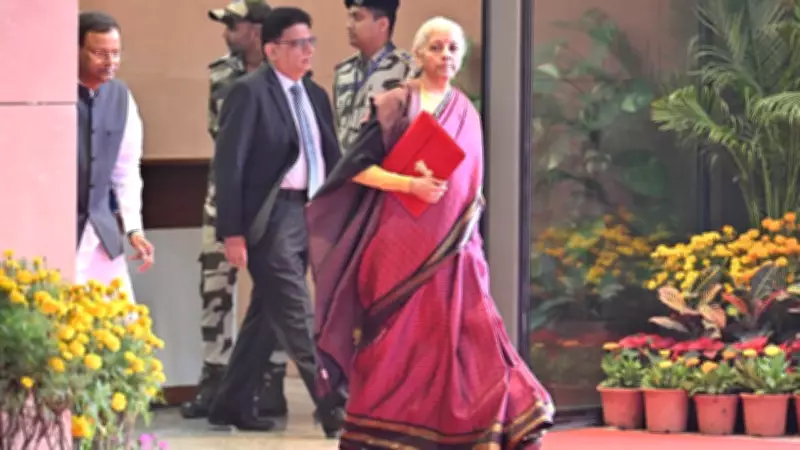
This year's selection featured a deep purple-magenta Kancheevaram silk saree, its surface animated by classic kattam patterns—a sophisticated grid of mustard-tinted checks anchored by a coffee-brown border adorned with fine, restrained thread embroidery. Paired with a bright yellow blouse and the familiar red-silk-wrapped Bahi-Khata, the ensemble projected calm assurance rather than theatrical spectacle. The overall presentation was dignified, culturally rooted, and unmistakably artisanal, reflecting a deliberate choice that values heritage over fleeting trends.
The Loom's Legacy: 400 Years of Pallava Dynasty Weaving Excellence
Kancheevaram silk represents far more than textile artistry—it embodies a comprehensive system of knowledge refined over generations. Originating approximately 400 years ago during the Pallava dynasty, this weaving tradition evolved through royal patronage, temple commissions, and ritual requirements, producing cloth designed to endure for decades rather than mere seasons. Early master weavers drew visual inspiration from South Indian architecture and sacred geometry, transforming stepped temple gopurams into angular borders, lotus medallions into elaborate pallus, and repeating geometric patterns that echoed stone carvings found in ancient shrines and courtyards.

Family lineages functioned as guilds, preserving intricate patterns through oral instruction and apprenticeship systems. These artisans passed down precise calculations for thread density, colour proportions, and motif scale with almost mathematical accuracy. Natural dyes extracted from roots, bark, and minerals gave traditional Kancheevarams their rich, earthy tones, while disciplined symmetry ensured even the most elaborate designs maintained perfect visual balance. Over centuries, the craft absorbed influences from various trade routes and court cultures while remaining firmly anchored in South Indian aesthetic principles: contrast over gradient, structure over flourish, and permanence over ephemerality.
Decoding the Design: Architectural Patterns and Symbolic Colours
The checked kattam pattern represents one of Kancheevaram's most recognizable layouts, creating rhythmic intersections of horizontal and vertical lines reminiscent of woven ledgers. Historically, such grids provided structural organization to expansive colour fields, preventing darker shades from overwhelming visual perception. In Sitharaman's saree, the muted gold-brown checks expertly tempered the intensity of purple, lending the garment an architectural serenity that complemented the parliamentary setting.
The border narrated its own compelling story. In South Indian weaving traditions, borders never serve merely decorative purposes—they frame the entire garment and often carry the densest design work. The coffee-brown edge, traced with delicate thread motifs, grounded the saree's brightness while adding sophisticated tactile complexity. Under proper lighting, the embroidery revealed subtle glints, rewarding close observation rather than demanding attention from distance.
Purple has long symbolized dignity and authority in Indian textiles, historically representing expensive dyeing processes reserved for royal courts and ceremonial occasions. Combined with mustard and brown accents, the colour gained warmth and accessibility, perfectly aligning with Sitharaman's reputation for understated, functional elegance in governance.

Saree Diplomacy: Crafting a Visual Archive of India's Textile Heritage
Through successive budget presentations, the finance minister has consistently spotlighted diverse regional textile traditions—from Mangalgiri cotton and Bomkai silk to Ikat patterns, Kantha embroidery, and Madhubani-painted borders. This repetition has created an annual visual archive of India's craft geography, quietly redirecting national attention toward weaving communities and artists who rarely occupy mainstream spotlight.
What distinguishes this approach is its elegant restraint. Unlike overt political messaging or slogan-stitched garments, the symbolism lies in continuity: handmade craftsmanship over mass production, heritage preservation over temporary trends, and local artistry elevated within global news cycles. In an era of amplified political imagery, this represents a softer communicative language—one that relies on texture, provenance, and cultural patience to convey deeper messages.
Art Before Arithmetic: When Handloom Becomes Historical Statement
From an art-historical perspective, Sitharaman's Budget-day sarees function as carefully curated exhibitions, unveiled annually under India's most scrutinized parliamentary lights. The 2026 Kancheevaram carried centuries of loom knowledge into modern governance chambers, effectively collapsing temporal boundaries through silk threads.
Every design element—from the geometric precision of checks to the substantial weight of the weave and disciplined border execution—spoke of labour measured in weeks rather than minutes. This served as a powerful reminder that economies aren't built solely from numbers and charts but equally from skilled hands, preserved techniques, and traditions transmitted carefully across generations.
As cameras flashed awaiting fiscal announcements, the purple saree offered its own eloquent preface: a visual argument for cultural continuity amidst economic reform, for artisanal craft within spaces dominated by capital discussions. Within those saturated folds resided a narrative older than the Budget itself—a story spun on wooden looms, perfected over four centuries, and continuing to shape how India presents its heritage to the contemporary world.