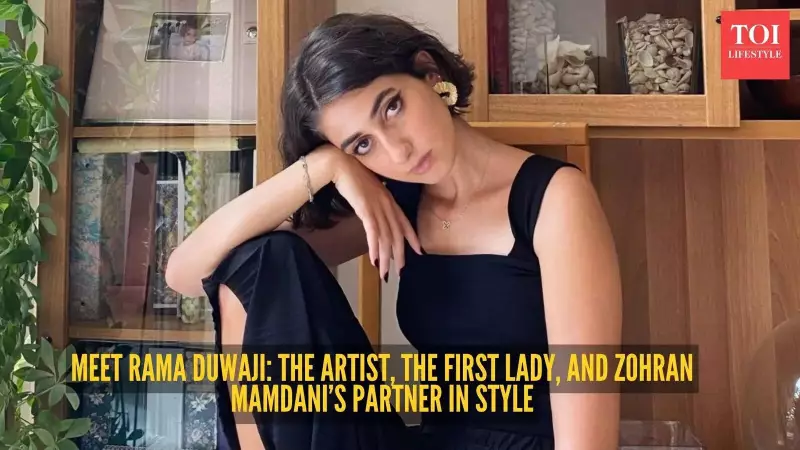
The start of 2026 witnessed a refreshing sartorial rebellion on the political stage, led by an unlikely figure. Rama Duwaji, the Syrian-American illustrator and animator who is married to New York City's new Mayor, Zohran Mamdani, and is the daughter-in-law of acclaimed filmmaker Mira Nair, is dismantling decades of rigid 'First Lady' fashion rules with her authentic, art-school cool.
The Midnight Subway Statement
The defining image broke through the holiday stupor on social media. It was not a typical, polished political portrait. Instead, it captured Rama Duwaji standing in a freezing, abandoned subway station at midnight, wearing tailored, knee-length shorts by The Frankie Shop. She paired them with lace-up boots and a vintage Balenciaga coat, rented from the exclusive Albright Fashion Library. This was a stark departure from the expected power suit or coordinated family tableau, introducing what many are calling an 'anti-bahu' energy—a rejection of the traditional, performative role of a politician's spouse.
Her overall aesthetic speaks of deliberate ease. With slightly smudged eyeliner and a blunt bob, Duwaji carries an air of being completely comfortable while others strain for perfection. She treats the role of First Lady not as a job to be performed, but as an art project to be inhabited. This was evident at the public inauguration, where she wore a brown coat by Palestinian designer Cynthia Merhej's label, Renaissance Renaissance, modified with faux fur—a choice echoing the sensibility of someone like Kiran Rao rather than a conventional political wife.

The Politics of Renting Over Buying
Duwaji's approach deeply resonates with the modern, fashion-conscious urbanite. She is a champion of the circular economy, preferring to rent and borrow rather than buy new. Her iconic midnight coat was a rental, and her boots were borrowed from the sustainable brand Miista. This mirrors a significant shift in consumer behavior, especially relevant in the Indian context where buying heavily embroidered outfits for single-use events like Diwali is increasingly seen as wasteful.
This is the politics of the 'archive' versus the 'store.' Where the old guard purchased new luxury to signal stability and status, the new guard curates vintage and archival pieces to signal taste, individuality, and conscious values. When Duwaji wore a laser-cut denim top by avant-garde designer Zeid Hijazi to the election victory party, she was making a clear statement: she would not stop being an artist to blend in with political donors.
The Audacity of Authentic Comfort
Perhaps the most powerful element of Duwaji's style is the audacity of comfort. In a cultural landscape—both in the West and in India—where formal ceremonies demand specific, often restrictive attire, her choice of shorts feels like a specific rebellion. It triggers a quiet envy not just for the clothes, but for the confidence to be one's full self in a high-stakes environment.
Her style suggests that the ultimate power move in 2026 isn't a perfectly tailored suit, but the self-assurance to leave the coat unbuttoned. It's a powerful message in an era of hyper-curation, where LinkedIn profiles and Instagram feeds are meticulously scrubbed clean. Zohran Mamdani also leaned into this narrative of rooted authenticity, wearing a tie by the Indian label Kartik Research to his inauguration, grounding the couple's public aesthetic in their cultural heritage.
Rama Duwaji's fashion choices are more than just personal style; they are a quiet manifesto. By swapping stiff silks for rented vintage and embracing imperfect, authentic glamour, she is redefining what it means to occupy space beside power, offering a compelling 'anti-bahu' narrative for a new generation.