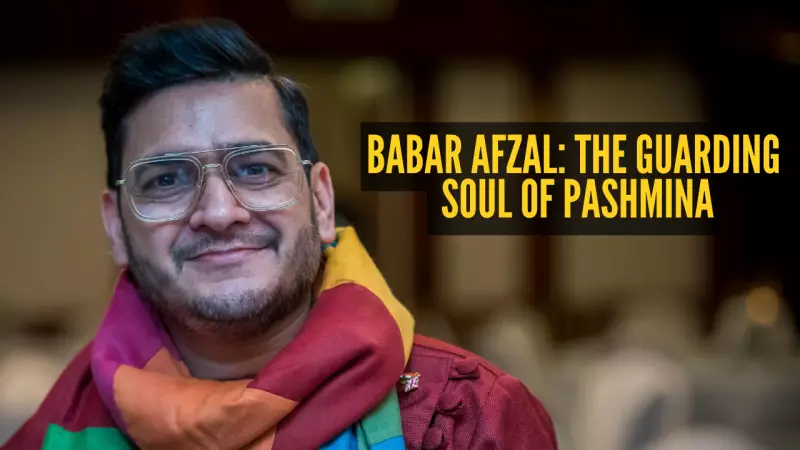
Babar Afzal: Redefining Luxury Through Himalayan Stewardship
While many work to earn a living, a select few dedicate their lives to transforming the very essence of existence. Babar Afzal stands firmly among these visionaries. Transitioning from a successful tech consultant to an artist, activist, and entrepreneur, Afzal has spent over a decade turning away from corporate boardrooms and financial spreadsheets. Instead, he has immersed himself in the fragile, wind-scoured ecosystems of the Himalayas, committing to safeguard something far more precious than any luxury textile.
The Genesis of The Pashmina Goat Project
As the founder of The Pashmina Goat Project, Afzal’s mission reimagines pashmina not merely as a fibre or fashion statement, but as a living, breathing ecosystem that demands profound responsibility, patience, and compassion. Through a unique fusion of art, traditional craft, cutting-edge technology, and community-driven initiatives, he strives to restore dignity to shepherd communities while reclaiming authenticity for one of the world’s most misunderstood luxury materials.
A Devastating Turning Point in 2012
The pivotal moment arrived quietly yet catastrophically in 2012, through a stark newspaper headline. Afzal read that approximately 25,000 pashmina goats had perished from starvation in Ladakh’s Changthang valley following an extreme winter. "The loss felt profoundly personal," he recalls, speaking at The Kunj in New Delhi, where his work was exhibited in December 2025.

This report disturbed him not only due to the scale of the tragedy but because it revealed how climate change, systemic neglect, and market exploitation had converged to endanger an ancient pastoral way of life. Rather than succumbing to outrage, Afzal chose deep immersion. He abandoned his corporate career and joined nomadic shepherds, embarking on a three-month journey on foot from Pahalgam through Sonamarg, Dras, Leh, and finally to Changthang.
For years, he lived as a goatherd, migrating seasonally with nearly 1,500 goats, absorbing the rhythms, ethics, and survival wisdom of the Changpa community. It was amidst this thin mountain air and timeless knowledge that Afzal realized the pashmina crisis was not merely environmental or economic—it was fundamentally existential.
Building a Multifaceted Initiative
In 2013, this lived experience crystallized into structured action with the formal establishment of The Pashmina Goat Project. "I wanted to protect authentic pashmina, support shepherd communities, and preserve knowledge systems that modern markets had rendered invisible," Afzal explains. The project operates across multiple interconnected layers—economic, cultural, and ethical. Beyond enhancing incomes, it focuses on restoring dignity, fostering communal pride, and ensuring that the people at the very origin of the pashmina supply chain are no longer overlooked by the global luxury market.
For Afzal, whose family has long been involved in Kashmir’s handicrafts trade, this endeavor also represents a profound reckoning with inheritance—choosing continuity over convenience, and conscientious care over mere scale.
From Emotional Reaction to Strategic Systems Change
Afzal is refreshingly candid about the initial recklessness of his passion. "At first, I was reacting purely emotionally," he admits. Gradually, this urgency matured into a comprehensive strategy, leading to the development of the Pashmina Transparency Standard and PashminaBlock.org, a blockchain-inspired digital repository that meticulously tracks pashmina from goat to finished garment. This innovative system eliminates exploitative middlemen, guarantees fair compensation, and introduces unprecedented traceability into a market historically plagued by opaque and unfair trade practices.
Complementing this is The Real Pashmina, a dedicated marketplace for authenticated products. Together, these initiatives have successfully repositioned genuine pashmina within the global discourse on sustainable luxury. "Artisan incomes have significantly risen, while communities once marginalized in value creation now occupy its very center," Afzal states with pride.

Furthering consumer education, Afzal has authored insightful books such as Pashmina Secret Revealed and 6 Times Thinner: The Call of Pashmina. These works challenge simplistic authenticity tests like the ring test, guiding consumers toward deeper, more meaningful markers of genuine craftsmanship.
Art as a Form of Resistance and Ecological Restoration
While shawls and wraps remain vital for awareness, Afzal felt compelled to transcend apparel, venturing into the realm of contemporary art. The result is Luxury Pashmina Art, a rare collection of abstract works created not on conventional canvas, but directly on authentic pashmina wool.
Each piece begins as a conceptual sketch, drawing inspiration from Himalayan landscapes, pastoral labour, and interconnected ecosystems. Through paint, intricate hand embroidery, and traditional techniques like Kani and Sozni, augmented with cotton and silk threads, the fibre is slowly transformed into both artistic surface and profound subject.
"Each artwork can take months, sometimes years," Afzal explains, a creative timeline that intentionally mirrors the seven-year journey from raising a goat to harvesting its precious, usable pashmina fibre.
Decoding the Woven Narratives
In his piece 'Butterfly World', a butterfly wing shaped like a world map evocatively invokes the Butterfly Effect—suggesting how small, ethical actions can create ripples across continents. Another work, 'Positive Mind', contrasts logic and intuition through a divided human brain, blooming with roses that symbolize resilience and renewal.
As Afzal gestures toward 'Positive Mind', he highlights a solitary figure standing with arms open to the sky. Behind this figure, the left hemisphere is dense with depicted struggle, while the right opens into a serene meadow—an intentional emptiness where new possibilities can take root.
Adjacent to it, the artwork titled 'Prayer' unfolds as a deeply symbolic composition. A horse, rendered in profound blue hues, emerges as a guardian of time and direction. Drawing from Buddhist Thangka motifs, the work also features figures engaged in sowing and reaping—representing labour and belief locked in an eternal, sustaining cycle. "This is a tribute to humanity," Afzal reflects, "to the acts of caring, believing, and continuing that keep our world in motion." For him, every single thread serves as a potent metaphor for craft, kindness, and continuity.
Advocating a Higher, More Conscious Standard of Luxury
In a global culture obsessed with speed, scalability, and superficial value, Babar Afzal’s work is a bold insistence on slowness, integrity, and deep accountability. His art does not merely decorate—it provokes critical thought. His enterprise does not extract resources—it actively restores and regenerates.
Under his stewardship, pashmina transcends its identity as mere fibre. It becomes living memory, seasonal migration, and cultural survival—a compelling argument for a radically different conception of luxury. This new idea is rooted not in exclusivity, but in genuine, systemic care. Perhaps this is Afzal’s most radical proposition: that art, when firmly grounded in compassion and ethical action, possesses the unique power to protect what commercial markets are often so quick to forget and forsake.