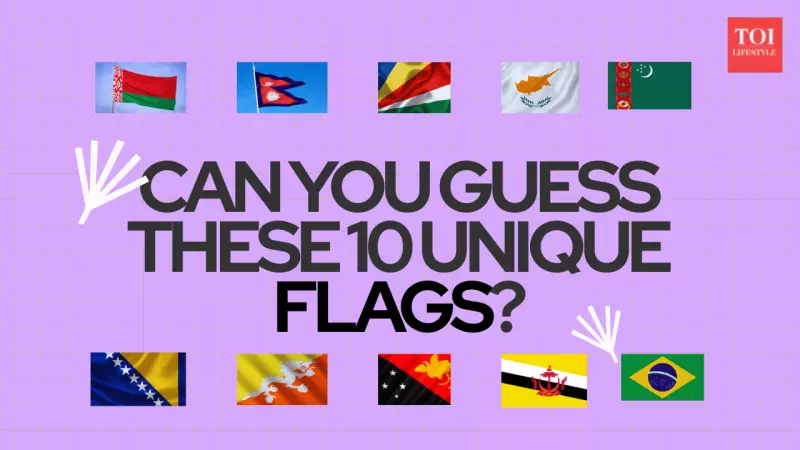
National flags are far more than just pieces of cloth; they are powerful symbols that tell the story of a nation's history, culture, and aspirations. While many flags follow familiar patterns, some stand out with such distinctive designs that they instantly capture global attention and curiosity.
Flags That Break The Mold
From unusual shapes to mythical creatures and vibrant colour combinations, these ten countries boast flags so unique that they defy conventional design. Based on popular rankings and global recognition, here is a curated list of the world's most distinctive national banners. How many of these can you correctly identify?
Seychelles: A Burst of Radiant Colour
The flag of Seychelles is a dynamic visual spectacle. It features five bold bands of blue, yellow, red, white, and green that radiate from the bottom left corner. This design is a powerful symbol of a nation moving forward. Each colour holds a specific meaning: blue represents the sky and sea, yellow symbolises the sun, red signifies the people and their determination, white stands for social justice, and green embodies the natural environment.

Cyprus: A Nation Mapped in Copper
Cyprus possesses one of the few flags in the world that features a map of its own territory. The national flag displays a copper-orange coloured outline of the island set against a pristine white background. This is flanked by two olive branches, which are universal symbols of peace. The design is a strong and direct statement of national identity and the hope for harmony.
Turkmenistan: A Tribute to Carpet Weaving
The flag of Turkmenistan is renowned for its rich, ornamental detail. It features a vertical red stripe on the hoist side adorned with five traditional carpet motifs, known as 'guls'. These patterns represent the country's major tribes and its deep heritage in carpet weaving. The main green field features a white crescent moon and five stars, symbols often associated with Islam and the five regions of the country.
Nepal: The Only Non-Rectangular Flag
Nepal holds a unique record in vexillology—it is the only sovereign nation whose flag is not rectangular. Its crimson red flag is composed of two stacked triangular shapes, or pennants. This design is deeply symbolic, representing the Himalayan Mountains and the two main religions of the country, Hinduism and Buddhism. The moon and sun emblems on the flag signify the hope that Nepal will endure as long as these celestial bodies.
Bhutan: The Land of the Thunder Dragon
The national flag of Bhutan is immediately recognisable due to the large white Druk, or Thunder Dragon, that dominates the centre. The dragon, which holds jewels representing wealth, is set against a background diagonally divided into saffron yellow and orange. The yellow colour symbolises the secular authority of the king, while the orange represents the spiritual traditions of Buddhism, which is deeply woven into the fabric of Bhutanese culture.
Brazil: A Starry Sky in a Yellow Diamond
The flag of Brazil is a beautiful and complex emblem. It features a green field with a large yellow diamond at its centre. Inside the diamond is a blue celestial globe depicting a starry sky, with a white band running across it bearing the national motto. The stars are not randomly placed; they are arranged to accurately represent the sky over Rio de Janeiro on the day the republic was proclaimed, with each star corresponding to a specific Brazilian state.
Papua New Guinea: A Vibrant Cultural Mosaic
The flag of Papua New Guinea is a striking combination of colours and symbols. It is diagonally divided into two sections: the lower half is a solid black, and the upper half is a bright red. The black section features the silhouette of the Southern Cross constellation, a common sight in the Southern Hemisphere. The red section displays the Raggiana bird-of-paradise, a spectacular bird that is native to the island and a powerful national symbol.

Brunei: Regal and Islamic Symbols
The flag of Brunei is distinct with its yellow field, which is crossed by two diagonal stripes in black and white. Superimposed over the centre of the flag is the national crest in red. This crest includes several important Islamic symbols, such as a crescent, a parasol (representing monarchy), and two supporting hands. The flag's design reflects the nation's identity as a Malay Islamic monarchy.
Belarus: A Traditional Ornamental Pattern
The flag of Belarus stands out due to the unique red-and-white ornamental pattern that runs vertically along the hoist side. This pattern is a traditional design taken from Belarusian folk culture. The rest of the flag is divided horizontally into a broad red band over a narrower green band at the bottom. This combination of modern national colours with a traditional folk motif creates a flag that is deeply rooted in the country's heritage.
Bosnia and Herzegovina: A Modern European Symbol
The flag of Bosnia and Herzegovina has a strikingly modern and geometric design. It consists of a blue background with a large yellow isosceles triangle. Running along the hypotenuse of the triangle is a continuous line of white, five-pointed stars. The triangle represents the three main ethnic groups of the country—Bosniaks, Croats, and Serbs. The blue and the stars are intended to symbolise the nation's aspirations and its place within Europe.
These flags demonstrate the incredible diversity and creativity in national symbolism around the globe. Their unique designs not only set them apart but also tell rich, visual stories about the countries they represent, sparking curiosity and admiration worldwide.