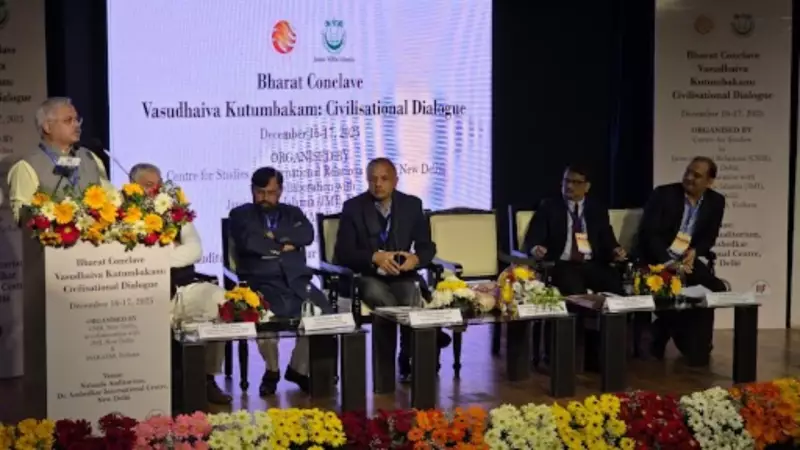
A significant conclave focusing on the ancient Indian philosophy of Vasudhaiv Kutumbakam (the world is one family) was successfully held on Tuesday, December 16, 2025. The event, titled 'Vasudhaiv Kutumbakam – Civilisational Dialogue', was a collaborative effort between the Centre for Studies in International Relations (CSIR) at Jamia Millia Islamia and MAKAIS, Kolkata.
Leaders Emphasise India's Timeless Ethos
The inaugural session set a profound tone for the discussions. In a special address, Sunil Ambekar, the Akhil Bhartiya Prachar Pramukh of the RSS, presented a compelling contrast. He noted that while Artificial Intelligence (AI) and Information & Communication Technology (ICT) have digitally connected the globe, humanity continues to grapple with violence, conflict, and ecological disasters. He underscored that India's foundational principles of unity, peace, and coexistence were cultivated over millennia without reliance on modern tools. Ambekar strongly advocated for an ethical application of power in international relations, one steered by core values, empathy, and deep cultural understanding.
Echoing this civilisational perspective, Prof Mazhar Asif, Vice Chancellor of Jamia Millia Islamia, stated that Vasudhaiv Kutumbakam is a manifestation of India's civilisational strengths, which are rooted in knowledge, spirituality, and inclusiveness. He elaborated that the Indian tradition has always encouraged inquiry, dialogue, and harmonious coexistence, rather than a dogmatic attachment to rigid beliefs.

From Philosophy to Practical Global Framework
Delivering the inaugural address, Prof Sachin Chaturvedi, Vice Chancellor of Nalanda University, Bihar, pushed the discourse beyond abstract philosophy. He framed Vasudhaiv Kutumbakam as a highly relevant framework for tackling contemporary global challenges. Prof Chaturvedi called for a paradigm shift in global priorities, urging a move beyond narrow economic metrics like GDP. He emphasized the urgent need to focus on sustainable production systems, building resilient infrastructure, and developing broader indicators that truly measure human well-being and planetary health.
Plenary Sessions Delve into Culture and Security
The conclave featured three detailed plenary discussions that explored specific themes. One pivotal session examined the concept of "Vrihad Bharat" or cultural India. Scholars and participants from India and abroad discussed how India's cultural influence extends far beyond its geographical borders. The dialogue stressed the nation's immense internal diversity and the importance of reviving cultural values that have faced historical suppression.
Another critical plenary focused on international security and the Bhartiya idea of peace. The debates encompassed a wide range of pressing issues, including state strategies, global governance challenges, the persistent threat of terrorism, and the escalating climate crisis. These discussions acknowledged that all these factors are deeply interconnected and pose significant threats to worldwide stability. The sessions provided attendees with nuanced insights and practical viewpoints on how India's age-old civilisational wisdom can be applied to these modern, complex concerns.
The conclave served as a vital platform, bridging India's profound philosophical heritage with the urgent need for collaborative, value-driven solutions to the world's most pressing problems.