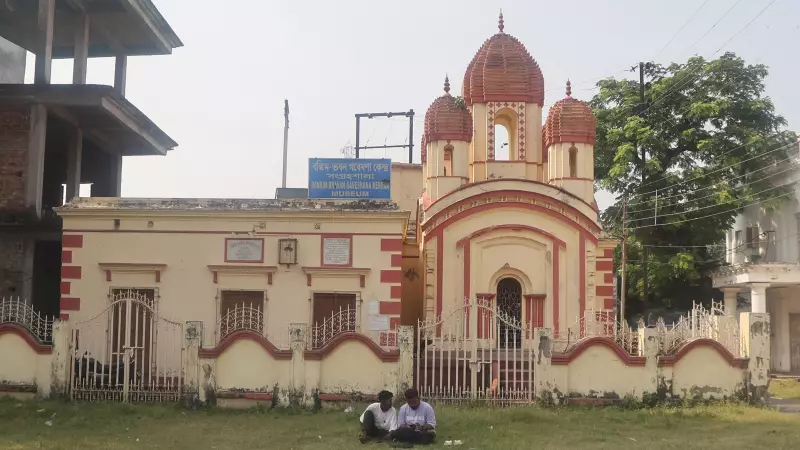
The historic birthplace of India's iconic patriotic song Vande Mataram is fighting a desperate battle for survival against government neglect and public apathy. Located in Kantalpara, Naihati, approximately 45 kilometers from Kolkata, the Bankim Bhavan Gaveshana Kendra Museum stands as a crumbling testament to the nation's rich cultural heritage.
A Legacy Fighting Decay
The red-and-beige single-storeyed building with distinctive shikhara domes and arched doorways served as Bankim Chandra Chattopadhyay's Baithakkhana - the three-room parlour where the 19th-century literary giant composed Vande Mataram. This year marks the 150th anniversary of the song that became a rallying cry during India's freedom struggle.
However, while political parties engage in credit wars about the poet's legacy, his actual workspace shows clear signs of deterioration. The walls bear damp patches from water seepage, lighting remains inadequate, and air conditioning is conspicuously absent throughout the museum premises.

Staff Struggles and Funding Crisis
Museum authorities cite severe financial constraints and manpower shortages as primary challenges. Ratan Kumar Nandi, director of the Bankim Bhavan Gaveshana Kendra that manages the museum, acknowledges the pressing need for renovations.
"The rooms containing Chattopadhyay's personal items, including original family photographs, urgently require maintenance," Nandi states. "We have only seven staff members currently, and positions vacated by retirees haven't been filled."
The museum depends entirely on state government funding for upkeep. Nandi reveals that a renovation proposal initially estimated at Rs 2 crore was scaled down to Rs 56 lakh, but even this reduced amount awaits government clearance.
Family Concerns and Visitor Apathy
Swati Ganguly, Bankim Chandra's great granddaughter based in Delhi, expresses deep concern about the museum's condition and the lack of visitors. "What saddens me most is that very few people visit the place," she shares. "Mainly researchers come occasionally, but general public footfall remains minimal."
The museum displays precious artifacts including:
- Bankim Chandra's iconic shawl and turban
- A bronze bust of the literary icon
- His handwritten music book
- Original family photographs
- The actual table and chair he used for writing
- Wooden chess pieces he played with
- Historical lanterns from his era
Adjacent to the Baithakkhana stands a two-storeyed white colonial-style building that once served as the family home. It now houses a research center and library, though part has been converted into a Vande Mataram Gallery.
Historical Significance and Ongoing Debates
Vande Mataram first appeared in the Chaitra issue of Bangadarshan Patrika, a monthly magazine edited by Bankim Chandra and his brother Sanjib Chandra. The song formed part of Bankim Chandra's novel Anandmath, initially serialized in 1881 and published as a book in 1882.
Classical vocalist Jadunath Bhattacharya originally set the song to tune, with Rabindranath Tagore later presenting his rendition at the Indian National Congress's 1896 session in Calcutta.
Meanwhile, confusion persists about when exactly Vande Mataram was written. While the central government celebrates it on November 7, 1875, family members and researchers suggest it might have been composed during Durga Puja of 1874.
Researcher Partha Pratim Chattopadhyay cites accounts suggesting the song emerged from emotional experiences Bankim Chandra described in his essay Amar Durgotsav, published on October 12, 1874.
Kolkata Memorial Faces Similar Neglect
The neglect extends to Bankim Chandra's final residence at 5, Pratap Chatterjee Lane in Kolkata, where he passed away on April 8, 1894. Converted into a library in 2006, the building now stands derelict with blackening, cracking walls and signs of unauthorized occupation.
Local residents report that the library remains closed most of the time, with political parties only visiting on the poet's birthday (June 26) to pay homage.

As India celebrates 150 years of Vande Mataram, the physical spaces associated with its creation cry out for attention, highlighting the urgent need to preserve the tangible connections to the nation's cultural history before they disappear completely.