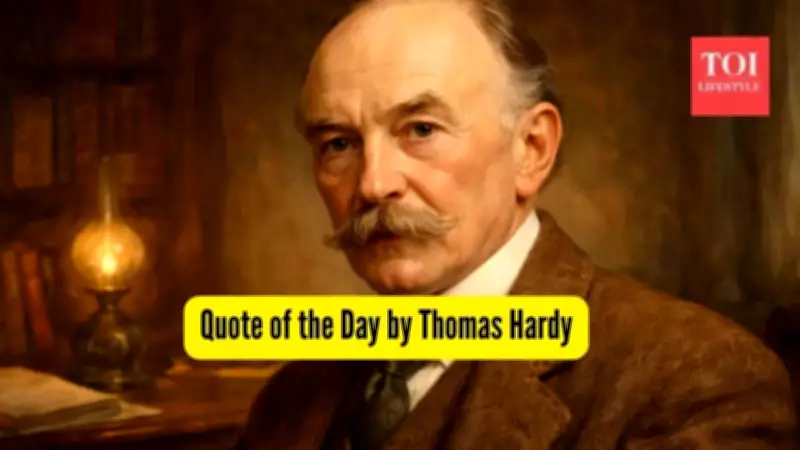
The Enduring Legacy of Thomas Hardy: More Than a Novelist
Thomas Hardy stands as one of those rare writers who seemed to hold an entire world within his mind. His literary output transcends mere characters and plots, delving into the very essence of the English countryside, the relentless passage of time, and the silent battles of ordinary individuals navigating a world that often defies logic.
From Dorset Roots to Literary Fame
Born in 1840 in the small village of Higher Bockhampton in Dorset, England, Hardy hailed from a modest background. His father worked as a stonemason and builder, while his mother, a well-read woman, encouraged his early education. This blend of working-class practicality and literary passion profoundly shaped Hardy's worldview. Immersed in rural traditions, folklore, and the rhythms of village life, these experiences later formed the foundation of his fictional realm, Wessex.
Initially pursuing a career in architecture, Hardy appeared destined for that profession. Yet, he wrote persistently during those years, as if compelled by an inner force. Ultimately, literature prevailed. His early works garnered little attention, but perseverance paid off with Far from the Madding Crowd, which marked his breakthrough and signaled his unique voice to the literary world.

Controversy and Transition to Poetry
Hardy's journey as a writer was fraught with challenges. While he achieved fame, he also faced harsh criticism for addressing contentious topics such as class disparities, religion, marriage, and women's roles. Novels like Jude the Obscure and Tess of the d'Urbervilles shocked readers with their unflinching honesty and rejection of tidy moral resolutions. The backlash, particularly against Jude the Obscure, deeply affected Hardy, leading him to abandon novel-writing in favor of poetry, a form he had always cherished. He considered himself primarily a poet, though today his novels remain his most celebrated works.
His personal life mirrored the complexities of his fiction. Married to Emma Gifford, their relationship deteriorated over time. Her death left Hardy heartbroken, inspiring some of his most poignant poems. He remarried later, but Emma's memory continued to permeate his writing.
Philosophical Depth and Realistic Style
Hardy's significance in literature stems not only from his themes but also from his distinctive style. Often labeled as realistic, his writing carries a profound philosophical weight, influenced by determinism. He believed that human agency is limited, with chance, fate, and societal forces often conspiring against individuals. This perspective is vividly portrayed in his characters—not traditional heroes, but everyday people like farmers, laborers, and young women striving to survive. For instance, Tess is not depicted as weak or foolish; rather, she is trapped by circumstances, societal judgment, and misfortune. Hardy refrains from blaming her, instead questioning the world's injustices.
Wessex as a Living Character
A hallmark of Hardy's writing is his masterful use of setting. Wessex is more than a backdrop; it functions as a character in its own right. The landscapes—fields, hills, and changing seasons—mirror the emotions and fates of the inhabitants, often foreshadowing tragedy with subtle yet powerful imagery. His prose possesses a poetic quality, with memorable descriptions and meticulously crafted sentences that capture minute details, such as light on a field or footsteps on a road, lending his work a quiet, enduring power.
Beneath the beauty lies a critical undercurrent targeting Victorian society. Hardy challenged rigid moral codes, gender restrictions, and institutional hypocrisy, not through overt preaching but by crafting narratives that evoke a visceral sense of unfairness in readers.

Bridging Victorian and Modern Literature
Hardy occupies a pivotal position at the intersection of Victorian and modern literature. While his detailed storytelling aligns with Victorian traditions, his exploration of themes like alienation, existential uncertainty, and moral ambiguity resonates with modernity. His influence is evident in 20th-century modernist literature, which shifted focus from clear resolutions to internal conflict and ambiguity. Hardy paved the way for a more honest, often uncomfortable, portrayal of human existence.
Readers continue to engage with Hardy not just for his literary impact but for his profound empathy for human vulnerability. His characters, with their flaws, hopes, and losses, feel authentic and relatable. Even in tragedy, his stories avoid exaggeration, instead reflecting the harsh realities of life.
The Human Condition in Hardy's World
Hardy's work serves as a reminder that life is unpredictable, devoid of guaranteed justice or meaning. This may seem bleak, but it offers a raw honesty—a refusal to sugarcoat reality. Amidst this, his writing finds beauty in fleeting moments: a conversation, a glance, or a tranquil night in the countryside, all rendered with significance.
Ultimately, Thomas Hardy was more than a storyteller; he was a seeker grappling with what it means to be human in an indifferent universe. His legacy endures because he poses enduring questions rather than providing easy answers.
Reflecting on Hardy's Insightful Quote
One of his most memorable lines encapsulates his worldview: "Time changes everything except something within us which is always surprised by change." This deceptively simple statement reveals a deep, unsettling truth about human nature. The first part acknowledges the inevitability of change—aging, shifting relationships, evolving beliefs. Yet, the twist lies in the second part: an inner emotional core that resists acceptance, perpetually shocked by change despite its certainty. This tension between external flux and internal desire for permanence defines the human experience, highlighting our longing for stability in a transient world.