In a profound exploration of timeless wisdom, the classic Tamil text 'Thirukkural' continues to offer real-world lessons, with its teachings on hospitality resonating as a powerful dharma rather than mere social etiquette. The series 'Thirukkural with the Times' delves into these enduring truths, guided by motivational speaker and diversity champion Bharathi Bhaskar.
The Puzzling Couplet on Hospitality
Written by the celebrated Tamil poet and philosopher Thiruvalluvar, the Thirukkural is a monumental work of ethics and morality. It comprises 1,330 short couplets, each seven words long, systematically divided into three books focusing on virtue (aram), wealth (porul), and love (inbam). This text has influenced countless scholars and leaders across social, political, and philosophical spheres for centuries.
Bharathi Bhaskar recounts her initial struggle with one particular verse from the chapter on hospitality. As a teenager, she found Couplet 85 lofty and impractical. The verse questions: "Is it necessary to sow seed in the field of the man who, having feasted his guests, eats what may remain?" The implication that a generous host might be exempt from agricultural toil seemed illogical, even exaggerated, to her young mind.

A Grandmother's Story: The Tale of Ilayankudi Mara Nayanmaar
Seeking clarity, Bhaskar turned to her mother and grandmother during a summer vacation in their Triplicane house in Chennai. Her grandmother, a gentle yet imposing woman known for pairing meals with stories, narrated the tale of Ilayankudi Mara Nayanmaar, one of the 63 revered Nayanmaars (servitors of Lord Shiva).
The story, evoked by the tangy taste of puli saadam (tamarind rice), was transformative. Mara Nayanar was a devout farmer bound by a sacred vow to feed Shiva's devotees daily, offering meals balanced with all six tastes. Over time, poverty engulfed his household, yet his commitment to hospitality never wavered—it was his core identity.
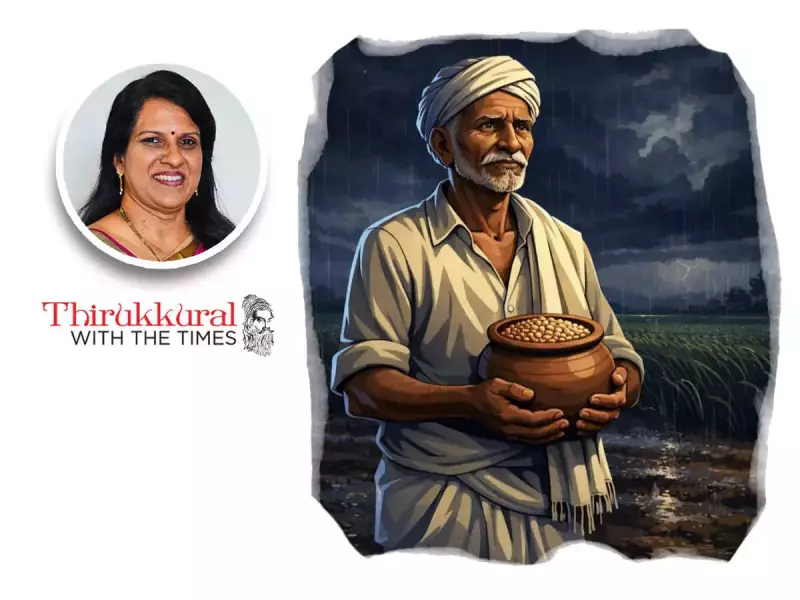
The ultimate test came on a stormy monsoon night. With no food or firewood left, and with the couple themselves lying hungry, a soaked and weary traveler arrived at their door. Undeterred, Mara's wife reminded him of the paddy grains soaking in their field, meant for sowing—a farmer's most sacred possession, never to be consumed.
Defying convention, Mara Nayanar ventured into the stormy, snake-ridden field to retrieve the wet grains. He then cut a wooden beam from his own roof for firewood and plucked greens from around the house. From almost nothing, a warm meal was prepared and served on a plantain leaf.
The Divine Revelation and the Kural's Deeper Truth
When the couple invited the guest to eat, he did not step forward. Instead, he revealed himself as a flash of light—Lord Shiva appeared with Goddess Shakti, seated on the holy bull Nandi. The divine couple blessed Mara Nayanar and his wife, granting them eternal grace for their selfless act.
Years later, when Bhaskar read this episode in the Periya Puranam, its power struck her anew. The couple's guiding principle was not even direct devotion to God, but an unwavering commitment to the guest. This embodies the ancient Indian philosophy of "Athithi Devo Bhava"—the guest is God—not as a metaphor but as a lived reality.
Revisiting Valluvar's couplet, the profound answer became clear. The poet poses a rhetorical question with an inherent truth: a person who serves humanity as service to the divine may not need to toil in conventional ways. The universe itself sows seeds for those who give without calculation. Their hospitality becomes the richest harvest, and grace follows their selfless actions.
Thiruvalluvar was not being illogical or exaggerated. His vision simply transcends ordinary calculation, seeing a cosmic reciprocity where selfless duty (dharma) invites divine providence. The story of Mara Nayanar is the living proof of this eternal principle, making the nearly 2,000-year-old couplet as relevant today as it was when first penned.