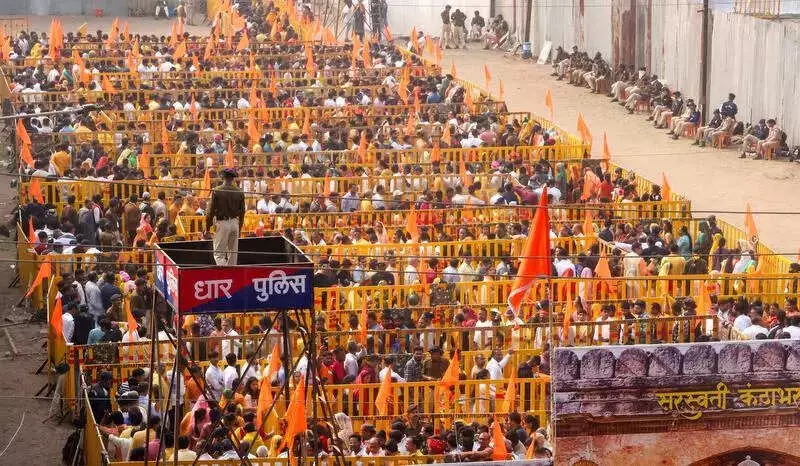
Saraswati Puja and Friday Namaaz Coincide Peacefully at Dhar's Bhojshala Complex Under Supreme Court Supervision
In a significant display of religious coexistence, Saraswati Puja and Friday namaaz took place simultaneously at the historically significant Bhojshala Saraswati Temple-Kamal Maula Mosque complex in Madhya Pradesh's Dhar district on Friday. This rare convergence occurred as Basant Panchami and Jumma namaaz fell on the same day, creating a unique scenario that required careful administrative planning and judicial oversight.
Supreme Court Directive Paves Way for Dual Worship
Following explicit directives from the Supreme Court issued on Thursday, the district administration implemented a meticulously planned arrangement that allowed both communities to practice their religious rituals without conflict. Hindu devotees began gathering at the complex from early morning hours to perform the traditional puja of Vaghdevi, the local name for Goddess Saraswati, while approximately 15-17 members of the Muslim community were escorted through a separate entrance between 1 pm and 3 pm for Jumma namaaz prayers.
The administration's careful segregation of entrances and timing proved crucial in maintaining harmony throughout the day. "We have been able to offer prayers to Goddess Vaghdevi on Basant Panchami," expressed Durga Rathore, a homemaker who waited over an hour for her turn at the entrance, capturing the sentiment of many Hindu devotees.

Heavy Security Deployment Ensures Peaceful Atmosphere
Dhar town transformed into a virtual fortress with unprecedented security measures implemented to prevent any potential confrontation. District collector Priyank Mishra revealed that approximately 8,000 security personnel were deployed around the sensitive site, comprising multiple forces including district police, Rapid Action Force, CRPF, MP Armed Force, SRPF, and specialized women police units.
The security apparatus extended beyond ground forces with drones conducting aerial surveillance and CCTV cameras monitoring strategic locations throughout the complex. Senior police officers maintained visible patrols along streets adorned with saffron flags since morning, their presence serving as a constant reminder of the delicate peace that required careful orchestration.
Community Responses and Future Aspirations
While Hindu devotees expressed jubilation at being able to worship at the site, many also struck conciliatory notes regarding the Muslim community's access. "The Muslim community has also been allowed to offer prayers. I hope that harmony prevails in Dhar town," remarked Sangeeta Gaikwad, reflecting a spirit of coexistence that many hope will continue.
The celebrations began at sunrise with devotees and members of the Basantoutsav Samiti performing havan in the courtyard, followed by a vibrant 'Shobha Yatra' procession that started from Ghoda Choupati. Approximately 10,000 participants, predominantly dressed in yellow traditional attire, raised devotional slogans as the procession wound its way for 1.5 kilometers before culminating at Bhojshala.
Amidst the celebrations, some devotees voiced aspirations for the future, particularly regarding the Vaghdevi statue currently housed in the British Museum in London. "Now we wish the Vaghdevi statue will reach Dhar and be installed at its original place," expressed college professor Tripti Sharma, expressing confidence that Prime Minister Narendra Modi would work toward repatriating the idol to India.
Historical Context and Administrative Challenges
The simultaneous worship events occurred against a backdrop of simmering tensions between communities in the lead-up to Basant Panchami, with neither side initially willing to compromise on access to the contested site. The Supreme Court's intervention proved decisive in breaking the impasse, allowing both religious practices to proceed while maintaining strict separation protocols.

District collector Mishra noted that while official estimates suggested around 20,000 visitors to Bhojshala throughout the day, visible attendance appeared significantly higher than these conservative figures. The heavy security deployment reflected not just administrative caution but the weight of history that continues to influence such contested religious spaces across India.
The successful execution of dual worship ceremonies at Bhojshala represents a potential model for managing shared religious spaces in India's diverse cultural landscape, demonstrating that with proper judicial guidance, administrative planning, and community cooperation, peaceful coexistence remains achievable even in historically sensitive locations.