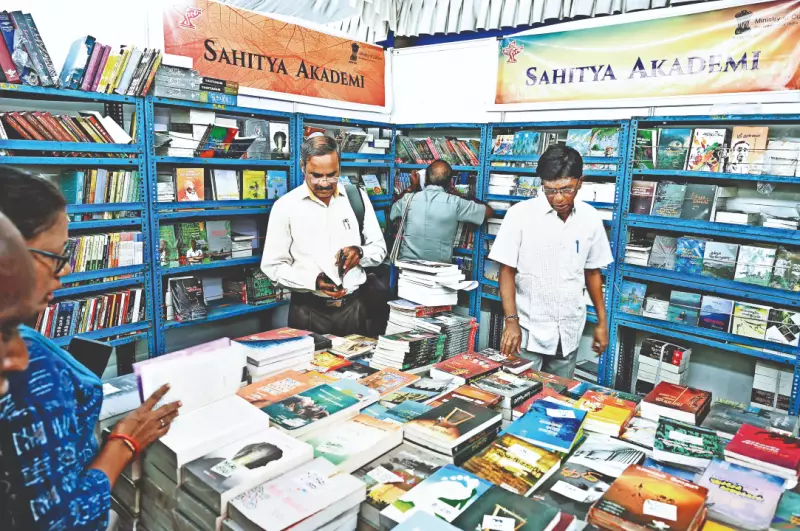
Sahitya Akademi Award Controversy Exposes Deep Structural Flaws
The Sahitya Akademi, India's National Academy of Letters, is no stranger to annual controversies surrounding award selections, jury biases, or author preferences. However, this year's dispute has taken a more serious turn, with the Akademi facing widespread criticism for withholding the announcement of awards across 24 languages. Reports indicate this decision came under direct instructions from the Union Ministry of Culture, unsettling literary communities nationwide.
Tamil Nadu's Literary Circles React Sharply
In Tamil Nadu, where the Sahitya Akademi awards are closely monitored for literary trends and potential biases, the reaction has been particularly intense. Leaks suggesting that left-leaning writer S Tamil Selvan was among those selected but had his name withheld due to his anti-government stance have fueled outrage. This incident raises fundamental questions about what truly ails the Sahitya Akademi and what recourse exists to restore its integrity.
Historical Context and Founding Vision
Following India's independence, the Union government established national academies to promote literature, visual arts, and performing arts as part of a visionary cultural policy. Accordingly, the Sahitya Akademi was constituted in 1952, followed by the Lalit Kala Akademi in 1953 for visual arts. Although created through separate resolutions, both institutions share remarkably similar objectives, structures, and funding patterns. Yet, over decades, the Sahitya Akademi has increasingly drifted from its founding purpose.

A comparative analysis with Lalit Kala Akademi reveals that the problem does not stem from the concept of a national academy itself but from structural anomalies and an unhealthy institutional culture that have permeated the Sahitya Akademi, necessitating urgent reform.
Constitutional Mandates and Structural Imbalances
The constitutions of both academies outline nearly identical mandates:
- Promoting cooperation among literary and artistic communities
- Encouraging research and critical studies
- Recognizing excellence through awards and honors
- Fostering national and international cultural exchange
Their officer structures are also comparable, with both being guided by general councils and executive boards. Despite these similarities, their operational styles differ significantly. While Lalit Kala Akademi demonstrates greater institutional balance and accountability, Sahitya Akademi suffers from structural excess and systemic bias.
The Problem of Size and Representation
The Sahitya Akademi General Council (SAGC) comprises 101 members, compared to Lalit Kala Akademi's 65. This excessive size does not enhance governance; instead, it often leads to inefficiency and lobbying. The Union government's representation is disproportionately low, with just five members in the general council, which is crowded with nominees from states, universities, literary associations, and "eminent writers."
This imbalance has historical roots. The Sahitya Akademi was established before the States Reorganisation Act of 1956, which reorganized states along linguistic lines. Today, this results in duplication: representation occurs both by state and by language. Consequently, languages like Tamil, Telugu, or Hindi—official in multiple states—become overrepresented, while others such as Sanskrit or Sindhi, which are not official languages of any state, remain marginalized.
For instance, Tamil enjoys four to five representations in different categories within the general council, whereas Konkani has only two. This numerical disparity inevitably translates into disproportionate influence.
University Representation and Selection Processes
India has nearly 900 universities, yet only 20 are represented in the Sahitya Akademi general council. In contrast, Lalit Kala Akademi sensibly channels academic representation through a single University Grants Commission (UGC) nominee, avoiding arbitrariness and lobbying.

A major flaw in Sahitya Akademi's structure is that the outgoing general council determines the composition of the incoming one based on recommendations from state governments, universities, and literary bodies. While this ensures continuity, it also fosters institutionalized lobbying and factionalism.
Lalit Kala Akademi adopts a more balanced approach:
- Fellows are selected through rotation
- State nominees are finalized in consultation with the Ministry of Culture
- Mandatory representation for women is ensured—a feature conspicuously absent in Sahitya Akademi
Power Concentration and Accountability Issues
The Sahitya Akademi executive board, elected by the already skewed general council, wields enormous power over appointments, awards, publications, and administration. Since the Ministry of Culture has minimal presence in both academies, public accountability remains weak despite government funding. It is puzzling why the Centre has allowed this imbalance to persist.
Institutional Culture: Cronyism and Ideological Gatekeeping
Beyond structural issues lies a deeper problem: institutional culture. The functioning of Sahitya Akademi has increasingly been marked by cronyism. A tacit quid pro quo—"You support me, I support you"—operates in nominations, appointments, jury selection, and awards.
Another disturbing pattern is ideological gatekeeping. When Akademi presidents are unfamiliar with certain languages, they rely on language convenors and lists provided by general council members, who bring their own biases. Jury panels are often drawn from ideologically aligned circles, resulting in certain political or cultural viewpoints dominating while writers with nationalist or alternative perspectives find themselves systematically excluded. This phenomenon is not confined to one language or region; it is visible in several states, including Tamil Nadu and West Bengal.
Such practices defeat the very purpose of a national academy meant to represent the diversity of Indian thought.
Pathways to Reform and Restoration
Reforming Sahitya Akademi does not require dismantling it, nor does it diminish the role of states or languages. A few constitutional amendments can restore balance and credibility:
- The Union government's nominations to the general council should be increased, ideally to one per recognized language
- Language convenors—and thereby the executive board—should be constituted by the Ministry of Culture from these nominees
- University representation should be routed through the UGC
- The head of the Akademi should be designated chairman and appointed by the President of India, as in Lalit Kala Akademi
- Five vice-chairpersons may be appointed for the five regions (north, south, east, west, and central) to ensure geographical balance
- Jury composition should be broad-based and ideologically balanced
Sahitya Akademi was envisioned as a national platform for literary excellence, not as a closed club driven by numbers, ideology, or patronage. Structural correction and cultural cleansing are essential if the Akademi is to regain moral authority and public trust. Such reforms will not weaken states or languages; they will strengthen Indian literature, true to the spirit in which the Akademi was founded more than seven decades ago.