Ancient Roman Medicine Vial Reveals First Chemical Proof of Human Feces Use
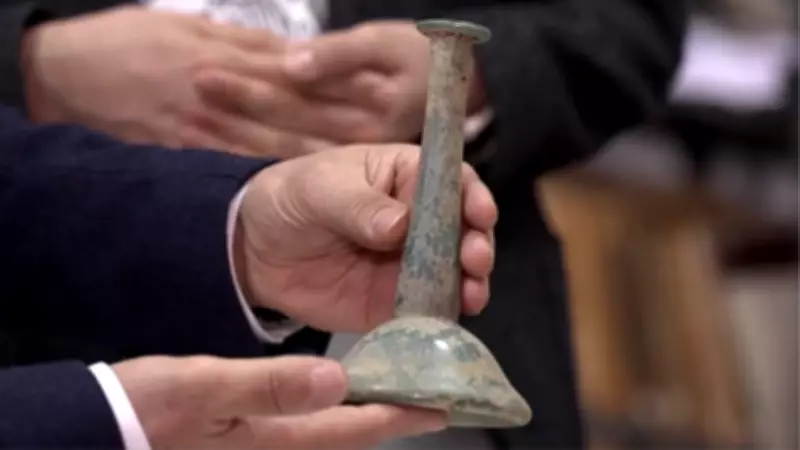
A remarkable archaeological discovery in western Turkey has provided the first direct chemical evidence that ancient Roman physicians used human feces as a medicinal ingredient. The finding comes from a small glass vial dating back approximately 1,900 years, containing dark brown residue that scientists have identified as human excrement deliberately mixed with thyme oil.
The 1,900-Year-Old Roman Medicine Vial
The discovery began in the storage rooms of the Bergama Museum in western Turkey, located near the ruins of the ancient city of Pergamon. Archaeologist Dr. Cenker Atila from Sivas Cumhuriyet University, who specializes in ancient perfumes and pharmaceutical vessels, was examining hundreds of Roman glass containers preserved in the museum's collection when he noticed something unusual.
Inside one of the small glass bottles known as an unguentarium—narrow vessels widely used in the Roman world to store perfumes, oils, and medicinal preparations—were small dark brown fragments that had been overlooked for years. As researchers opened and inspected the container more closely, they realized that residue had survived inside the vessel, prompting a detailed scientific investigation.

The artefact is believed to date to the second or third century AD, during the height of the Roman Empire. It likely originated from a tomb in ancient Pergamon, a city well known in antiquity for its medical knowledge and healing centers.
The Chemical Analysis That Revealed the Truth
To determine what the residue contained, researchers carried out laboratory testing using gas chromatography and mass spectrometry. This technique allows scientists to identify organic molecules preserved in ancient materials. Pharmacologist Ilker Demirbolat analyzed the residue and identified several compounds that revealed its origin.
Two important biomarkers were detected: coprostanol and 24-ethylcoprostanol. These substances form during digestion and are widely recognized indicators of fecal matter. The proportions of the compounds strongly suggested that the material came from human feces rather than animal waste.
The analysis also detected carvacrol, a chemical compound commonly found in thyme and other aromatic herbs. This indicated that the fecal matter had been deliberately mixed with thyme oil as part of a prepared medicinal mixture.
A Medicine Described in Ancient Texts
What made the discovery especially significant was how closely the mixture matched remedies described in ancient Roman medical writings. According to Dr. Cenker Atila, the team quickly recognized the formula when the results were analyzed.
"In this sample we identified human feces mixed with thyme," he explained. "Because we are well acquainted with ancient textual sources, we immediately recognized this as a medicinal preparation used by the famous physician Galen."
Galen of Pergamon lived between 129 and 216 AD and was one of the most influential physicians in ancient history. His medical writings shaped European and Middle Eastern medicine for more than a thousand years. In several of his works, Galen described treatments that included fecal substances. He believed certain forms of dung could help treat infections, inflammation, and some reproductive disorders.
In one example, he recommended using the feces of children who had eaten specific foods such as legumes, bread, and wine, believing these substances possessed particular therapeutic qualities. Until the recent discovery, historians only knew about these treatments from written sources. The vial now provides direct archaeological evidence that such remedies were actually prepared.
Why Thyme Was Added to the Mixture
Another key detail revealed by the analysis was the presence of thyme oil. Ancient physicians understood that medicines made with fecal matter would have an extremely strong smell. As a result, medical texts often recommended adding aromatic herbs to make remedies easier for patients to tolerate.

Thyme likely served two purposes: it masked the unpleasant smell of the feces and added antimicrobial compounds that may have provided mild medicinal benefits. The discovery closely matches descriptions found in ancient Roman medical texts that advised mixing foul ingredients with fragrant herbs to make them more acceptable.
Pergamon: A Center of Roman Medicine
The location of the discovery is also important. Ancient Pergamon, located in present-day western Turkey, was one of the most famous medical centers of the Roman world. The city was home to a renowned healing sanctuary dedicated to Asclepius, the Greek god of medicine. Patients traveled from across the Roman Empire to seek treatment there.
Pergamon was also the birthplace of Galen. Because of the city's strong medical tradition, researchers believe the vial may once have belonged to a physician or pharmacist working in the region. The design of the glass vessel is consistent with Roman medicinal bottles used during the second century.
The Strange World of Ancient Medicine
Although the idea of using human feces as medicine may seem shocking today, it was not unusual in ancient medical traditions. Many cultures used substances that modern medicine would consider unhygienic or unpleasant. Ancient remedies could include:
- Human or animal dung
- Urine
- Blood
- Crushed insects
- Plant extracts
These treatments were based on early medical theories that attempted to balance the body's internal fluids or remove harmful substances from the body. Roman medical writers such as Pliny the Elder and Dioscorides also described dung-based treatments in their writings. The new discovery shows that these unusual remedies were not merely theoretical ideas but were actually prepared and used.
A Discovery That Changes Our Understanding of Roman Medicine
The research provides the first direct chemical evidence that fecal matter was used as a medicinal ingredient in the Roman world. For historians of medicine, the discovery confirms that practices described in ancient medical texts reflected real treatments rather than purely theoretical instructions.
It also demonstrates how modern scientific techniques can uncover hidden information preserved in ancient artefacts. By analyzing microscopic residues inside objects such as glass bottles, researchers can reconstruct aspects of everyday life that written records alone cannot fully explain.
A tiny glass vial preserved for nearly two thousand years has therefore provided new insight into the medical practices of the ancient Roman world. While the treatment itself may seem strange to modern readers, it reveals how physicians in antiquity experimented with a wide range of substances in their search for healing remedies.