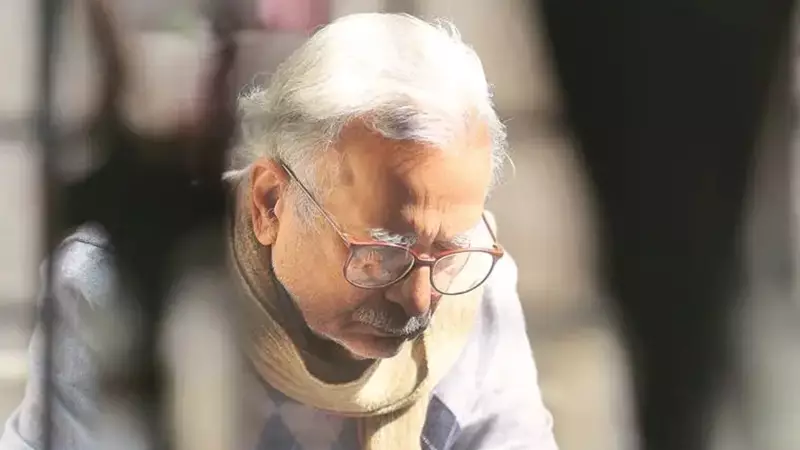
The literary world mourned the passing of a unique voice when Hindi writer Vinod Kumar Shukla died on December 23, 2025. An author who masterfully blended the commonplace with the magical, Shukla carved a niche where modest lives were touched by wonder, earning him titles like "philosopher-magician" and "special-effects wizard" of literature from critics like Vidyan Ravinthiran.
A World Apart from Literary Stardom
Shukla's unassuming nature was as distinctive as his prose. Writer Sara Rai recalled a telling encounter at the Jaipur Literature Festival in 2011. While literary celebrities stayed in flashier hotels, Shukla was in a modest one, blissfully unaware of the fame surrounding him. He didn't recognize other famous writers and was puzzled by the long queues for book signings, a world entirely foreign to him. After seeing a crowd for J.M. Coetzee, he guiltily confessed he hadn't bought the author's book, relieved to learn it wasn't compulsory. His realm was different, both in life and in the pages of his books.
Where the Ordinary Transformed into the Wondrous
In Shukla's fictional universe, the laws of the mundane were gently bent. A bus travelled through the air, a man with two noses walked down the street, and herons politely exited a classroom upon seeing a lesson in progress. An elephant moved, leaving an elephant-shaped space behind. A police station was likened to a watchman with big moustaches. In this world, light was not needed to see in the dark.

This was a landscape of absurd humour and tender light-heartedness, lifting cramped, ordinary lives just enough to give them space to breathe. The unexpected was always nestled within the humdrum. As Shukla himself believed, "my imagination is also my reality." He saw imagination as a protective cover "when fires rain down," and his art thrived on the uncertainty of what happens next.
The Deceptive Simplicity of a Complex Craft
Shukla's writing, akin to Swiss writer Robert Walser's, spoke "simply as he can and must." This apparent simplicity inspired many Hindi writers to emulate him, only to discover its intricate depth. A straightforward sentence would suddenly twist, acquiring complex syntax and demanding an imaginative leap from the reader.
For instance, in Teen Billiyaan (Three Cats), he wrote: "Sometimes one saw at the same time three or four cats. To see three cats at the same time was like seeing three times the act of seeing the three cats." In one vertiginous moment, the focus shifted from the cats to the very act of looking. His sentences covered substantial mental distance, asking readers to constantly adjust their angle of vision.
He wrote about simple people in everyday circumstances, yet their inner lives shimmered with a subtle magic. He was obsessed with the small and the ordinary, yet, as Walser noted, "We don't need to see anything out of the ordinary. We already see so much." In Shukla's provincial worlds, rendered in extraordinary detail, everything was possible. The comic was never far from the quotidian, nor the real from the imagined.
For Shukla, writing was "a continuous process of becoming," never a completion. "Just as one never stops experiencing," he said in an interview, "written literature is... never a completion." This quality of perpetual "becoming" gave his stories a feather-light, elusive quality, a "winged existence" that continues to resonate, leaving readers with a sense of haunting, ironic presence—indistinguishable from the mist, yet profoundly tangible.