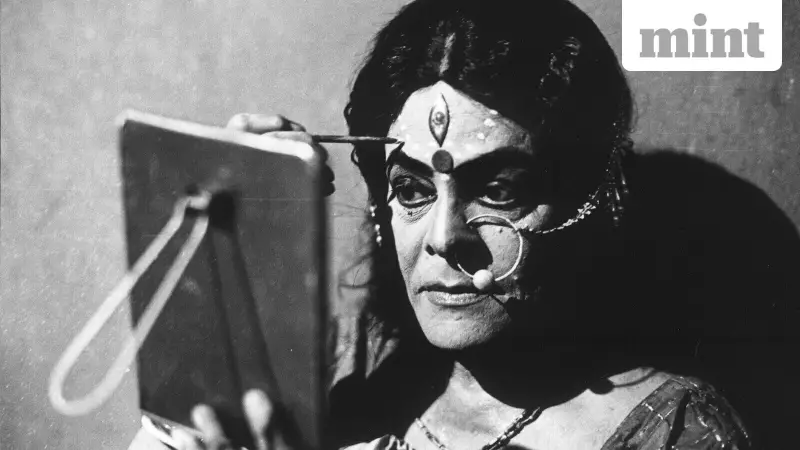
The renowned makeup artist scrutinized me from head to toe with a dismissive air before asking, 'So, what character are you portraying?' I murmured, 'Morjina.' His expression shifted to one of mild surprise. 'Oh,' he responded, pausing briefly. 'Well, you're young. I suppose you'll look acceptable.'
The Art of Transformation Begins
He meticulously blended white powder with yellow, adding a touch of orange to create a paste. I observed intently, attempting to memorize each step. With a brush, he applied the mixture to my face as though painting a wall. Once it dried, he dusted powder across my cheeks. Satisfied with the base, he skillfully used a matchstick to outline my eyes and eyebrows with precision.
The final touch was my lips. After applying color, he employed the matchstick tip to define my upper lip, enhancing its shape. Stepping back to examine his work, he called out, 'This one is playing Morjina. Nirode, bring his costumes!'

Becoming Morjina
Nirode-da arrived with Morjina's gleaming red satin attire. The character required breasts, but in those days, we lacked falsies or knowledge of bras and bodices. Instead, they secured a long ribbon with two small cloth bundles tightly around my chest.
Next, Lalu-da, whom we termed a 'hair-fit man,' placed a wig on my head and swiftly braided the long hair. 'Now, go look at yourself in the large mirror over there,' he instructed.
Standing before the mirror, I failed to recognize the reflection. A beautiful woman in loose Baghdadi pyjamas, a red shirt, and a golden Irani waistcoat stared back. Her hair was divided into two thick braids, adorned with shimmering gold jewelry. Someone mentioned that in Arabian tales, maids wore gold while queens wore diamonds. Morjina was a maid.
A Moment of Self-Discovery
'Is this truly me? Or is it my sister?' I pondered, gazing in astonishment. Gradually, a group of young men gathered, encircling me with curious stares. One older, handsome man around 25 or 26 approached. 'Everything appears exquisite,' he remarked—and indeed it did—'but something is missing.'
Confused, I replied, 'I don't understand.' At that time, I was remarkably innocent and naive. He produced a red rose with a flourish and offered it. 'I cannot accept this,' I said, blushing. 'But you may pin it on me.' He did so as the other boys cheered and whistled.
The Stage Beckons
Then the curtain rose. The clarinet, essential in jatras of that era, played Morjina's lively signature tune, 'Chhi chhi itna janjaal.' Yet, I stood frozen, clutching peacock feathers, anklets on my feet, wobbling in heeled shoes. I stepped forward, then retreated.
A man pushed me gently. 'Proceed! The scene is flowing by.' This peculiar phrase—'the scene is flowing by'—suggested it was like a river. Thus, I stumbled onto the stage, diving headfirst into my inaugural female role.
The year was 1955, and I had no inkling this role would irrevocably alter my life.
Life Beyond the Stage
Seven days later, I secured employment with Indian Railways as a 'chain-man,' earning 2.50 rupees daily, approximately 75 rupees monthly. My duty involved measuring land with a steel chain, but I never actually performed this task. Venturing into the sun was unthinkable—I had to preserve my complexion for the stage. That was my genuine occupation.
Each month brought a new play, as the Railways' numerous departments each had recreational clubs. Whenever a dance scene arose, they summoned me. In those days, plays featured 'drops' akin to intermissions. After the initial four scenes, a drop would descend, followed by a dance number. A few more scenes, another drop, and another dance performance. I executed these dance numbers, gradually developing a fondness for them.
The Addiction to Performance
It resembles tasting alcohol for the first time: one sip leads to another, and eventually, some succumb while others endure, but addiction takes hold. Acting shares this allure.
However, I needed to grasp acting's fundamentals to transcend mere song-and-dance routines. One day, my friend Subrata suggested, 'Why not apply your own makeup? You could surpass the makeup artist.'
He imparted some techniques, but I inquired, 'What about my hair?' 'Your hair is already lengthy. Simply part it centrally and smooth it on both sides.'

The Craft of Wigs
At that time, wigs came in two varieties: full bust and half bust. The half bust was positioned on the head, fastened at the back, and blended seamlessly with natural hair. If executed properly, the transition was undetectable. The full bust, as implied, completely concealed one's hair.
Wigmakers like Farhad, Mehboob, and Abdul hailed from Kolkata's Chitpur area, near Nakhoda Masjid. They measured your head to craft custom wigs. Today, they have vanished, much like my hair.
This excerpt is adapted from 'Chapal Rani, the Last Queen of Bengal: The Life and Times of a Female Impersonator' by Sandip Roy, published by Seagull Books, spanning 520 pages and priced at ₹999.