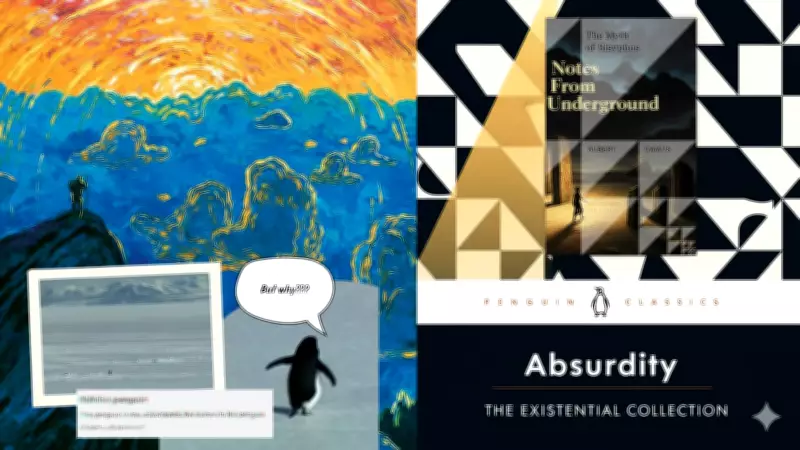
The Nihilist Penguin: An Antarctic Odyssey That Mirrors Existential Philosophy
In a striking scene from Werner Herzog's 2007 documentary Encounters at the End of the World, a lone Adélie penguin captures the modern imagination. On the vast, blinding white expanse of the Ross Ice Shelf, a colony of penguins flows like a living river toward the open sea for sustenance. Yet, one solitary bird pauses, turns its back on the life-sustaining water and its communal kin, and embarks on a deliberate, steady march inland. This journey, destined for the distant Transantarctic Mountains, spans approximately 50 miles without food or hope of survival, marking a poignant act of defiance that has resonated deeply across the internet.
From Documentary Footnote to Viral Meme: The Rise of the Nihilist Penguin
For years, this sequence remained a haunting footnote among Herzog aficionados, but today, it has exploded into a viral meme. Dubbed the "nihilist penguin" or "depressed penguin," the clip saturates social media platforms, serving as a Rorschach test upon which a generation projects its anxieties, alienation, and existential fatigue. The internet's most common label for the bird, nihilist penguin, suggests a collapse of all value structures, transforming this Antarctic creature into a feathered embodiment of philosophical inquiry.
Echoes of Dostoevsky: The Spiteful Freedom of Rebellion
Before being labeled a nihilist, this penguin is fundamentally a rebel. Its defining act is not a logical search for an alternative but a primal, irrational refusal. This mirrors the essence of Fyodor Dostoevsky's seminal anti-hero from Notes from Underground, who insists, "What man wants is simply independent choice, whatever that independence may cost." The penguin's turn inland represents the animal equivalent of the Underground Man's perverse celebration of his own suffering—an assertion of will so pure it luxuriates in self-destruction. It chooses, fully aware that the choice is fatal. An ecologist in the film confirms this stubborn agency, noting that even if captured and returned to the colony, the bird would immediately resume its inward march. Here, we witness freedom in its most absolute and terrifying form: the freedom to choose oblivion, simply to prove that one can.

Confronting the Absurd: A Waddle Through Camus' Philosophy
Herzog and the accompanying scientist pose the inevitable question: "But why?" This echoes the central inquiry Albert Camus placed at the beginning of The Myth of Sisyphus, where he defines the absurd as the "confrontation between the human need for clarity and the unreasonable silence of the world." The penguin, having abandoned the colony's shared, purposeful logic, embodies this confrontation. The blank, white expanse offers no answers, yet the march persists as a response. It is a physical manifestation of the absurd condition: continuing to move with purpose in a context that renders purpose meaningless. Like Sisyphus condemned to push his rock, the penguin is condemned to walk. Modern viewers, sensing the futility of endless digital scrolls and algorithmic lives, recognize a kindred spirit in this Antarctic wanderer.
Nietzsche's Void and the Penguin's Passive Nihilism
The viral penguin clip enacts what Friedrich Nietzsche might have seen as a passive nihilism—the draining of meaning that follows the proclamation "God is dead." The old commandments of nature, such as seeking food or staying with the colony, no longer compel this bird. It lives, or ultimately dies, in the void left behind. As contemporary philosopher Nolen Gertz explores in Nihilism, this void is not an end but a beginning, a tool for "questioning norms." The penguin's act forces us to interrogate the very instinct to follow the path and to ask why survival is considered the highest good. However, it stops short of Nietzsche's fuller prescription in Thus Spoke Zarathustra to become the Übermensch who creates new values. This penguin is the herald of the crisis, not the prophet of the solution—a reverse of the "last man" concept.

Why This Symbol Resonates in the Modern Era
Scientists offer a mundane, and likely correct, explanation: the animal was disoriented, ill, or neurologically damaged. Adélie penguins are profoundly social, coast-bound creatures, making this a tragic aberration rather than an intentional parable. Yet, literature has always thrived on such aberrations. The public, in embracing this bird, has voted for the poetic over the pathological. In an age of collapsing meta-narratives, the penguin's solitary defiance resonates with the internet, mirroring the feeling of moving against the collective current and questioning the very point of the march. We have read its story before—in the tortured rebellions of Dostoevsky, the lucid confrontations of Camus, and the terrifying, empty freedoms of Nietzsche's world—making it a timeless symbol of existential exploration.