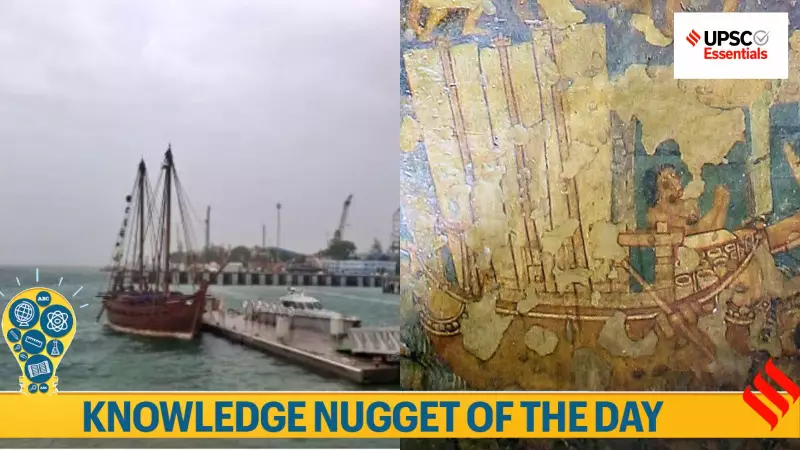
The Indian Navy is embarking on a unique voyage that bridges millennia, using a vessel built with techniques from antiquity to celebrate the nation's rich seafaring heritage. The Indian Naval Sailing Vessel (INSV) Kaundinya, a remarkable "stitched ship," is set to retrace ancient maritime trade routes on a historic journey from India to Oman.
A Journey Through Time: From Karwar to Oman
The vessel began its modern-day odyssey by sailing from Karwar to Porbandar on December 13. Its primary historic voyage is scheduled to commence from Porbandar on December 29, charting a course towards Oman. This expedition is not merely a naval exercise but a conscious effort to honor and retrace the paths forged by Indian mariners centuries ago, highlighting India's role as a historic hub for trade and cultural exchange.
The Art and Craft of a Stitched Ship
What makes INSV Kaundinya extraordinary is its construction method. Instead of using metal nails, the ship has been built using traditional stitching techniques, a practice once common across the Indian Ocean region. Skilled artisans from Kerala employed materials like coconut fibre, coir rope, wooden joinery, natural resins, and cotton sails to bring this vessel to life.
The design inspiration is drawn from a fifth-century vessel depicted in the famous Ajanta cave paintings. The ship features a main mast, mizzen mast, and bowsprit mast, with steering controlled through steering oars. It is equipped with trailing oars, square sails, and boasts a flexible hull, much like its ancient counterparts.
Symbolism and Historical Homage
Every detail of INSV Kaundinya is imbued with historical symbolism. The sails proudly display the Gandabherunda, the mythical two-headed bird that was the symbol of the Kadamba dynasty, along with the Sun. The bow carries a carving of a Simha Yali (a mythical lion-elephant creature), and the deck holds a stone anchor styled after those used in the Harappan civilization.
The ship's name itself is a tribute to history. It is named after Kaundinya, a legendary Indian mariner who, around 2,000 years ago, is said to have sailed to Southeast Asia. After surviving pirate attacks, he married Queen Soma and founded the Funan kingdom. Sanjeev Sanyal, a member of the Prime Minister's Economic Advisory Council who championed the project, noted that Kaundinya is "the first Indian mariner, who we know by name, to have crossed the seas to visit Southeast Asia."
Relevance for Heritage and UPSC Aspirants
This initiative is a joint effort by the Indian Navy, the Ministry of Culture, and Hodi Innovations. For students, particularly UPSC aspirants, the project is a living case study connecting ancient history with contemporary soft power and maritime diplomacy.
The project revives knowledge from historical texts like the Yuktikalpataru, a Sanskrit treatise on shipbuilding compiled by Bhoja Narapati. It also addresses why such ships declined; stitched vessels became unsuitable after European colonization introduced naval cannons, as their construction could not withstand the recoil.
A specially trained 16-member Indian Navy crew, who received instruction in traditional rigging and carpentry, will man the vessel. INSV Kaundinya was formally inducted into the Navy in May 2025 and underwent trials at Karwar before its voyages.
This voyage of INSV Kaundinya is more than a naval journey; it is a powerful statement. It showcases India's ancient maritime prowess, reflects on a history of oceanic trade that stretched to Mesopotamia, and demonstrates a modern commitment to preserving and celebrating that legacy on the global stage.