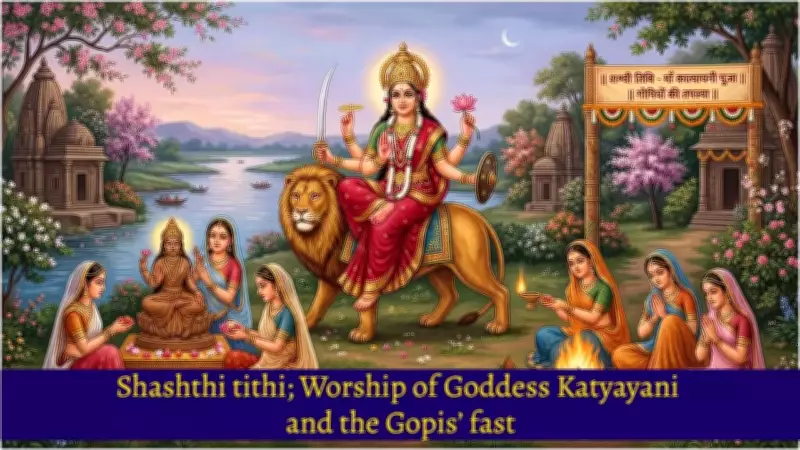
Navratri Day 6: Shashthi Tithi Honors Goddess Katyayani with Deep Devotion
The sixth day of Navratri, known as Shashthi Tithi, holds a unique and profound significance in the Hindu festival calendar. This day is wholly dedicated to the worship of Goddess Katyayani, a form of the Mother Goddess, and is not shared or divided with other deities. It stands as a distinct point in the larger flow of Navratri, directing devotees' attention solely to Katyayani, with the day's meaning resting entirely on her reverence.
Goddess Katyayani in Ancient Indian Texts
Goddess Katyayani is one of the most vividly discussed forms of the Mother Goddess across ancient Indian scriptures. This is not a casual description but a reflection of her deep reverence in texts such as the Yajurveda's Taittiriya Aranyaka, Patanjali's Mahabhashya, and the Puranas. Her presence in these diverse sources shows that she is not limited to one corner of tradition but is widely spoken of, remembered, and revered as a central figure in Hindu devotion.
To approach Shashthi Tithi is to enter a stream of remembrance that connects devotees to this rich textual heritage. Worshiping Katyayani on this day means standing where these ancient texts place her—vividly discussed and deeply honored, offering a spiritual anchor in the Navratri celebrations.

Basic Setup, Fasting Practices, and a Famous Precedent
Modern daily fasting practices during Navratri can vary widely, but the most famous historical precedent for observing a fast for Goddess Katyayani comes from the Gopis. Their example is not a vague story but a clear reference point in tradition, often cited to illustrate how fasting for Katyayani has been practiced historically.
The Gopis observed a strict fast during the month of Margashirsha, performing Puja and praying with deep devotion to attain her blessings. This practice is described plainly, with the intent and result clearly stated: sincere worship and steadfast devotion to Mother Katyayani are believed to yield abundant blessings and divine presence in one's life.
The Gopis' Traditional Fast, Intent, and Result
The traditional fast observed by the Gopis is detailed with specificity. During Margashirsha, they adhered to a strict regimen, emphasizing Puja, prayer, and deep devotion. Their intent was straightforward—to seek Katyayani's blessings through heartfelt worship. The result, rooted in belief, suggests that such sincere and steadfast devotion can bring divine abundance into one's life.
For those observing Shashthi Tithi, the guidance is simple: perform Katyayani's Puja, pray with deep devotion, and maintain sincere worship. This approach aligns with the historical precedent set by the Gopis, offering a timeless model for spiritual practice during Navratri.
About the Author
AstroDevam is a premium organization providing ancient and authentic knowledge in Astrology, Vastu, Numerology, and Innovative Corporate Solutions with a contemporary perspective. With patrons in over 100 countries, it is promoted by Achary Anita Baranwal and Achary Kalki Krishnan, who hold Master's Degrees in Astrology and have been teaching Scientific Astrology, Vastu, and Numerology for more than three decades.