Navratri Day 3: Goddess Chandraghanta Embodies the Strength of Household Life
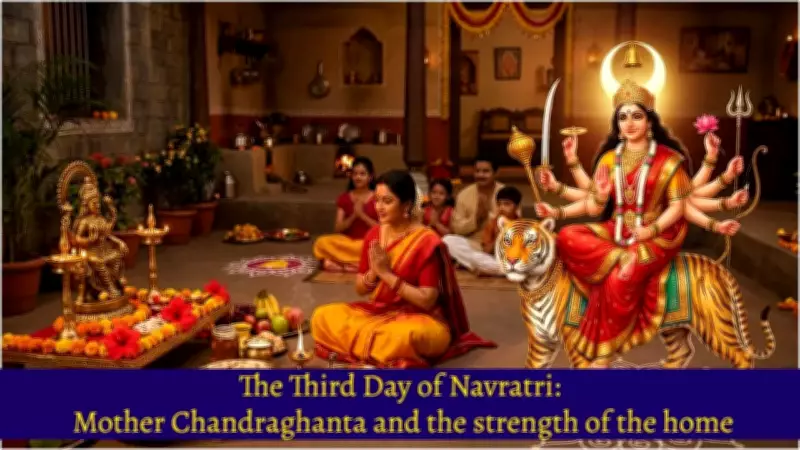
The third day of the sacred Navratri festival is dedicated to the worship of Mother Chandraghanta, a divine form whose very name reveals her essence. Chandraghanta translates to "the one with a bell-shaped crescent moon on her head," a visual symbol that quietly announces her presence in the spiritual journey. This day invites devotees to perceive the Goddess not merely as a distant power, but as a living ideal integrated into everyday existence.
The Navratri Journey: From Birth to Penance to Household Life
Navratri unfolds as a deliberate progression through distinct phases of the Goddess's narrative. The first day, Shailputri, commemorates her birth, while the second day, Brahmacharini, represents her intense penance and unwavering focus. These are not arbitrary days but meaningful stages in a spiritual story. Having achieved her goal of union with Lord Shiva, the third day portrays her as a married woman, a grihast, who manages family and daily responsibilities.
This shift is profound, marking the transition from birth and austerity to the realm of household life. It is here that devotion permeates the kitchen, storeroom, courtyard, and countless small duties. Worship meets routine, reflecting the stamina, steadiness, and resilience required to sustain a home. The Goddess arrives at a form that resonates deeply with devotees: the form of a householder.

The Goddess of the Householder: An Ideal for Married Life
Mother Chandraghanta embodies the ideal form for a married housewife, showcasing an independent personality that makes her the perfect deity for householders to venerate. On this day, she stands as a symbol of household life lived with strength and grace. Those with families who worship her with sincere devotion are believed to attract new success, growth, and prosperity into their homes.
This promise is intrinsically linked to her form. Unlike withdrawn depictions, Day 3 shows the Goddess actively engaged within life, family, and daily duties. A grihast life transcends mere task management; it involves sustaining a home and keeping its spirit vibrant, which is precisely why her worship speaks so profoundly to householders.
Offerings and Colors for Day 3: Nourishment, Joy, and Energy
Recognizing that running a household demands immense vitality, the offerings to Goddess Chandraghanta are deeply nourishing. Sacred items that provide energy and sustenance are emphasized, including:
- Milk
- Pure ghee
- Honey
- Vermicelli kheer (sevai)
The Mother's primary colors are red and yellow. When worshipping her, devotees are encouraged to use items in these hues, particularly flowers. Yellow symbolizes joy, while red represents energy, both essential for a happy and thriving household. The practice is simple yet sincere: offer nourishing foods like milk, ghee, honey, or sevai kheer, and adorn the altar with red and yellow flowers. This worship mirrors what a home truly needs: vitality to operate, joy to sweeten it, and energy to ensure its flourishing.
Navratri's structured journey underscores that the form, timing, and progression matter deeply. Day 3 is not a random observance but a continuation, a moment in both the Goddess's path and our own, where spiritual devotion and daily life beautifully converge.