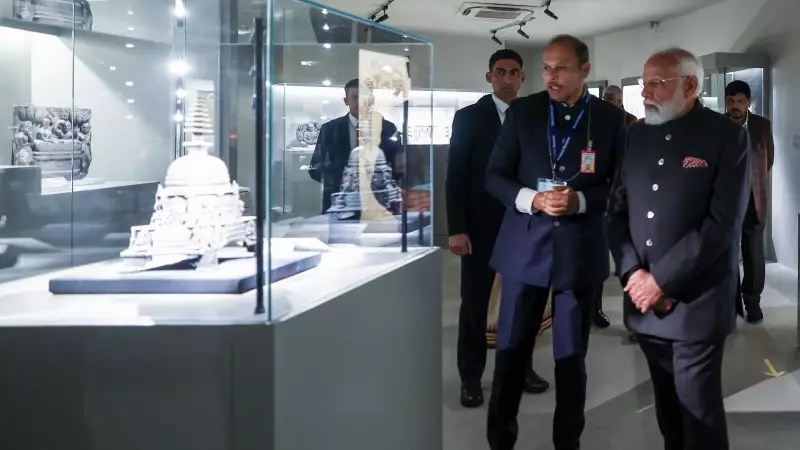
Prime Minister Narendra Modi declared that the sacred relics of Lord Buddha are an integral part of India's civilisational heritage and not just archaeological artefacts. He made this powerful statement while inaugurating a major exhibition in the national capital.
A Historic Homecoming After 125 Years
The Prime Minister inaugurated The Grand International Exposition of Sacred Piprahwa Relics at the Rai Pithora Cultural Complex in New Delhi on Saturday, January 4, 2026. The event, titled "The Light & the Lotus: Relics of the Awakened One," marks a momentous occasion—the return of these priceless relics to Indian soil after an absence of 125 years.
PM Modi emphasised that this homecoming was made possible through the concerted efforts of the Indian government and the Godrej Group. Their timely intervention last May prevented the relics from being auctioned off in Hong Kong, securing their journey back to their homeland.

Spiritual Bonds Beyond Politics and Economy
In his address, attended by Buddhist scholars, diplomats, and dignitaries, the Prime Minister framed the relics as a symbol of India's deeper global connections. "This shared heritage of Lord Buddha is proof that India is not connected merely through politics, diplomacy, and economy, but through deeper bonds of emotions, faith and spirituality," he stated.
He recounted how the sacred Piprahwa relics had recently travelled to nations with significant Buddhist populations, including Vietnam, Thailand, and Russia. In each location, they inspired waves of devotion, with huge numbers of people turning up to pay homage.
India as the Living Custodian of Buddha's Legacy
Modi positioned India not just as a custodian of physical relics but as the living carrier of Buddha's tradition. "For India, the sacred relics of Bhagwan Buddha are not merely artefacts; they are a part of our revered heritage and an inseparable part of our civilisation," he affirmed.
He connected the event to a broader vision for 2026, expressing hope that with Lord Buddha's blessings, the year would usher in a new era of peace, prosperity, and harmony for the entire world.
The Prime Minister also shared personal reflections, noting that his birthplace, Vadnagar, was a major centre of Buddhist studies. He highlighted the proximity of Sarnath—where Buddha delivered his first sermon—to Varanasi, which he referred to as his 'karmabhoomi,' the constituency he represents.
Global Pilgrimage and Government Initiatives
Modi recounted his pilgrimages to key Buddhist sites across the globe, both before and during his premiership. His journeys included:
- Lumbini in Nepal
- To-ji Temple and Kinkaku-ji in Japan
- The Giant Wild Goose Pagoda in Xi'an, China
- Gandan Monastery in Mongolia
- Jaya Sri Mahabodhi in Anuradhapura, Sri Lanka
- Wat Pho in Thailand
- The Buddha Tooth Relic Temple in Singapore
He poignantly mentioned the Bodhi tree standing in the botanical garden of Hiroshima, a city devastated by an atomic bomb, calling it a profound message for humanity.
Outlining his government's efforts, Modi stated that initiatives like the Global Buddhist Summit and the celebration of international events like Vesak and Ashadha Purnima are driven by the goal of preserving Buddhist heritage for future generations. A significant step has been granting classical language status to Pali, the language of Buddha's original teachings, to facilitate deeper understanding and research.
The Piprahwa relics, discovered in 1898, are central to the archaeological study of early Buddhism. The site is widely associated with ancient Kapilavastu, where Buddha spent his early life before renunciation. Their exposition in Delhi stands as a powerful testament to India's enduring spiritual legacy and its role as a beacon of Buddha's timeless message.